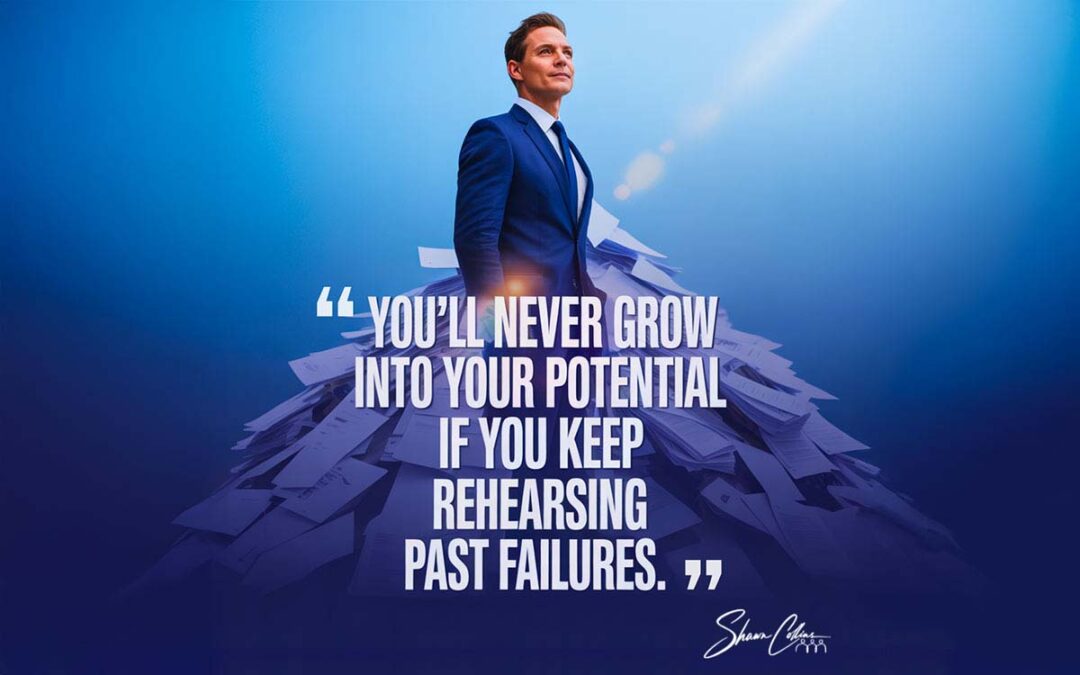
You can’t scale anything—your influence, your impact, or your organization—if your mindset is stuck in yesterday’s mistakes.
Replaying failures on a loop keeps high-performing leaders locked in neutral. Every missed opportunity. Every botched decision. Every internal critique that starts with “I should’ve known better.” It piles up until your energy is spent spinning context instead of commanding clarity.
This isn’t just mindset fluff. It’s a leadership problem with serious consequences. Holding on to past errors shrinks risk tolerance, stalls decision-making, and encourages a fear-based culture. That’s not the kind of leadership that drives transformation. That’s survival mode masked as analysis.
Let’s be real: C-suite executives, HR leaders, and entrepreneurs don’t have time for emotional quicksand.
But here’s the truth most aren’t willing to say out loud: Your potential isn’t limited by your ability. It’s limited by your obsession with not getting it wrong again.
You’re building something bigger than your past. Your team watches how you handle loss more than how you win. If they sense hesitation, fear, or internal chaos, they’ll mirror it. Growth stalls. Culture fractures. Talent checks out.
Every minute you spend dissecting a failure beyond what’s useful is a minute you’ve lost leading with intention. Reflection is valuable. But reflection without movement becomes a trap.
This matters more at the top than anywhere else. When leaders rehearse their failures, it quietly infects the organization. Risk-taking fades. Innovation flatlines. People hold back. And when your people hesitate, your mission does too.
Clarity can’t coexist with shame. Growth doesn’t partner with regret. You’ve got to choose.
Your leadership starts where your self-sabotage ends.
Identifying the Psychological Impact of Dwelling on Past Failures
Leadership doesn’t break from strategy. It breaks from hesitation.
Slide into any executive boardroom or HR war room, and you’ll find brilliant minds shackled by hesitation. Not because they don’t have the answers. Because they’re still carrying the weight of the last wrong one.
That’s the hidden cost of looping your failures: your future decisions are filtered through fear instead of clarity.
Here’s what really happens when leaders stay stuck in the past:
- Fear of risk replaces vision. When you’re haunted by a bad call, you stop trusting your instincts. You play small. You delay. You overanalyze. Risk becomes the enemy instead of the runway.
- Confidence crumbles. High-capacity leaders don’t often crumble outwardly. But that inner erosion shows up in second-guessing, in procrastination, in the inability to rally others behind a bold move. You stop believing your voice should lead.
- Self-talk gets toxic. “I always screw this up.” “They probably think I have no idea what I’m doing.” That internal narration isn’t harmless. It rewires your mindset. It creates a ceiling where there shouldn’t be one.
- Decision paralysis takes over. When leaders fear repeating a mistake more than making progress, decisions stall. Options spiral into hours of overthinking. By the time action arrives, momentum is already lost.
It’s a slow unraveling that starts in the head but ends up infecting the culture.
As a leader, your internal stability transfers externally. If your judgment is under siege by past regret, your people will feel it. They’ll stop bringing their best ideas. They’ll coast when they should stretch. They’ll mimic your fear and call it “being careful.”
Leadership isn’t about being fearless. It’s about moving forward anyway.
This is where mindset becomes mission-critical. Not for theory, but for trajectory. The way you process failure either tightens the noose or clears the path.
Don’t let fear run your strategy. Don’t let shame set your pace.
Choose insight. Choose clarity. Choose forward.
The Importance of a Growth Mindset for Leadership and Organizational Success
If failure is your identity, your leadership will always panic at the edge of the unknown.
This is where high-level impact gets decided—not in strategy offsites or quarterly reviews, but in mindset. Specifically, a growth mindset.
The term gets thrown around a lot, but let’s cut the fluff. A growth mindset is the belief that ability isn’t fixed. That skills can develop. That setbacks aren’t signs you’re finished—they’re signals to adjust and step forward.
When leaders internalize this, everything shifts.
Here’s what a growth mindset does for you and your organization:
- Reframes failure as fuel. Instead of spiraling into doubt, you extract the insight, apply it, and move. You stop asking, “What does this say about me?” and start asking, “What does this teach me?”
- Keeps innovation alive. Teams won’t pitch bold ideas if they believe mistakes equal shame. A growth mindset models curiosity, not control. That’s the permission they need to experiment, evolve, and win.
- Builds resilient teams. People replicate your mindset. If you react to setbacks with learning and intention, they will too. Over time, you build a culture that doesn’t crack under pressure—it calibrates.
Too many executives are trapped chasing perfection. What they need to chase is progress on purpose.
The 100X Leader framework calls leaders to be both healthy and multiply that health to others. That’s only possible with a growth mindset. When you operate from fear, you hit the ceiling of what you can do. When you lean into growth, you raise the floor for everyone you lead.
You are the thermostat, not the thermometer.
If you’re stuck rehearsing the last failure, your organization stays cold. If you set the tone with curiosity, clarity, and resilience, they rise with you.
Flip the lens. View setbacks as signals. Lead forward anyway.
Common Traps in Leadership and HR That Reinforce Focus on Past Failures
If you feel stuck, it’s not your ability—it’s your default mindset loops.
Executives and HR professionals don’t fail for lack of ambition. They fail when they let fear, blame, or control creep into their leadership rhythm. These traps don’t always scream their presence. They hide behind process. Behind language. Behind culture. That’s what makes them dangerous.
Your team doesn’t just follow your goals. They mirror your mindset.
Here are the traps keeping top-tier leaders anchored in the past:
- Blame culture. When mistakes trigger finger-pointing instead of problem-solving, no one takes ownership. People act safe instead of smart. Everyone deflects to survive. This shows up subtly in performance reviews, meeting language, and decision-making chains. It kills growth. Fast.
- Perfectionism masked as “excellence.” It sounds noble. But if mistakes aren’t allowed, momentum dies. Perfectionism breeds fear, not standards. Leaders agonize over optics. HR defaults to rigid process. Employees hesitate to challenge, explore, or adapt. Nothing meaningful scales in that environment.
- Resistance to change labeled as “stability.” Holding tight to “what’s worked before” sounds strategic. It’s not. It’s timid. Change isn’t the threat. Avoidance is. When organizations cling to old systems out of fear of repeating pain, they lose relevance and future-readiness.
Every one of these traps is a comfort zone in disguise.
This is how failure keeps speaking long after it’s over:
- “We tried that before and it didn’t work.”
- “Let’s not risk that again.”
- “Stick to the plan, don’t make waves.”
All of it feels safe. But safe doesn’t scale. Safe doesn’t lead. Safe can’t answer the complexity and speed of 2025 business—because it’s still reacting to outdated pain.
If you want progress, you can’t protect your old wounds more than your current mission.
Use frameworks, not fear
Leaders need durable filters—not just instincts. Blame culture? Use the Communication Code to restore trust and clarity. Perfectionism? Lean on the 5 Voices to hear every perspective, not just the loudest or safest. Resistance to change? Shift using 100X Leader language that empowers people instead of controlling outcomes.
Growth doesn’t come from replaying. It comes from reprocessing.
Choose frameworks that move your team forward. Burn the scripts that keep them frozen.
Practical Strategies to Break Free from Rehearsing Past Failures
Clarity doesn’t arrive by accident. You have to go after it with intention.
If you’re ready to stop looping the loss and actually lead from a position of growth, it’s time to apply real tools. Not theories. Not platitudes. Actual practices that interrupt the cycle of mental rehearsal and move you forward with focus.
Here’s what high-level leaders leverage when they’re done letting regret run their calendar:
1. Build Mindfulness into Your Routine
This doesn’t mean sitting cross-legged in silence for hours. It means owning your attention. High performers fail when they can’t recognize their own mental patterns. Mindfulness gives you that ability. It’s how you slow the spin cycle long enough to shift direction.
- Start your day with 3 minutes of intentional stillness. Breathe. Observe. Name what you’re bringing into the day.
- During high-pressure moments, use sensory resets (feel the chair under you, your feet on the floor, a deep exhale) to snap out of spirals.
- End each day with a mental audit: “What did I feel? What did I carry? What do I need to let go tonight?”
Awareness interrupts autopilot. That’s where control begins again.
2. Reframe Thought Patterns That Keep You Stuck
Self-talk creates your internal climate. When that climate is cold and cynical, nothing thrives. You need to rewrite the automatic loops holding you in place.
- Replace reactive thoughts like “I failed again” with intentional questions like “What was the useful mistake here?”
- Challenge conclusions. Instead of “That went wrong because I’m not cut out for this,” ask “What variables shaped the outcome, and which can I control now?”
- Use frameworks like the Peace Index to assess your internal balance—low peace is often where fear-based thoughts live.
You’re not your last decision. You’re the person who decides what happens next.
3. Set Future-Focused Goals on Purpose
Don’t drift. Drive.
Leaders caught in past failures aren’t anchored in the future. They’re reactive. Distracted. Over-apologizing or under-performing. The fix? Set goals that pull you forward fast enough that you can’t look backward long.
- Use the 5 Gears framework to align your actions with your priorities. Gear down to reflect. Gear up to execute.
- Label your top 3 growth targets for the next quarter—and attach a daily behavior to each.
- Revisit those goals weekly with your team or coach to fuel accountability over avoidance.
Action starves fear. Goals give clarity a job to do.
4. Practice Reflective Learning, Not Rumination
Reflection is powerful. But reflection without structure turns into self-judgment. High-level leaders must build rhythms of learning that fuel forward momentum instead of trapping them in the past.
Here’s a template to use after setbacks:
- What happened? (Just facts. No spin.)
- What was my part? (Own actions, not outcomes.)
- What am I learning? (Insight over indictment.)
- What changes now? (Specific, immediate application.)
Build this into your leadership rhythm. Weekly. Monthly. Post-project. On repeat.
Leaders who reflect intentionally grow exponentially.
5. Cultivate Emotional Intelligence as a Daily Discipline
If you can’t name your own fear, you’ll reroute it into your entire team. That’s what reactive leadership does. Emotional intelligence isn’t “nice to have.” It’s your edge.
- Get honest about where your ego flares. Ego is often just insecurity in armor.
- Name your go-to defense mechanisms—deflection, perfectionism, overwork, withdrawal. Then disarm them out loud.
- Use the 5 Voices to understand your default communication style and how it impacts culture when emotion overrides intention.
Confidence doesn’t come from avoiding emotion. It comes from mastering it.
You don’t need to rehearse the past to honor the lessons. You need to lead with courage and clarity toward what’s next.
That starts with a decision: Do I want growth bad enough to drop the scripts that no longer serve me?
Choose progress. Choose resilience. Burn your old failure loops and build something stronger.
Building an Organizational Culture That Supports Moving Beyond Past Failures
You can’t build a forward-moving organization on a backward-facing culture.
It’s not enough for you, as the leader, to shift how you think about failure. If your culture still punishes mistakes, silences bold ideas, or treats innovation like a liability, your mindset won’t matter. Because the environment will override your example.
Culture either fuels growth or it clips its wings. There is no neutral ground.
Create a Culture of Continuous Learning
Performance-driven organizations often confuse “learning” with “training.” But training builds skill. Learning builds mindset. It’s the difference between checking the box and changing how your people think.
Use debriefs not just for wins, but for misses. Ask what worked, what didn’t, and what adjusts moving forward. - Normalize micro-failures in real-time communication. Leaders who call out their own missteps without judgment model what safe reflection looks like. Done well, this becomes part of the learning fabric.
- Use frameworks like 5 Voices across departments to give teams shared language and cross-functional awareness. That’s how learning scales into how people relate, not just what they know.
Learning creates agility. But agility doesn’t happen in environments that fear mistakes.
Establish Psychological Safety as a Standard
Psychological safety isn’t about coddling. It’s about clarity. People can’t innovate when they’re worried their performance is tied to perfection. If the environment penalizes risk, you lose creativity, self-initiative, and engagement in one sweep.
- Anchor teams around the Communication Code. It sets ground rules where honesty, curiosity, and clarity replace passive-aggression or silence. This isn’t about being “nice.” It’s about being real.
- Hold space, then hold standard. Listen fully before speaking. Clarify tone before content. Then, make proactive asks about behavior, outcomes, or expectations. Safety and accountability are not opposites—they’re partners.
- Evaluate managers on how they foster safety—not just deliverables. Promote leaders who create conditions for others to thrive, not just hit their numbers.
The faster your team feels safe to speak, the faster they’ll move through setbacks and into solutions.
Champion Innovation Without Glamourizing It
Innovation isn’t sexy in the day-to-day. It looks like incomplete drafts, flawed ideas, interrupted meetings, and mid-flight pivots. If you glamorize only the wins, you train your team to hide the process. That’s how you lose your edge.
- Use the 100X Leader toolkit to develop systemic feedback culture. It’s not just about better brainstorming—it’s about sustainable experimentation tied to mission outcomes.
- Reward questions, not just solutions. Every new insight starts with a leader bold enough to say, “What are we not seeing?” If no one’s asking that, ideas go stale fast.
- Train teams through failed pilots—if they’re meaningful and managed. The metric isn’t success rate. It’s learning velocity. You can iterate on that. You can’t iterate on silence.
Don’t confuse compliance with alignment. A team that agrees silently isn’t innovating. It’s coping.
Your culture isn’t a poster on a wall. It’s what your team experiences on their worst day. It’s how they’re treated when a project fails. It’s how safe they feel to propose the crazy idea that might just work.
You don’t build culture by telling people what to value. You build it by regularly demonstrating that failure is feedback—not final.
Here’s the hard rally cry every executive must own:
If your culture punishes the past, you forfeit the future.
You can’t workshop your way out of a fear-based leadership environment. You have to build from conviction. That means:
- Modeling clarity over perfection
- Valuing emotional intelligence in hiring and development
- Embedding reflection into operational rhythms, not just offsites
- Teaching frameworks first, then inspecting implementation
The cultures that outlast disruption and outperform expectations are those that treat failure as data, not drama.
Stop rehearsing the past. Start re-engineering your culture for what’s next.
Measuring Progress and Sustaining Growth Mindset in Leadership
Growth isn’t a feeling. It’s a pattern. Track it or lose it.
If you’re serious about shifting out of failure loops, you need more than inspiration. You need a repeatable way to measure momentum and stay rooted in a growth mindset when real pressure hits. That kind of consistency doesn’t happen through hope. It happens through systems, feedback, and courageous accountability.
Use Regular Feedback Loops That Actually Mean Something
Not once-a-year performance reviews. Real-time, high-value feedback that sharpens reflection and fuels action.
- Implement weekly feedback checkpoints in leadership circles. Make it simple. What worked, what didn’t, what’s next.
- Apply the 5 Voices in reviews so every team member knows how to give and receive insight in a way that lands.
- Set a feedback protocol using the Communication Code. When people know how to speak truth respectfully, you eliminate awkward silence—and prevent toxic candor.
Clarity compounds when feedback is a rhythm, not a reaction.
Invest in Coaching That Refines Self-Awareness
The best leaders in the room are the most coached. Not the loudest. Not the most experienced. The ones who process openly, change quickly, and apply consistently.
- Schedule a leadership coaching cadence that focuses on growth mindset—not just performance metrics.
- Use the Peace Index in every session to assess what’s drawing down emotional margin or fueling progress.
- Coach around forward goals, not backward pain. The best reflection is always tied to future decision-making.
If you’re not being challenged with truth, you’re probably coasting.
Create Visible Accountability Across Roles
High-performance cultures are built on shared responsibility. Accountability doesn’t mean micromanaging. It means you and your team track what matters and call out misalignment without flinching.
- Define clear growth metrics tied to personal development, not just output. Think: mindset resilience, risk engagement, communication style shifts.
- Build peer accountability rhythms into leadership cadences. Side-by-side ownership fuels more buy-in than top-down mandates.
- Call your defaults to the surface. Are you hiding hesitation under busyness? Is your fear of failure shaping decisions? Make that visible. Own it. Then move forward.
Accountability isn’t a punishment. It’s a spotlight on your progress story.
Watch for the Signals of a Sustained Growth Mindset
If you don’t know what to look for, you’ll miss the wins that prove you’re actually evolving.
Use this checklist to self-assess and course-correct as needed:
- Am I reflecting regularly—and moving forward faster each time?
- Are my decisions based on vision and values—or fear of repeating mistakes?
- Is my team opening up more ideas—or editing themselves out of safety?
- Are coaching and feedback part of my rhythm—or last resorts?
- When I fail, do I shift gears with action—or spiral into analysis?
If the answers are trending upward, you’re not just growing—you’re scaling leadership maturity your entire org can feel.
Never Measure Based on Perfection
You will mess up. You’ll hesitate. You’ll dip into old scripts. That doesn’t disqualify your growth. It renews your need to pay attention.
Sustaining a growth mindset isn’t about never looking back. It’s about why you look. Are you rehearsing or reviewing? Are you stuck or studying? Are you paralyzed or pivoting?
Growth leaders don’t pretend they’ve arrived. They prove they’re still moving.
Choose clarity. Choose accountability. Choose to keep becoming the leader your mission requires next.
Conclusion: Embracing Forward Momentum to Unlock True Potential
You’re not leading if you’re rehearsing. You’re just revisiting.
This entire journey points to one conclusion: Leadership doesn’t grow in the rearview mirror. It grows in the clarity of forward motion, in the courage to recalibrate, and in the discipline to build again with what you’ve learned—not what you fear.
You don’t have to forget the failure. You just have to stop letting it own your future.
Replaying mistakes strangles innovation, drains confidence, and leaves entire organizations paralyzed. But you’ve seen what’s possible when you shift. A growth mindset transforms how you show up, how you lead others, and how your culture adapts under pressure. Reflection becomes your launchpad, not your landing zone.
Rehearsing the past will never make you wiser. But reflecting with intention will make you unstoppable.
Here’s the charge every serious leader must answer:
- Are you using your influence to restore clarity—or relive shame?
- Are your systems built to multiply growth—or repeat survival?
- Is your culture fueled by curiosity—or fear of getting it wrong again?
This is the pivot point. Choose progress. Refuse to water your leadership with old regret. Upgrade your inner dialogue. Reinforce your outer culture. Teach your people how to move after mistakes, not just apologize for them.
You’re building something worth following. But you can’t carry what’s next with hands full of what didn’t work.
Let go. Step up. Lead forward.
Your next level of leadership starts the moment you stop rehearsing the past and start designing the future.