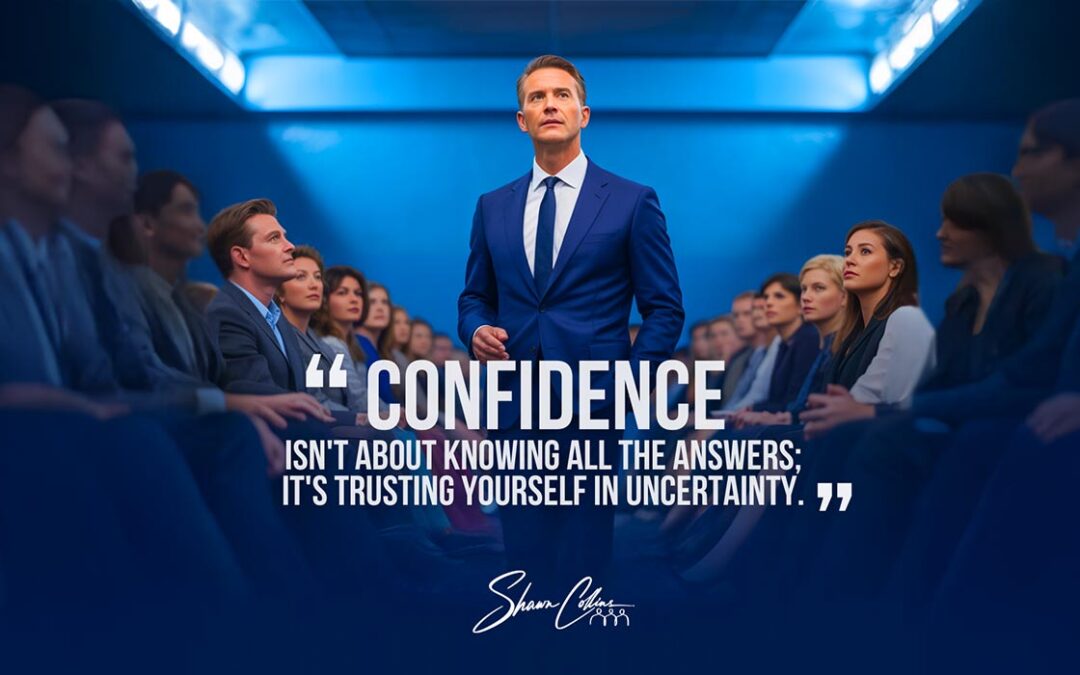
Confidence isn’t knowing more. It’s trusting yourself when certainty isn’t possible.
This is where most leaders get stuck. They think confidence is about mastery—having the right answer, predicting every outcome, never missing a beat. That’s not confidence. That’s performance anxiety in a tailored suit.
Here’s the truth: Real leadership confidence is the ability to stand firm when the data’s incomplete, the direction’s unclear, and the stakes are real. It’s not about control. It’s about clarity.
Why the “Confidence Equals Certainty” Myth Hurts Leaders
Many C-suite executives, entrepreneurs, and people managers buy the lie that confidence means you’re always decisive, always sure, always right. That mindset creates toxic pressure and unrealistic expectations—for yourself and your team.
- It kills innovation. If you only act when you’re certain, you’ll always be behind.
- It drives burnout. Pretending to know everything is exhausting. You aren’t a machine.
- It feeds loneliness. If you can’t admit doubt, you can’t lead with authenticity.
Leadership confidence doesn’t mean you predict the future. It means you trust yourself to respond with clarity and courage, even when you don’t. That’s where real authority comes from: your ability to navigate the unknown, not avoid it.
Confidence as Internal Trust, Not External Knowledge
You’ll never outthink every variable. You’ll never out-plan uncertainty. Stop waiting until you’re 100% sure. Confidence isn’t found in answers. It’s forged in motion.
Here’s what confidence actually looks like at the executive level:
- Clear mindsets that guide you when strategy falters
- Emotional resilience when the feedback is harsh or ambiguous
- The capacity to admit “I don’t know” without losing authority
- Consistent trust in your process, not your perfection
Your team doesn’t follow you because you’re always right. They follow you because you keep moving—deciding, iterating, adjusting—even when you’re not.
Let go of perfect. Choose real. Lean into trust.
The Role of Uncertainty in Leadership and Entrepreneurship
You chose this path. Uncertainty came with it.
If you’re leading at the executive level or launching something from scratch, here’s the deal: uncertainty isn’t the obstacle. It’s the environment. And no level of intelligence, experience, or success removes it. The sooner you stop resisting that truth, the more power you gain inside it.
Uncertainty is baked into leadership. It’s present in every high-stakes decision, every new market, every bold hire. Waiting for every piece of information to fall into place isn’t strategy. It’s paralysis.
Whether you’re guiding a team through change, scaling a business, or navigating competitive threats, this part is always the same: You won’t have all the answers. And that’s not a weakness. That’s normal.
Uncertainty Doesn’t Block Growth. It Drives It.
You don’t grow by staying where things are obvious. You grow by leading through what’s unclear.
- Uncertainty pushes clarity. It forces you to clarify what matters most—values, direction, priorities—because noise must be cut fast.
- It reveals leaders. When the plan falls apart, your mindset and presence are what anchor people.
- It accelerates innovation. Safe certainty leads to repetitive actions. Uncertainty invites bold iteration.
Here’s the shift: stop fearing uncertainty as something to eliminate. Start seeing it as fuel for critical thinking, agility, and personal authority. That’s how high-trust leaders build staying power.
Certainty Isn’t Coming. So What’s Your Anchor?
Since certainty isn’t showing up to save you, you need something stronger. That internal anchor is self-trust.
You lead well not because you know how things will turn out. You lead well because you trust yourself to respond, reset, and rise again when things don’t go as planned.
Refuse to view uncertainty as failure. Every strategic move, every team dynamic, every new venture will involve risk and doubt. Acting anyway—that’s leadership.
Your challenge isn’t to remove uncertainty. Your challenge is to lead inside it with clarity and courage.
Developing Trust in Yourself: The Core of Authentic Confidence
Self-trust is not an accident. It’s a discipline.
When you stop chasing certainty, you make room for something more powerful: grounded internal confidence rooted in who you are, not what you know.
That kind of confidence requires inner work. Practical. Repeatable. Uncomfortable at times, but incredibly freeing.
1. Build Sharp Self-Awareness
You can’t trust what you don’t understand. Confidence without self-awareness becomes arrogance. Lack of confidence without clarity becomes self-doubt.
Use proven tools like the 5 Voices to uncover your natural tendencies—how you communicate, make decisions, and experience pressure. Understand how your voice shows up under stress and where it thrives in collaboration.
Practical move: Schedule a monthly check-in to reassess how you’re showing up across the 5 Gears. Are you spending too much time in task mode? Not enough in connect mode? That imbalance erodes clarity—and therefore confidence.
2. Practice Reflective Leadership
Reflection is the engine of learning. Confidence grows when you create space to observe your own thinking, reactions, and patterns—without judgment.
- Start a decision journal. What was the situation? What did you choose? What drove that choice? What would you do differently next time?
- Use the Peace Index weekly to measure inner equilibrium. Low peace = low clarity = low confidence.
Leaders who reflect effectively don’t over-explain failure or over-celebrate wins. They stay honest. They stay curious. That’s what rebuilds trust most—the willingness to review, not rerun.
3. Choose Vulnerability Over Posturing
You don’t earn trust by pretending. You earn it by being real—even when that means owning the hard truths.
“I don’t know” is a leadership move when it’s followed by intention and action. Pay attention to how often you avoid that phrase. That avoidance is costing you clarity.
Vulnerability doesn’t mean spilling emotion recklessly. It means acknowledging uncertainty in a room full of people who are hoping someone will be brave enough to name it.
- Let your team see your process, not just your results
- Ask for input without disowning your authority
- Admit when something didn’t go how you expected—and what you’ll adjust
That kind of honesty builds credibility fast. Confident leaders don’t protect a perfect image. They protect real trust.
4. Reframe Setbacks as Training, Not Failure
Confidence doesn’t come from always being right. It comes from knowing you can move through wrong and recover well. Setbacks aren’t the problem. Your reaction to them is.
Want better self-trust? Develop better recovery reps.
- Detach identity from outcome. You lost that pitch? That doesn’t make you less capable—it gives you clarity.
- Extract the lesson. What didn’t work? What was missing? What will you repeat?
- Close the loop. Make one adjustment and act again. Confidence grows with motion, not over-analysis.
Perfectionism is control in disguise. Trusting yourself means you stop trying to skip pain. You learn from it. Quickly. Strategically. With intention.
If you want lasting confidence, stop waiting for certainty and start building self-trust on purpose.
You don’t need more answers. You need more alignment. With who you are. With how you lead. With what matters most—especially when uncertainty shows up.
Balancing Preparation and Flexibility
Confidence doesn’t come from having the perfect plan. It comes from your ability to adjust when the plan changes.
If you’ve been in executive leadership long enough, you already know this: Preparation matters. But rigidity kills momentum. The edge belongs to leaders who prepare well, then pivot fast.
Too many leaders mistake thorough planning for control. They get obsessed with forecasting every variable, boxing out surprises, and insulating decisions with layers of analytics. Preparation becomes armor. And armor limits agility.
The antidote? Stop treating your prep work like a protective shield. Start treating it like a launchpad built for agility.
Preparation as a Discipline, Not a Crutch
Smart preparation is strategic. It’s grounded. It starts with clarity about what success looks like—and what levers matter most. Here’s what intentional prep looks like:
- Determine the 80/20. Focus on high-impact steps. Don’t drown in details that distract from the priorities that move things forward.
- Scenario map for flexibility. Build plans A, B, and C—not because you’ll use them all, but because thinking that way conditions your brain for agile decision-making.
- Clarify principles before tactics. Know your values, decision filters, and mission-drivers first. These are your anchors when the data shifts.
Preparedness isn’t about knowing it all in advance. It’s about having the mental clarity and operational rhythm to move quickly when things evolve.
Agility Over Absolutes
You won’t win by being the predict-everything, know-every-outcome kind of leader. That mindset is fragile. It crumbles the second disruption hits.
You win by staying clear-headed in chaos.
Agile leaders don’t wait for the perfect path. They move with what they have, adapt their approach, and respond in real time. That’s not recklessness. That’s precision under pressure.
- Get aligned fast, then act. Waiting too long for consensus can cost you relevance.
- Make decisions with enough information—not all of it. That moment never arrives.
- Refactor quickly. Pride slows adaptation. Resilience speeds it up.
You can’t control the chaos. But you can control how confidently you show up inside it.
Confidence Grows at the Intersection
The magic isn’t in prep or flexibility alone. It’s in how you blend them. When you prepare with clarity and lead with adaptability, your confidence gets gritty. It becomes lived—not rehearsed.
That’s the kind of confidence your team needs. Not theoretical brilliance. Lived clarity. Modeled courage. Strategic grit.
So here’s your mandate: Prepare with intention. Pivot with purpose. Stop waiting to feel “ready enough.” You already are.
Step forward with clarity now. Confidence meets you in motion.
Leading Others with Confidence in Uncertainty
Your people don’t need a flawless leader. They need a present one.
Confidence doesn’t scale by telling your team everything is certain. It scales when you model how to lead through what isn’t. In high-trust environments, uncertainty isn’t buried. It’s named. Addressed. Used as a proving ground for thoughtful decision-making under pressure.
Model the Behavior You Expect
Great leaders go first. If you want your team to respond to uncertainty with calm, trust, and clarity, they have to see that behavior in you—consistently.
- Name uncertainty early. Don’t wait until confusion grows. Say it out loud: “We’re stepping into unknowns. That’s normal.”
- Show your process, not just the outcome. Let others see how you gathered inputs, what you weighed, and what mattered most when deciding.
- Hold space for questions. If your confidence is real, it won’t be threatened by pushback. Invite curiosity. It drives alignment.
Confidence is contagious when it’s honest. Pretending creates silence. Transparency creates buy-in.
Build a Culture That Learns in Motion
If perfection is the expectation, risk-taking dies. Your job is to make sure your team doesn’t wait for certainty to act.
Here’s what courageous cultures do:
- Normalize ambiguity. Instead of avoiding tough conversations, leaders set the tone: decisions come with incomplete data, and that’s expected.
- Reward decisions, not just results. Encourage smart, aligned risks. Debrief often. Learn fast together.
- Use shared frameworks. Anchor conversations to tools like the Peace Index or 5 Voices. They give teams language to stay grounded.
The team that keeps moving is the team that keeps winning. Momentum creates clarity. Not the other way around.
Decide with Informed Intuition
You won’t have data for everything. But you do have a decision-making instinct—if you’ve trained it. Build that gut check into your team’s culture.
- Clarify key decision filters. What matters most in this moment? Speed? Alignment? Brand reputation?
- Create short loops. Don’t drag decisions across too many meetings. Evaluate, decide, and debrief quickly.
- Use post-mortems to calibrate. Not to assign blame. To adjust the intuition model going forward.
Uncertainty isn’t a reason to freeze. It’s a signal to choose with intention and stay adaptable. When your team sees you do that, they’ll rise to match it.
The confidence you display under pressure becomes the permission your team uses to engage it themselves.
Lead first. Name the uncertain. Trust your gut. Invite the team into it. That’s how confident leadership scales.
Overcoming Fear and Imposter Syndrome in Leadership Roles
You don’t need to feel bulletproof. You need to trust that you’re built for this.
High-level leadership will test your confidence in ways few other roles can. The pressure is real. The expectations are high. And if you’re honest, self-doubt has a way of creeping in—quietly, but consistently.
Here’s the typical pattern: You hit a new level or face a tough decision. Fear of failure shows up. Then come the thoughts—What if I can’t deliver? What if I’m exposed? What if they figure out I’m not as competent as they think? That internal static? It’s called imposter syndrome. And if left unchecked, it will hijack your clarity, slow your decision-making, and erode your authority from the inside out.
Fear Is a Liar, Not a Leader
Fear whispers the worst-case scenario with confidence. It doesn’t care about facts. It cares about control. And when you don’t address it on purpose, it takes the wheel.
- Fear doesn’t protect you. It limits you. It makes you default to safe, familiar decisions instead of bold, necessary ones.
- Fear distorts data. It hijacks your ability to evaluate risk or potential with clarity.
- Fear keeps your confidence outsourced—depending on external validation to feel legitimate.
Want to lead with grounded confidence? You need to engage fear, not obey it.
Reframe the Fear: From Exposure to Alignment
Imposter syndrome convinces leaders that visibility equals vulnerability. That being seen means being scrutinized. But what if visibility isn’t exposure—it’s alignment?
You’re not an imposter for growing. You’re not a fraud for learning. The presence of doubt doesn’t mean the absence of qualification. It means you’re human. The key move is this: Shift the narrative from “I’m not enough yet” to “I’m in motion, on purpose.”
Use this reframing move:
- “This discomfort isn’t a warning. It’s an indicator.” You’re stretching. Building capacity. That’s the cost of leadership that matters.
- “I don’t have to prove ‘enoughness.’ I need to stay aligned.” With values. With purpose. With the leader you want to be.
- “I’m allowed to occupy this space fully—imperfect, growing, present.”
Confidence doesn’t mean you always feel ready. It means you step toward what matters, even when you don’t.
Stop Outsourcing Your Confidence
If your belief in yourself rises and falls with someone else’s opinion, you’re not leading—you’re performing.
Validation addiction is confidence sabotage. It keeps you swinging between approval highs and self-doubt crashes. And it prevents you from owning your decisions without over-explaining.
Here’s a checklist to assess if you’re outsourcing confidence:
- You wait for praise before acting on your instincts
- You worry more about being liked than being respected
- You need constant reassurance to feel competent in new roles
- You avoid tough calls so no one can point blame
If that’s you, you’re not weak. You’re human. But it’s time to lead differently.
Build Internal Authority on Purpose
You don’t silence imposter syndrome with positive affirmations. You silence it with practice, clarity, and rep after rep of showing up anyway.
- Stabilize your confidence inputs. Use tools like the Peace Index weekly to recalibrate. If your peace is low, your confidence will be fragile.
- Lead out of your voice. Revisit your leadership style using the 5 Voices. Own how you see the world, and clarify how you contribute under pressure.
- Audit your internal dialog. Catch the moments your inner critic gets loud. Address the lie. Replace it with alignment: “I’m not failing. I’m leading inside hard growth.”
Confidence gets built in silence long before it’s seen from a stage.
There is no arrival point where fear disappears forever. But there is mastery in confronting it on command.
Trade performance for presence. Release approval-seeking. Step fully into the room and take up space as a leader who’s learning, deciding, moving forward with clarity.
You don’t need to feel like the most confident person in the room. You need to trust that you belong there anyway.
Actionable Mindset Shifts and Habits to Build Ongoing Self-Trust
Confidence compounds through practice, not just perspective.
If you want trust in yourself to last, it has to become part of how you operate—not just how you feel when things go well. The best leaders don’t wait for confidence to magically show up. They build it into their rhythm. Daily. Weekly. On purpose.
Build a Mindset That Reinforces Self-Trust
1. Replace self-doubt with pattern recognition. When uncertainty hits, the default reaction is to second-guess. Break that pattern. Practice identifying where you’ve navigated similar pressure before, even if the variables were different. Confidence grows when you see yourself as resourceful, not perfect.
2. Shift “Will this work?” to “Can I adjust if it doesn’t?” Real self-trust doesn’t need guaranteed outcomes. It thrives on your ability to stay responsive. Train your mind to focus less on certainty, and more on strategic agility.
3. Don’t try to silence doubt. That’s wasted energy. Acknowledge it, name it, and then act anyway. Presence beats perfection.
Create Habits That Reinforce Clarity and Alignment
You can’t scale confidence without systems. These are your reps. Stack them into your routine:
- Decision Journaling: Pick a cadence (daily, weekly). Record your highest-stakes decisions. Capture what you knew at the time, how you decided, and what followed. This creates clarity over time and reduces hindsight bias.
- Weekly Peace Index check: Low peace equals diminished clarity. Use a quick 1–10 scale across five domains (purpose, place, people, personal health, provision) to spot pressure points early.
- Apply the 5 Gears: Your confidence tanks when you’re constantly in overdrive or never shift into recharge. Block specific time for each gear every week—especially connect and recharge gears.
- Strategic reflection prompts: End each week with 3 questions:
- Where did I lead in alignment with my voice?
- Where did I bypass clarity for speed?
- What’s one way I’ll show up with more intention next week?
This isn’t busy work. It’s clarity work. If your rhythms don’t support your mindset, your confidence will default to the opinions around you.
Invite Feedback Without Dependency
Confident leaders seek input—but don’t require it to move.
If you can’t receive feedback without spiraling or rewrite your entire plan based on one opinion, the issue isn’t the input. It’s internal trust.
- Ask with purpose: Be clear on what kind of insight you want—validation, challenge, clarity. Ask accordingly.
- Filter for alignment: Not all feedback deserves action. Run it through your values, goals, and leadership voice to decide what stays and what gets set aside.
- Practice vetting, not swallowing: Thoughtful leaders don’t ignore hard feedback. But they don’t ingest every opinion like a mandate either.
Stand in your authority. Be shaped, not shaken.
Adopt an Iterative Learning Model
Perfection kills confidence. Iteration builds it.
- Run tight cycles: Try something. Note what clarifies. Adjust. Repeat. Keep momentum moving over trying to avoid every mistake.
- Debrief moments, not just milestones: You don’t need a product launch or big win to justify learning. Pause after the meeting. Reflect after the conversation. Capture small insights now.
- Normalize misfires: You’re not failing when something doesn’t land. You’re refining. Keep iteration part of your leadership rhythm, especially in high-change seasons.
Confidence thrives in motion, not perfection.
Stack small shifts. Trust the reps. Build the rhythm that builds the leader.
You don’t need to fake certainty. You need to live with clarity, on purpose, every day.
Confidence Isn’t Found. It’s Chosen—in Uncertainty
If you’re leading, you’re already living in uncertainty.
The question is whether you’re owning it, naming it, and trusting yourself enough to keep moving inside it—or still chasing answers that don’t exist. Certainty is comfortable, but it’s not the soil where confidence grows.
Confidence isn’t a personality trait. It’s a leadership decision.
It’s the call to trust your instincts when the path gets foggy. To move with clarity when outcomes are unknown. To speak with presence instead of over-rehearsing perfect. That’s what lasting authority looks like. Not performative polish. Not overprepared scripts. Presence. Alignment. Self-trust.
And yes, the more responsibility you carry, the louder the inner doubts can become. That’s normal. But you don’t have to fight fear with more noise. You face it with clarity. You answer it by showing up on purpose—again and again—until decision-making under pressure becomes your default, not your Achilles.
So stop deferring confidence to tomorrow’s data.
Your growth doesn’t depend on knowing more. It depends on trusting what you already know—and building from that posture with intention.
- Reject the myth that confident leaders have all the answers.
- Reframe uncertainty as the training ground for real growth.
- Establish repeatable rhythms that reinforce clarity, resilience, and internal authority daily.
Here’s the bold move ahead: Drop the script. Ditch the performative pressure. Choose radical alignment instead.
Your next level of leadership doesn’t require perfection. It requires presence. It requires trust—in yourself, your rhythms, and your capacity to rise.