You carry more battles in your head than most people see in a year. Client demands, revenue targets, headcount decisions, culture issues, performance conversations, all of it lands on your desk and expects a fast, confident answer.
If you are honest, some days it feels less like leadership and more like constant firefighting. You resolve one tension and two more surface. You jump from strategic planning to an HR concern, then back to a sales call, all before lunch. By the end of the day, you are drained, and you are not even sure if you gave your best energy to what truly matters.
That is the quiet threat for leaders today. It is not just the volume of decisions, it is the cost of fighting every battle with the same intensity. When everything is urgent, nothing is truly important. Spread-out focus weakens culture, confuses teams, and erodes your influence over time.
So here is the real question in front of you this year. How will you decide which battles are worth your courage, and which ones you need to release? This is not a tactical question about priorities on a calendar. It is a character question about what you are willing to stand for, and what you are willing to stop carrying.
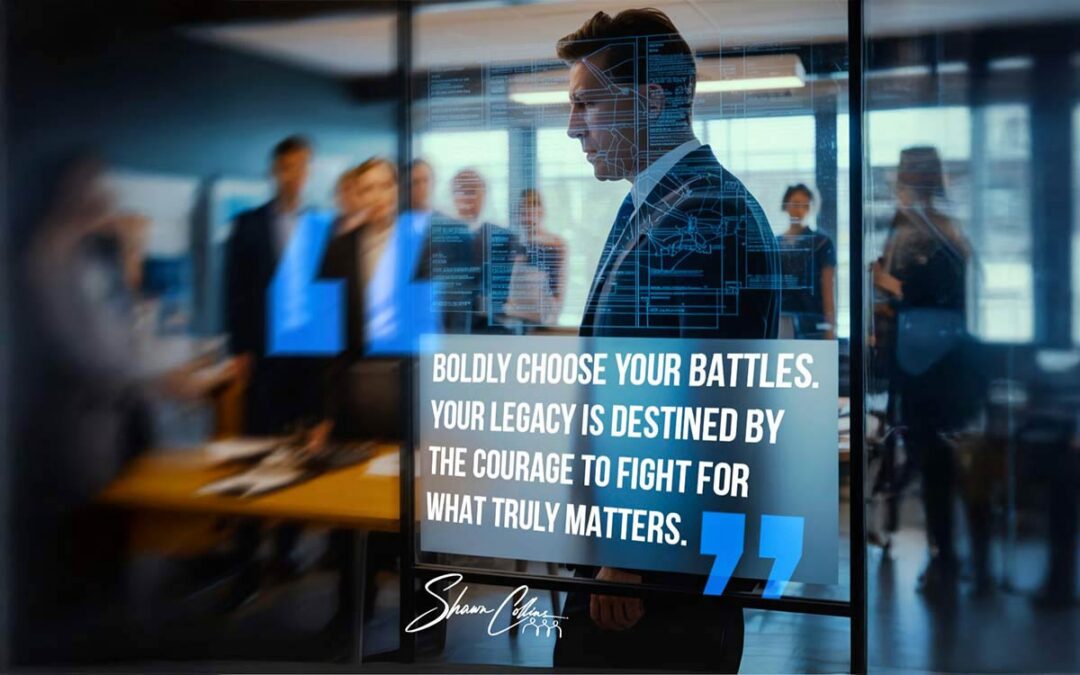
Your legacy is not built by winning every argument, fixing every problem, or saying yes to every opportunity. Your legacy is built by the battles you choose to enter on purpose, with clarity, for the sake of people and mission, not ego or fear.
Take a moment and be honest with yourself.
- Where are you exhausted from saying yes to too much, for too long?
- Which tensions keep resurfacing because you have avoided a hard, necessary battle?
- Where are your people confused about what really matters because your attention is scattered?
What is it like to be on the other side of your leadership right now, in the middle of all these competing battles?
Your team feels the impact of your choices, whether you name it or not. The good news is this. You can decide, starting now, to lead with clearer conviction. To choose fewer, truer battles. To align your energy with the culture and legacy you actually want to build.
<pAs you read ahead, hold one question close: Which battles, if you chose them with intention, would honor your values, strengthen your culture, and be worth being remembered for?
The Truth About Culture as the Strategic Foundation
If you feel like every decision is urgent and every battle lands on your plate, it is usually a sign of one root issue. The culture is unclear. When culture is vague, everything feels important, and everyone pulls in their own direction.
Healthy culture is not the backdrop to strategy. It is the foundation that gives every decision context and weight. Culture answers the questions your calendar cannot. Who are we, what do we stand for, and how do we show up for each other when pressure hits.
Culture Drives Sustainable Performance
Strategies change. Markets shift. Targets move. Culture is what stays with your people in the middle of that movement. It shapes how they respond when a client is unreasonable, when a key hire leaves, or when the numbers fall short.
When culture is strong and clear, your team does not wait for you to step into every fight. They already know how to act, how to communicate, and what tradeoffs align with your values. That is how performance becomes sustainable instead of dependent on your constant intervention.
- Clarity of values guides daily decisions without constant approval.
- Shared expectations reduce drama, rework, and confusion.
- Trust frees people to take ownership instead of playing it safe.
Culture Supports Courageous Decisions
Every leader faces moments where the right choice is not the easy one. Letting a toxic high performer go. Pushing back on misaligned revenue. Naming a pattern of underperformance that others tiptoe around.
Culture either cushions those decisions or punishes them. In a healthy culture, people expect courage. Accountability is normal, not personal. Difficult calls are seen as protection of the whole, not an attack on an individual.
That kind of culture requires clear lines.
- What behavior is out of bounds, no matter the title or revenue impact.
- What you will protect, even when it costs you short term wins.
- How conflict is handled so people can speak truth without fear.
Collective Purpose Over Fragmented Tactics
Without a strong culture, your organization becomes a collection of isolated tactics. Every department chasing its own goals, every leader fighting private battles that may or may not align with where you are trying to go.
Culture pulls those efforts into a shared story. It gives your agency, executive team, or HR function a clear north. People understand why certain battles matter more than others, and they are willing to let go of the rest.
If you want to stop drowning in scattered priorities, start with culture. Get clear on what you will stand for, how you will treat people, and what success really means in your context. Then let every battle be measured against that foundation.
Your next decision is not just about performance. It is about the kind of culture you are reinforcing every time you choose where to spend your courage.
Clarity in Communication and Leadership Decisions
Most leaders do not lose influence because they lack ideas. They lose it because people are not clear on what they mean, what matters, or what happens next. Confusion spreads fast when communication is vague, and that confusion makes every battle feel bigger and harder than it needs to be.
Clarity is not a personality trait, it is a discipline. It is a choice to slow down, say what you mean, and own the impact of your words. When you practice clarity, you build trust. When you avoid it, you invite drama, second guessing, and sideways energy.
Clarity Is a Reflection of Character and Courage
Clarity is not just about sharp strategy decks or clean talking points. It exposes your character. It takes courage to say the hard thing plainly, to set boundaries on your time, to tell a senior leader, “This is not a battle worth our focus right now.”
Vague communication usually protects ego, not people. We soften expectations so we feel liked. We blur accountability so we can avoid conflict. That might feel kind in the moment, but it erodes trust over time. Clear expectations, even when they are firm, show respect for the adults you hired.
For leaders of faith, clarity is also stewardship. You have been given influence for a purpose. Being honest, consistent, and direct is one way you honor that responsibility.
Using the 5 Voices to Choose How You Show Up
The 5 Voices framework helps you understand your natural leadership voice and how others hear you. Each voice has strengths and blind spots. Some tend to over communicate and overwhelm people. Others hold back and leave people guessing.
Use a simple rhythm with your team:
- Identify your primary voice and share it with your team. Invite them to share theirs.
- Ask: “Where does my voice create clarity for you, and where does it create confusion?”
- Agree on one adjustment you will make in the next [insert time frame], such as fewer last minute changes or more written follow up.
When you understand your voice, you can choose your battles with better judgment. You know when to speak, when to listen, and when to let someone else lead the conversation.
Using the Communication Code to Make Expectations Explicit
The Communication Code gives language to the purpose of a message. Are you processing, sharing an update, asking for input, or making a decision. When you do not name that up front, people interpret for themselves, and that is where misalignment starts.
Before your next meeting or message, use this simple template:
- State the code: “I am sharing an update” or “I am making a decision.”
- Clarify the ask: “Here is what I need from you by [insert time frame].”
- Connect to the battle: “This is a battle we will fight” or “This is not where we will spend energy right now.”
Clear codes protect culture and focus. They reduce emotional swirl, protect your calendar, and keep your team aligned on which battles you are choosing together, on purpose.
Ask yourself: Where has vague communication forced your people to guess what battle they are in with you, and what would change if you made clarity your daily discipline?
Faith and Purpose as the Internal Compass for Choosing Battles
If culture is the foundation and clarity is the discipline, faith is the compass that keeps you from drifting. Not faith as a slogan, or a line in your bio, but a deep internal conviction about who you answer to and what your leadership is really for.
When faith is internal, it guides your courage instead of becoming an agenda you push on others. It steadies you when pressure rises. It reminds you that your worth is not tied to this quarter’s numbers, the loudest client, or the next promotion. That freedom changes which battles you enter and how you show up in them.
Humility: You Do Not Have to Win Every Battle
Humility is not weakness. It is a clear view of your role. You are responsible for stewarding people, resources, and opportunities, but you are not the savior of your organization.
- Humility lets you release ego driven battles. You can walk away from arguments that only protect your image.
- Humility opens you to feedback. You can ask, “What am I not seeing in this situation?” and actually listen.
- Humility keeps you grounded. Wins do not inflate you, and losses do not define you.
Leaders of faith understand that influence is given, not owned. That perspective softens your grip and sharpens your focus.
Stewardship: Treating Influence as a Trust
Stewardship means you see your role as a trust from God, not a personal empire. That lens changes how you evaluate every battle.
- Is this decision protecting people or just protecting comfort?
- Is this opportunity aligned with our purpose, or is it just flattering?
- Is this conflict about truth and health, or about control?
When you think as a steward, you stop asking, “What can I get away with?” and start asking, “What choice honors the trust I have been given?” That is a different kind of courage.
Character: Choosing Purpose Over Immediate Outcomes
Faith shaped character holds the long view. You care about who you are becoming, not just what you are achieving. That mindset helps you endure short term loss for long term integrity.
Character driven leaders will lose a deal before they lose their word. They will confront damaging behavior even if it risks short term numbers. They will say no to misaligned partnerships, even when the revenue looks attractive on paper.
That level of conviction does not appear in a meeting. It is formed in private decisions, daily disciplines, and honest reflection before God.
If your internal compass is clear, your external battles get simpler. You may still face hard choices, but you will not be tossed around by every demand. You will know what you stand for, who you serve, and which battles are worth your courage.
Reflection for this week: Where are you trading long term character for short term comfort, and what would it look like to steward your influence in a way that honors the purpose you say you believe in?
Applied Leadership Habits for Intentional Decision-Making
Principles do not change a culture by themselves. Habits do. If you want to choose your battles with clarity, you need repeatable patterns in your day that keep you honest, aligned, and aware of your impact on people.
Intentional decision-making is less about heroic moments and more about quiet, consistent practice. The goal is not to control everything. The goal is to train yourself to pause, reflect, and act in line with your values and culture, even when pressure is high.
A Daily Rhythm For Choosing The Right Battles
Use a simple three part rhythm to filter your decisions. You can apply this in [insert time frame] during your morning, mid day, and end of day.
- Morning focus
- List your top [insert number] decisions or conflicts for the day.
- Ask, “Which of these battles directly affects our culture and long term health?”
- Circle the few that deserve your best energy, and delegate or defer the rest.
- Mid day check
- Pause between meetings.
- Ask, “Am I still fighting the right battles, or have I drifted into distractions?”
- Realign your calendar for the rest of the day where possible.
- End of day review
- Write down three decisions you made.
- Note which ones honored your values and which ones were driven by fear, ego, or fatigue.
Repeat this rhythm until it becomes instinct. Over time, you will catch yourself before you say yes to the wrong battle.
Using Reflection To See “The Other Side Of You”
One of the most powerful questions you can carry is, “What is it like to be on the other side of my leadership?” Most leaders rarely slow down long enough to ask it, let alone to listen for honest answers.
Build a habit around that question with these steps.
- Self reflection: Once per week, journal responses to
- “Where did my team feel supported by me?”
- “Where did my urgency, frustration, or silence create confusion?”
- “If I worked for me, what would I be celebrating, and what would I dread?”
- Safe feedback: Choose [insert number] trusted people and ask,
- “When I am in a battle, how do I show up?”
- “What do you need more of or less of from me when stakes are high?”
- One concrete adjustment: Turn that insight into a habit, such as pausing before you respond, naming emotions in the room, or clarifying the decision before debating it.
Aligning Habits With Values And Culture Goals
Choosing battles on purpose requires a visible link between your calendar and your convictions. Without that, your stated values become wall art instead of operating standards.
- Create a “values filter” card with [insert number] core values and culture goals. Keep it visible during meetings.
- Before committing to a battle, ask, “Which value is this protecting?” If you cannot name one, question the fight.
- After major decisions, tell your team, “Here is the value we chose to honor.” That repetition teaches your culture how you decide.
Leadership habits are spiritual and practical at the same time. They shape your character, guard your culture, and protect you from drifting into battles that do not deserve your courage.
Action for this week: Pick one habit from this section, commit to it for the next [insert time frame], and ask someone you trust to hold you accountable for how you choose your battles.
Retention as the Natural Outcome of Aligned Culture and Leadership
Most leaders feel the pressure to “fix” retention. You look at reports, track exit reasons, adjust compensation, and launch another engagement initiative. The problem is, when you treat retention as a metric to manage, you miss the deeper truth that your people already feel every day.
Retention is a mirror of your culture and leadership, not a project for HR to solve in isolation. People stay where they trust the leadership, understand the mission, and feel their work matters. They leave where battles are random, values shift with pressure, and communication is unclear.
Trust, Clarity, and Purpose Create Staying Power
Your highest capacity people have options. They do not stay for a title on a slide or perks that wear off in a few weeks. They stay when the environment around them is healthy enough for them to give their best without burning out or losing themselves.
- Trust: People trust leaders who are consistent, honest, and willing to own their decisions. They can predict how you will respond when things go sideways.
- Clarity: People give more when they know what matters, what success looks like, and how decisions get made.
- Purpose: People endure hard seasons when they believe their work aligns with a meaningful mission, not just short term targets.
When these three are in place, retention becomes a byproduct, not a target. You stop trying to convince people to stay and start creating a culture they are reluctant to leave.
Choosing the Right Battles Signals What You Value
Your team pays attention to the battles you choose. If you always fight for revenue at any cost, they learn that numbers outrank people. If you only confront poor behavior when clients complain, they learn that image outranks integrity.
Aligned culture looks different. You consistently choose battles that protect your values and your people, even when it costs time, comfort, or short term wins.
- You address toxic behavior, even from high performers.
- You defend sustainable workloads, not just aggressive timelines.
- You protect space for development, not just production.
Those choices preach louder than any speech about culture. Over time, your best people recognize, “This is a place where what we say we value actually shapes decisions.” That is where retention grows roots.
Investing in People Without Creating Pressure
Retention is not about promising people a lifetime seat. It is about honoring the season they are with you. When you invest in their growth with clarity, you serve both them and the organization.
- Career conversations: Ask, “What kind of work gives you life, and where do you want to grow in the next [insert time frame]?” Then connect opportunities to that clarity.
- Clear expectations: Define what “great” looks like in their role. Vague expectations create anxiety and quiet resentment.
- Healthy challenge: Stretch people with new responsibilities that align with their strengths, not random gaps you need to fill.
You do not need to pressure people into staying. You need to create a culture where they feel seen, stretched, and aligned with the battles you are choosing as a team.
Reflection for you: If retention in your organization is a concern, start by asking, “What do our current battles teach our people about what truly matters here, and would I stay if I worked on the other side of my own leadership?”
Closing with a Call to Purposeful Action
You have enough insight now to do more than nod along. This is the moment where leadership shifts from good intentions to intentional action. The question is not whether you are in battles. You are. The question is whether those battles are worthy of your time, your team, and your legacy.
Bold leadership is not louder leadership. It is clearer, more convicted leadership. It is the quiet resolve to say, “This is what we will stand for,” and to let lesser battles pass without apology. That kind of resolve protects your culture, your team, and your own soul.
A Simple Commitment for the Next Season
Before you move on to the next meeting, make a specific commitment. Do not keep this theoretical. Put it into practice.
- Choose one battle to release in the next [insert time frame]. Something you have been clinging to out of ego, fear, or habit.
- Choose one battle to own that you have avoided, but you know is tied to your values, culture, and long term health.
- Tell your team what you are choosing and why. Let them see the alignment between your words and your actions.
Leadership clarity grows when you stop trying to fight everything and start fighting for the right things, on purpose.
A Reflective Question to Carry Forward
If you remember nothing else from this, carry this question into your calendar, your one on ones, and your quiet moments of reflection:
“If my legacy was shaped only by the battles I am fighting this year, would I be proud of what I am known for?”
Take Your Next Step Toward Clarity and Culture Health
You do not have to sort this out alone. Clarity, culture, and aligned decision-making are muscles you can build with the right structure, language, and support.
If you are ready to lead with less confusion and more conviction, take a next step.
- Visit ShawnCollins.com for resources that help you build a culture where the right battles are clear and shared.
- Explore CulturebyShawn for coaching and tools that support you, your executive team, or your agency as you align culture, communication, and leadership habits.
Your influence is a stewardship, not an accident. Choose your battles with clarity and courage, and let this be the year your leadership aligns with the legacy you actually want to leave.

About the Author
Shawn Collins
Shawn Collins is a leadership strategist, keynote speaker, and founder of EXTEND GROUP. Since 1997, he has helped organizations strengthen leadership, improve communication, and build cultures that drive performance. As a GiANT-certified consultant in 5 Voices, 100X Leader, and 5 Voices for Teams, Shawn equips leaders with practical tools to create alignment, increase retention, and make strategy stick.