A report does not retain people.
A readout does not change manager behavior by itself.
A meeting does not fix communication.
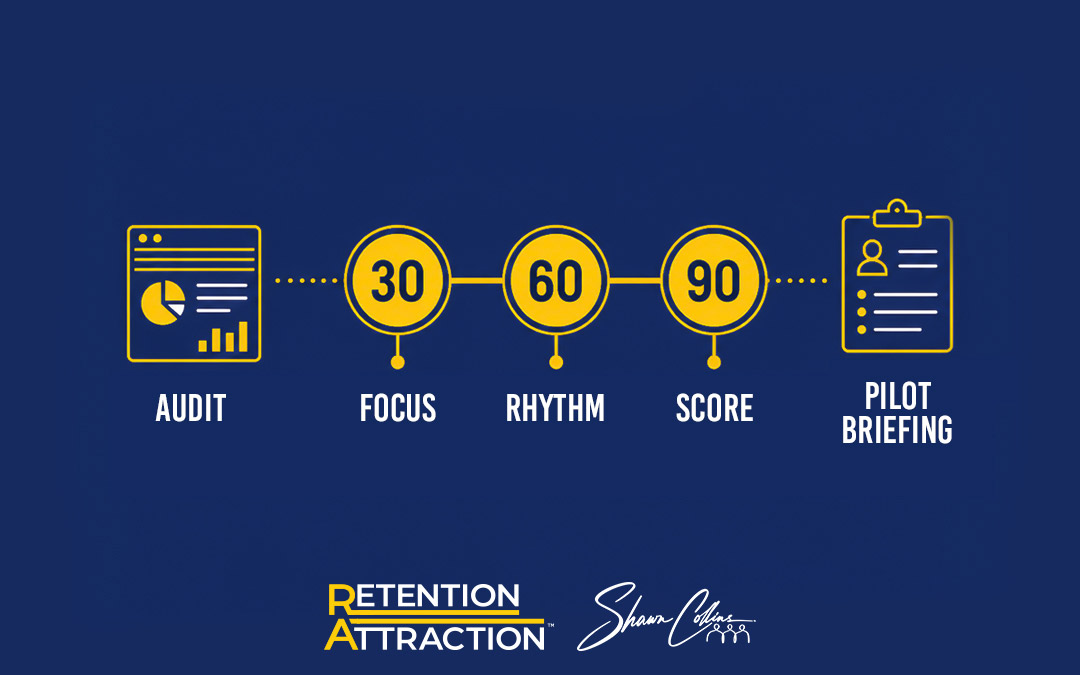
The first 90 days after the Audit matter because that is where leaders prove whether the information will become action.
Many companies already have reports. They have survey slides, exit notes, HR dashboards, manager opinions, and meeting recaps. The issue is not always missing information. The issue is too many findings and too little movement.
The Retention = Attraction™ Audit is designed to avoid that trap.
The owner-facing thesis
The first 90 days after the Audit should be focused enough to start and strong enough to matter.
That means leaders should pick one to three plays, set a simple cadence, and keep score without burying the team in a broad culture push.
The readout should create choices
A good Audit readout should make the issue easier to act on.
It should show what turnover may be costing, where the pattern is concentrated, and what leadership or manager habits may be tied to the friction. From there, the leadership team should be able to sort the findings into decisions.
What needs action in the next 30 days?
What needs more discussion?
What should wait?
What should be rejected because it does not fit the real pattern?
This kind of sorting matters. If every finding becomes a project, nothing moves. If every concern becomes a meeting, managers lose energy. If every answer is company-wide, the team misses the concentrated pattern that actually needs attention.
Start with one to three plays
The first 90 days should not attempt to fix every culture concern.
That is how leaders overload teams and turn good intent into another stalled initiative.
A better approach is to pick one to three plays tied directly to the Audit findings. These plays should be practical, visible, and connected to the pattern that showed up in the readout.
A play might be:
- A weekly manager rhythm for one department.
- A Communication Code reset for one leadership team.
- A 5 Gears capacity conversation for managers who are living in constant task mode.
- A clearer onboarding handoff between HR and operations.
- A role clarity conversation for a team with constant rework.
- A simple stay conversation process for one critical role group.
The point is not to look busy. The point is to change the daily experience in the place where the pattern is costing the business.
Days 1 to 30: Name the focus
The first 30 days should answer one question:
What are we fixing first?
This is where the leadership team takes the readout and agrees on the first play or plays.
The owner should not leave this decision only to HR. HR is a critical partner, but the right leaders need to agree on the business case and the behavior change. That may include finance, operations, department leaders, and the managers closest to the pattern.
During the first 30 days, define the following:
- The target team, role, shift, or manager layer.
- The current pattern.
- The behavior or rhythm that needs to change.
- The leader who owns the play.
- The weekly check-in rhythm.
- The simple way progress will be watched.
Keep this clean. If it cannot be explained in a few sentences, it probably is not ready to start.
Do not let the readout become another report.
If turnover, weak manager habits, or recurring team friction are starting to shape your planning, do not wait for another exit to make the cost visible.
Days 31 to 60: Build the rhythm
The second 30 days are about rhythm.
Most retention plays fail because the first meeting is strong and the weekly habit is weak.
The leadership team agrees on the issue. Everyone nods. A few action items get written down. Then normal business pressure returns. Urgent customer needs, staffing gaps, production issues, and inbox load take over.
This is why the rhythm matters.
If the Audit points to manager inconsistency, managers need a consistent touchpoint.
If the issue is communication, leaders need a repeatable language for care, clarification, critique, collaboration, and celebration.
If the issue is capacity, leaders need a way to talk about focus mode, task mode, social mode, connection, and recharge without making it personal.
The rhythm keeps the action from depending on memory or mood.
Days 61 to 90: Keep score and decide what comes next
The final 30 days are not just for checking boxes.
They are for asking whether the first play created enough movement to continue, adjust, or expand.
The score does not need to be complicated. It should be tied to the pattern.
- Did manager one-on-ones happen?
- Did new hires receive clearer expectations?
- Did the handoff between HR and operations improve?
- Did leaders address communication misses faster?
- Did the target team report less confusion?
- Did overtime, open seats, or rework begin to move in the right direction?
The goal is not to declare victory too early. The goal is to learn what the first play changed and what the next play should be.
A practical example
A 75-person company receives an Audit readout showing early-tenure turnover concentrated in one role group.
The team could respond with a broad employee engagement push. That may sound active, but it may miss the pattern.
A stronger 90-day path could look like this:
- Days 1 to 30: Confirm the role group, manager layer, onboarding handoff, and weekly ownership rhythm.
- Days 31 to 60: Train managers on one communication habit, set weekly check-ins with new hires, and clarify what good performance looks like in the first 30 days.
- Days 61 to 90: Review early signs, compare manager consistency, and decide whether to expand the play to another role group.
That is practical. It is narrow. It respects the workload. It also gives leaders a better chance to see real movement.
Why this matters for owners
Owners are often tempted to wait until there is a perfect plan.
That delay can be expensive.
A good 90-day path does not require a perfect plan. It requires a clear first move, a rhythm that keeps the move alive, and a simple way to see whether the move is working.
This is how retention moves from concern to leadership discipline.
The best time to plan the pilot
The best time to plan the first 90 days is immediately after the readout.
That is when the leadership team has the cost, the pattern, and the attention needed to act. If the team waits too long, the urgency fades and the business returns to old habits.
The Audit should lead to a pilot briefing because the readout should not sit alone. The briefing helps leaders decide who needs to be involved, what play should start, what cadence will hold it, and what needs to be watched.
A report is not the win.
The first visible change is.
Move from readout to action with a clear 90-day path.
The Audit gives you a clear starting point: the number, the pattern, and the first action path. Use it before another quarter gets built around the same preventable churn.

About the Author
Shawn Collins
Shawn Collins is a leadership strategist, keynote speaker, and founder of EXTEND GROUP. Since 1997, he has helped organizations strengthen leadership, improve communication, and build cultures that drive performance. As a GiANT-certified consultant in 5 Voices, 100X Leader, and 5 Voices for Teams, Shawn equips leaders with practical tools to create alignment, increase retention, and make strategy stick.