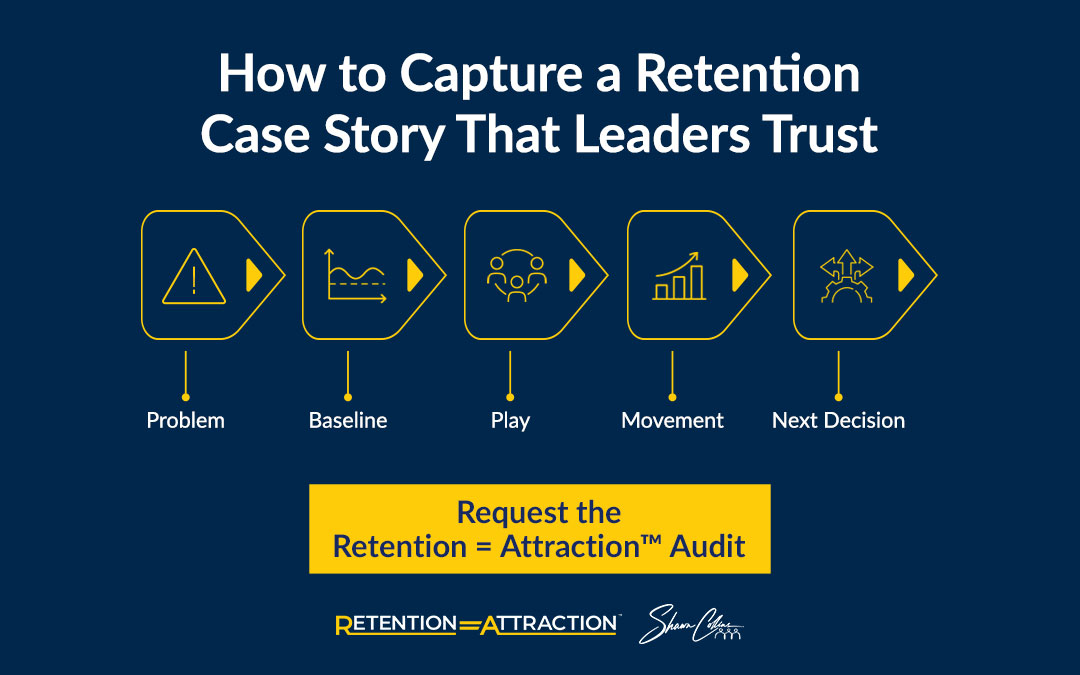
The strongest retention proof does not begin with the result. It begins with the business problem leaders were trying to solve. A credible retention case story connects the starting problem, baseline, action, measurable movement, and next decision.
The story has to start before the success
A retention case story becomes credible when it shows where the organization started. Leaders do not need a polished success story that makes the work look effortless. They need enough context to understand the business problem, why it mattered, and what was happening before the intervention. A story that begins with the solution skips the most important part of the decision.
Baseline turns a testimonial into evidence
A testimonial tells you that someone liked the work. A baseline gives you a reference point. That can include a retention-risk signal, manager confidence, communication consistency, team confidence, or another practical indicator tied to the problem. The point is not to manufacture a perfect number. The point is to establish what leaders were seeing before the play began.
Document the play without turning it into a sales pitch
The next part is the action. What did leaders actually do differently? A useful case story names the behavior or rhythm that changed without exposing proprietary formulas or internal scoring logic. A team may have introduced a more consistent manager conversation rhythm, clarified expectations, or created shared language for a recurring communication problem.
If you want to understand where retention risk is showing up before choosing the next intervention, start with the diagnosis.
Movement is the part leaders can use
Movement does not have to mean a dramatic percentage change. In leadership and retention work, early movement can show up in better conversations, stronger rhythm adherence, fewer surprises, clearer expectations, improved confidence, or reduced risk. Those signals become more useful when they are connected to the original problem.
The next decision completes the story
A strong case story does not pretend the first intervention solved everything. It shows what leaders learned and what they decided to do next. That may mean continuing the rhythm, expanding the play, measuring another indicator, or addressing a different retention risk. The next decision makes the story honest and useful.
A practical example
Consider a company where supervisors and frontline employees repeatedly misunderstand expectations. Rather than saying a communication workshop went well, leadership records the starting pattern, the manager behavior they changed, the rhythm they practiced, and the movement employees reported afterward. The resulting story is useful because another leader can understand what changed and why it mattered.
What leaders should take away
A useful proof asset should make the next leadership decision clearer. It should show enough of the starting point to establish context, enough of the action to understand what changed, and enough of the movement to make the result credible. It should also be honest about what remains unresolved. That is how Retention = Attraction™ moves from a claim to something leaders can examine, discuss, and act on.
If you are ready to see what the retention patterns in your organization are telling you, start with the Audit.

About the Author
Shawn Collins
Shawn Collins is a leadership strategist, keynote speaker, and founder of EXTEND GROUP. Since 1997, he has helped organizations strengthen leadership, improve communication, and build cultures that drive performance. As a GiANT-certified consultant in 5 Voices, 100X Leader, and 5 Voices for Teams, Shawn equips leaders with practical tools to create alignment, increase retention, and make strategy stick.