Preventable churn is hard to address when no one wants to sound accusatory.
HR sees the pattern, but does not want to blame managers.
Operations feels the strain, but does not want to turn every staffing issue into a leadership debate.
Finance sees the cost, but may not have the people detail behind the numbers.
The owner feels the drag, but may not know where the real leak is hiding.
So the issue stays polite.
The company keeps rehiring. Managers keep patching. HR keeps filling roles. Finance keeps absorbing the cost. Operations keeps working around the gaps.
That is not leadership. That is drift.
The owner-facing thesis
Preventable churn should be discussed as a business pattern, not a blame session.
The goal is not to accuse a person or department. The goal is to help the leadership team see the cost, concentration, and first action path well enough to act.
Start with the business cost
The best way to begin the conversation is to avoid making it personal too quickly.
- Do not start with, “Our managers are the problem.”
- Do not start with, “HR needs to fix retention.”
- Do not start with, “People just do not want to work.”
Start with the cost.
A stronger opening sounds like this:
“We need to look at what churn is costing us and where it is concentrating. We may not be able to prevent every exit, but I do not want us to keep paying for the same avoidable pattern.”
That language lowers defensiveness because it starts with the business issue.
It also invites the right leaders into the conversation.
Separate exits from patterns
One exit may be personal. A pattern is operational.
That distinction matters.
If one person leaves, the story may be unique. If five people leave from the same role group, same manager layer, same shift, same tenure window, or same handoff, the leadership team needs to pay attention.
The conversation should move from stories to patterns.
Use this language:
“I am less concerned with debating one exit. I am more concerned with whether the same type of exit keeps repeating.”
That sentence helps leaders stop chasing anecdotes and start looking for concentration.
Ask what the company is paying for twice
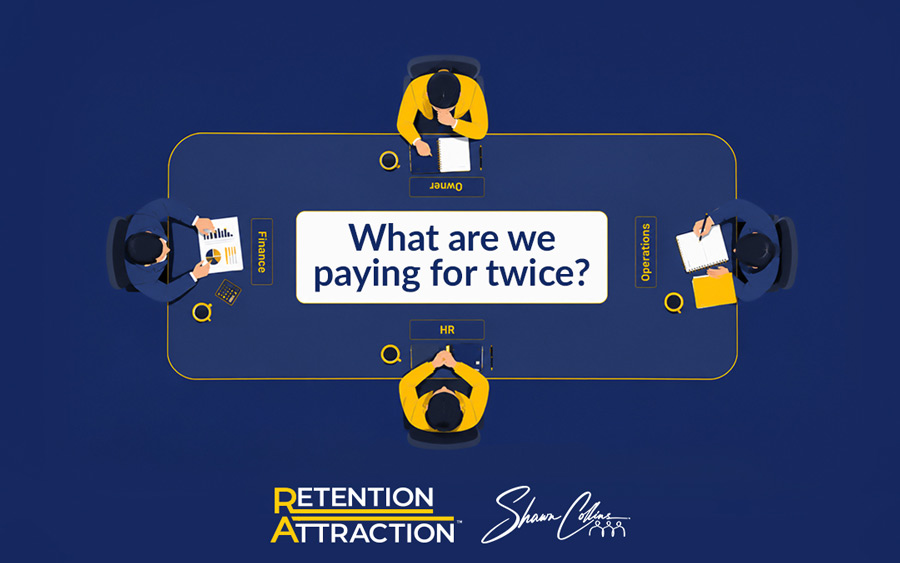
This question cuts through noise: “What are we paying for twice?”
- You may be paying once through recruiting and again through the manager rhythm that causes the role to reopen.
- You may be paying once through training and again through a weak handoff that slows ramp time.
- You may be paying once through overtime and again through the unclear expectation that keeps burning out reliable people.
- You may be paying once through HR effort and again through the absence of executive agreement on what must change.
This question is useful because it is direct without being reckless. It makes the cost visible without pointing fingers.
Bring finance, operations, HR, and ownership together
Employee retention cannot stay in one lane.
HR may own recruiting systems and employee feedback. Operations owns much of the daily work experience. Finance sees the cost. Owners and executives set the standard. Managers shape the daily reality.
If one of those seats is missing, the conversation is incomplete.
A practical leadership meeting should include these four views:
Owner: Where is churn slowing growth or creating instability?
Finance: Where are replacement cost, overtime, ramp time, or rework showing up?
Operations: Where are gaps affecting throughput, quality, schedule, or customers?
HR: What themes are showing up in exits, stay conversations, manager feedback, and hiring friction?
The goal is not a long meeting. The goal is a shared view of the same pattern.
Bring the right leaders to the same table.
If turnover, weak manager habits, or recurring team friction are starting to shape your planning, do not wait for another exit to make the cost visible.
Use language that reduces defensiveness
The way you raise the issue matters.
Avoid language that turns the meeting into a courtroom. Say:
“We are looking for patterns, not scapegoats.”
“We need to separate what we can control from what we cannot.”
“We need to know whether the same issue is creating cost in more than one place.”
“We are not trying to solve everything today. We are trying to identify what to diagnose first.”
“We need a readout the owner, finance, operations, and HR can all use.”
That type of language protects the conversation from becoming personal too soon.
It also keeps the group focused on action.
A practical example
A people leader sees a rising exit pattern among newer employees.
The easy move is to bring exit comments to the leadership team and hope the concern gets attention. That rarely works well. Some leaders will question the comments. Some will defend the manager. Some will say the labor market is the issue.
A better opening is more business-focused.
“We have a pattern that deserves a closer look. Newer employees in one role group are leaving faster than we expected. HR sees the exit themes. Operations feels the schedule strain. Finance is absorbing overtime and replacement cost. I would like us to look at the cost, concentration, and leadership factors before we spend more on recruiting.”
That statement does three things.
- It names the pattern.
- It shows how each function feels the cost.
- It asks for diagnosis before more spending.
That is a stronger leadership conversation.
Do not wait for another exit interview
Exit interviews have value, but they arrive late.
By the time the exit interview happens, the cost has already been created. The role is open. The manager is covering the gap. HR is replacing the person. Operations is adjusting. The team is watching.
The Audit looks upstream.
It helps leaders see the cost and pattern before the next exit sets the agenda. That is why the right time to raise the issue is before another resignation forces the meeting.
The meeting agenda
Use a simple agenda.
- Name the business concern.
- Review where churn appears to be concentrating.
- List the costs each function is feeling.
- Identify what information is missing.
- Decide whether the issue needs an Audit readout.
- Agree on who should be part of the readout.
- Set a date for the decision.
That is enough. Do not turn the first meeting into a full retention plan. The first job is to make the issue clear enough to diagnose.
The leadership question
Ask your team this:
“Are we treating retention as an HR concern because that is where the exits show up, or as a leadership concern because that is where the daily experience is shaped?”
That question can reset the room.
It does not blame HR. It does not blame managers. It calls the leadership team into ownership.
That is the work.
Preventable churn keeps costing companies because the conversation starts too late, stays too vague, or sits with the wrong person.
The Retention = Attraction Audit gives leaders a better starting point.
Start the leadership conversation before another exit sets the agenda.
The Audit gives you a clear starting point: the number, the pattern, and the first action path. Use it before another quarter gets built around the same preventable churn.

About the Author
Shawn Collins
Shawn Collins is a leadership strategist, keynote speaker, and founder of EXTEND GROUP. Since 1997, he has helped organizations strengthen leadership, improve communication, and build cultures that drive performance. As a GiANT-certified consultant in 5 Voices, 100X Leader, and 5 Voices for Teams, Shawn equips leaders with practical tools to create alignment, increase retention, and make strategy stick.