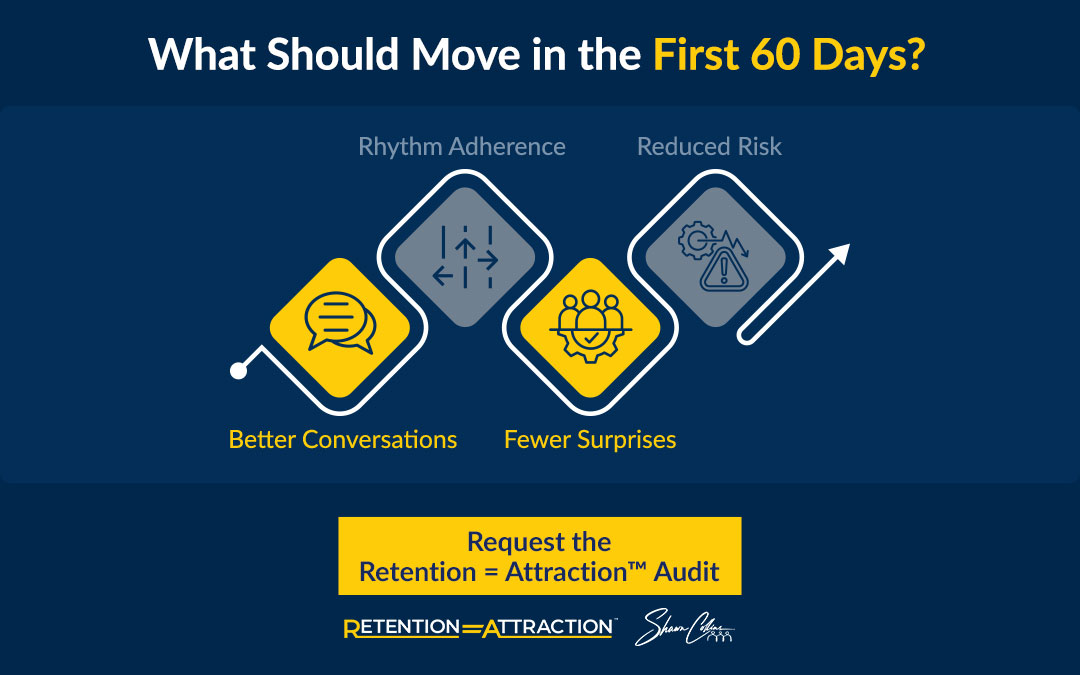
The strongest retention proof does not begin with the result. It begins with the business problem leaders were trying to solve. Early proof should focus on a few decision-useful indicators rather than trying to measure everything.
The first 60 days should create evidence, not perfection
Leaders often want a pilot to prove the entire business case immediately. That creates pressure to measure too much and promise too much. A better approach is to identify a small set of indicators that should reasonably move if the intervention is working. Early proof is about direction and decision quality.
Start with behavior before outcome
Retention itself may take longer to move than the behaviors contributing to retention risk. If managers are supposed to have more consistent conversations, measure whether the rhythm is happening. If clarity is the target, look for changes in clarity. Behavior gives leaders an earlier read on whether the play is taking hold.
Look for practical movement
Useful early markers can include better conversations, stronger rhythm adherence, fewer surprises, clearer expectations, stronger team confidence, or reduced risk. These are not universal metrics. The right indicators depend on the problem identified in the Audit and the play being tested.
Avoid the measurement trap
A scorecard should help leaders decide, not create another reporting burden. Five useful indicators are better than twenty numbers nobody reviews. Keep the scorecard simple enough that an owner, COO, CFO, or HR leader can understand the movement and ask what should happen next.
If you want to understand where retention risk is showing up before choosing the next intervention, start with the diagnosis.
The 60-day conversation
At the end of the first 60 days, leaders should be able to answer three questions: What changed? What did we learn? What should we do next? That is more useful than declaring a pilot successful because everyone attended the sessions. Proof is movement tied to a decision.
A practical example
A pilot team tracks whether managers are completing an agreed 1:1 rhythm, whether employees report greater clarity, and whether recurring communication surprises are declining. After 60 days, leaders can discuss which behaviors moved and whether the evidence supports continuing the work.
What leaders should take away
A useful proof asset should make the next leadership decision clearer. It should show enough of the starting point to establish context, enough of the action to understand what changed, and enough of the movement to make the result credible. It should also be honest about what remains unresolved. That is how Retention = Attraction™ moves from a claim to something leaders can examine, discuss, and act on.
If you are ready to see what the retention patterns in your organization are telling you, start with the Audit.

About the Author
Shawn Collins
Shawn Collins is a leadership strategist, keynote speaker, and founder of EXTEND GROUP. Since 1997, he has helped organizations strengthen leadership, improve communication, and build cultures that drive performance. As a GiANT-certified consultant in 5 Voices, 100X Leader, and 5 Voices for Teams, Shawn equips leaders with practical tools to create alignment, increase retention, and make strategy stick.