Business owners rarely wake up one morning and discover they have a turnover problem.
Instead, they notice a series of operational frustrations that seem unrelated at first. Productivity slows. Managers begin carrying more of the workload themselves. Team members stop bringing new ideas forward. Customer issues take longer to resolve. Recruiting becomes a constant activity instead of an occasional necessity.
Eventually, someone announces they are leaving, and the resignation becomes the event everyone points to as the problem.
In reality, it is usually the final chapter of a story that began months earlier.
One of the greatest misconceptions about employee retention is that people leave because of one significant event. While compensation, career opportunities, and personal circumstances certainly influence decisions, most regrettable turnover develops gradually. Employees do not suddenly disengage. They slowly become less connected to their manager, less confident in their future, and less convinced that their contributions matter.
By the time an owner hears, “I’ve accepted another opportunity,” the real opportunity has already passed.
The challenge is not simply identifying why people leave. The challenge is creating a leadership system that allows managers to recognize problems while they are still small enough to solve.
That is one of the central ideas behind Retention = Attraction™.
Organizations that retain exceptional people rarely do so because they offer the highest salaries or the most impressive perks. They create environments where employees experience consistent leadership, clear expectations, meaningful feedback, and genuine interest in their success. Those experiences are built through ordinary conversations repeated consistently over time.
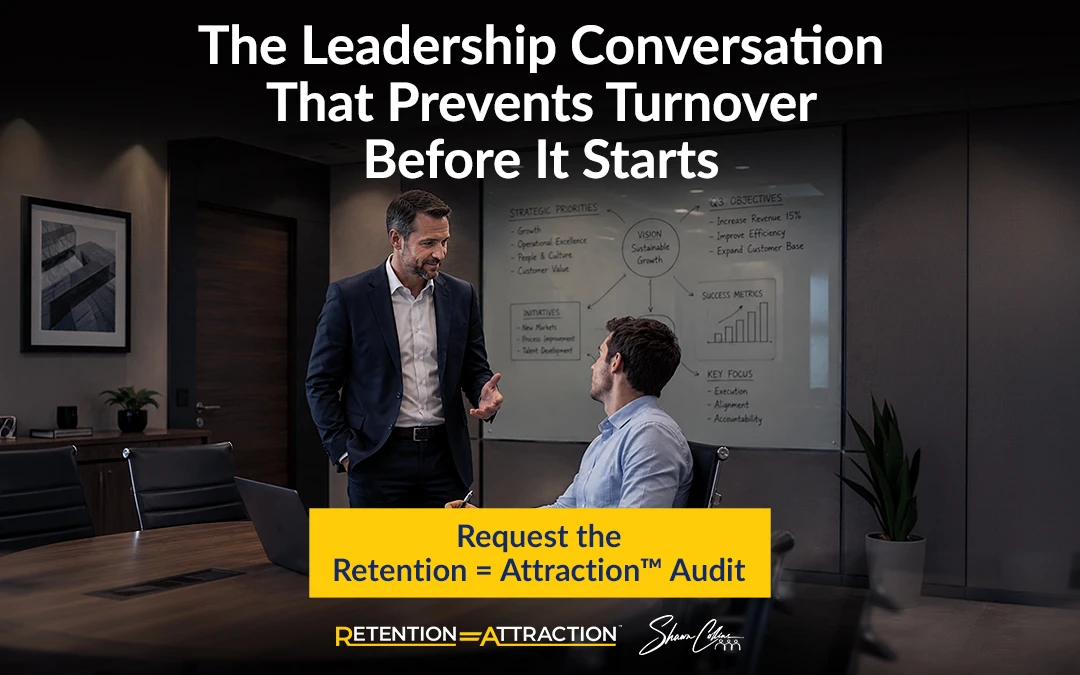
One of the most effective of those conversations is the manager one-on-one.
Most One-on-One Meetings Are Too Late
Ask ten managers whether they meet with their employees, and most will answer yes.
Ask employees whether those meetings help them grow, and the answers often become much more varied.
That gap matters.
Too many one-on-one meetings exist only because a calendar reminder says they should. The conversation becomes a quick status update. Deadlines are reviewed. Project lists are checked. Questions such as “Everything going okay?” receive the predictable response of “Yes,” and both people return to work believing they have communicated.
They have exchanged information.
They have not strengthened trust.
The most valuable one-on-one conversations are not performance reviews in miniature. They are opportunities for managers to understand what is changing beneath the surface of daily work. They create space for employees to discuss obstacles before those obstacles become frustrations, to ask for support before performance declines, and to reconnect with the larger purpose of their work.
When these conversations happen consistently, they become one of the earliest warning systems an organization can have.
Managers begin noticing changes in attitude before disengagement becomes visible.
Employees raise concerns before they become complaints.
Misunderstandings are clarified while they are still minor.
Instead of reacting to turnover, leaders begin preventing it.
That shift is significant because it changes leadership from being reactive to becoming intentional.
A Retention = Attraction™ Audit often uncovers that organizations already have talented managers who genuinely care about their people. What they lack is not commitment. It is a repeatable rhythm for meaningful conversations. The August campaign emphasizes practical leadership habits that create measurable movement before organizations invest in broader initiatives.
Many turnover issues begin long before someone resigns.
If your managers only discover problems after an employee has mentally checked out, it may be time to evaluate the leadership rhythms shaping your culture.
A Practical Example: The Cost of Waiting
A manufacturing company I worked with had a manager everyone respected. He was dependable, technically excellent, and always willing to step in when production issues surfaced. If a machine failed, he was there. If a customer order was behind schedule, he found a solution. By every traditional measure, he was a strong leader.
Yet his department had the highest turnover in the company.
When we looked closer, the problem was not his work ethic. It was his leadership rhythm.
He viewed one-on-one conversations as something to have when an employee was struggling. If someone was performing well, he assumed they needed very little of his time. Weeks would pass without meaningful conversations beyond production updates and daily tasks.
His employees were not looking for more supervision. They were looking for more connection.
They wanted to understand where they were growing, what opportunities were ahead, and whether their manager noticed the effort they invested every day. Instead, they received feedback only when something required correction.
No one was intentionally creating a poor employee experience. Everyone was simply focused on keeping production moving.
That distinction matters.
Most retention problems are not created by bad managers. They are created by good managers who have never been given a practical system for leading people as intentionally as they lead operations.
Once the organization established a consistent rhythm for one-on-one conversations, something interesting happened. Managers were no longer surprised by employee frustrations because those frustrations surfaced earlier. Employees became more comfortable discussing obstacles before they affected performance. Coaching became part of the normal workweek instead of an event reserved for difficult situations.
The business did not eliminate every challenge overnight, but it did eliminate many of the surprises that had previously led to disengagement and turnover.
The Most Valuable Conversation Is the One That Happens Early
One of the defining characteristics of exceptional leaders is not that they solve every problem. It is that they recognize patterns before those patterns become expensive.
Think about how most organizations approach equipment maintenance. They do not wait for a critical machine to fail before inspecting it. They establish preventive maintenance schedules because the cost of routine attention is far less than the cost of unexpected downtime.
Leadership works the same way.
Consistent one-on-one conversations are preventive maintenance for your people.
They provide managers with opportunities to understand what employees are experiencing, clarify expectations, recognize progress, and identify obstacles before those obstacles begin affecting performance or engagement.
Unfortunately, many organizations unintentionally train managers to prioritize operational urgency over leadership consistency. Calendars fill with production meetings, customer issues, financial reviews, and project deadlines. One-on-one meetings become the first commitment postponed because they do not appear urgent.
Ironically, those conversations often prevent the very crises that consume so much of a manager’s schedule.
When employees feel connected to their manager, they are more likely to ask questions early, admit mistakes quickly, and seek guidance before small problems become larger ones. Managers gain visibility into concerns that would otherwise remain hidden until someone submits a resignation.
The conversation itself is not the solution.
The consistency of the conversation is.
Why This Matters to Every Owner
Owners often ask me how they can tell whether their culture is healthy.
My answer is rarely found in an engagement survey or an exit interview.
Instead, I encourage them to ask a different question.
If I quietly observed every one-on-one conversation happening in my organization this week, what would I learn about our leadership culture?
Would employees leave those conversations with greater clarity than they had when they entered?
Would they understand how their work contributes to the company’s success?
Would they feel challenged, supported, and valued?
Or would those meetings simply become another calendar appointment focused on project updates and unfinished tasks?
The answers reveal far more than employee satisfaction.
They reveal whether leadership is being practiced intentionally or simply managed reactively.
That distinction sits at the heart of Retention = Attraction™.
Organizations become more attractive when employees consistently experience leadership that builds confidence, trust, and clarity. Recruiting improves because retention improves first. Reputation improves because culture becomes more consistent. Operational performance improves because managers spend less time replacing talent and more time developing it.
One thoughtful conversation each week may not seem transformational.
Over the course of a year, however, those conversations shape the culture employees experience every single day.
Culture is rarely changed through one memorable speech or a new initiative.
It is built through leadership habits repeated consistently until they become the normal way people work together.
Begin Before the Problem Becomes Expensive
If your managers are discovering employee frustrations only after performance declines or resignations occur, the issue may not be a lack of commitment. It may be a lack of leadership rhythm.
A Retention = Attraction™ Audit helps uncover where those rhythms are breaking down, where communication is becoming reactive instead of intentional, and where practical improvements can create measurable business results.
The goal is not to give managers more work.
The goal is to help them have the conversations that matter most before small concerns become costly turnover.
That is where stronger retention begins.
And over time, it is also where stronger attraction is built.
Every great culture is built one conversation at a time.
If you want to identify the leadership habits that are quietly influencing retention across your organization, start with a clear diagnosis before the next resignation catches you by surprise.
About the Author
Shawn Collins
Shawn Collins is a leadership strategist, keynote speaker, and founder of EXTEND GROUP. Since 1997, he has helped organizations strengthen leadership, improve communication, and build cultures that drive performance. As a GiANT-certified consultant in 5 Voices, 100X Leader, and 5 Voices for Teams, Shawn equips leaders with practical tools to create alignment, increase retention, and make strategy stick.