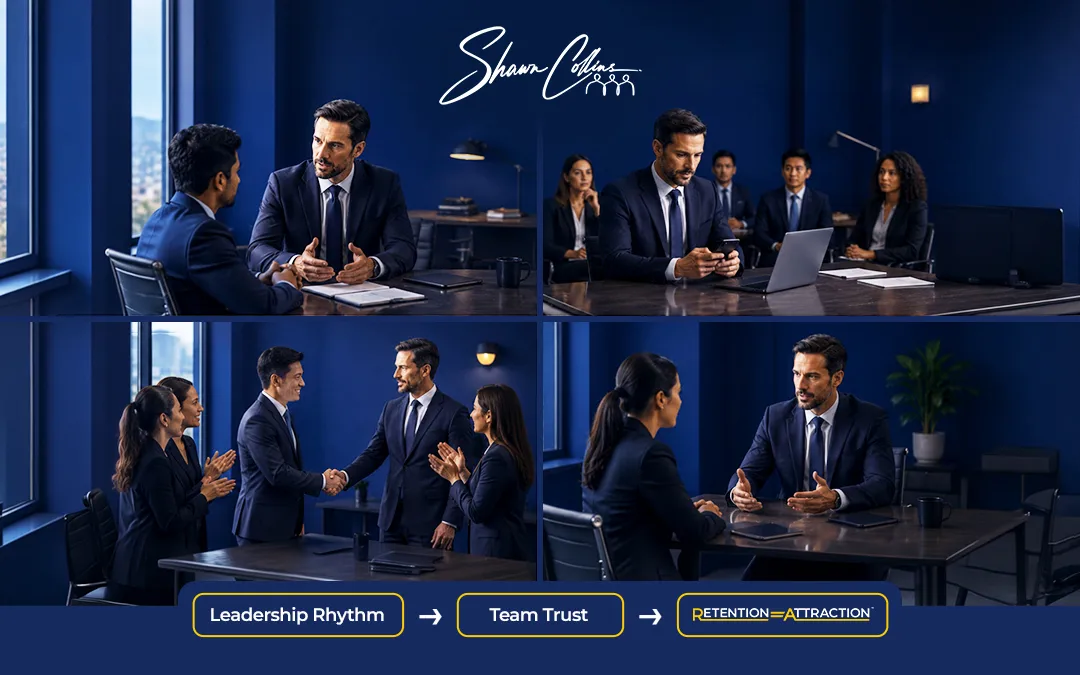
Every business owner eventually asks the same question. “Why are good people leaving?” Most begin by looking outward.
- Compensation.
- Benefits.
- Competitors.
- Recruiting.
Those factors certainly matter. But after working with leadership teams across many organizations, I’ve found that one of the biggest contributors to turnover usually lives much closer to home.
It lives inside the daily rhythm of managers. Not because managers don’t care. Because most have never been taught how to consistently lead people while managing everything else competing for their attention.
That creates an important distinction. Turnover isn’t always an employee problem. Often, it’s a leadership rhythm problem.
When managers operate inconsistently, employees experience inconsistency, expectations change, and communication becomes reactive. Coaching happens only when something goes wrong. Recognition becomes rare and eventually, talented people begin wondering if another organization offers something better.
That is why Retention = Attraction™ starts with leadership behavior, not recruiting tactics.
If your current employees consistently experience clarity, trust, and accountability, your organization naturally becomes more attractive to future employees. Improving manager rhythm is one of the quickest ways to begin creating that experience.
Busy Is Not the Same as Present
One of the most common observations I hear from owners is this:
“My managers are working incredibly hard.”
I believe them. Hard work is rarely the issue. Presence is.
Managers spend their days answering emails, solving customer issues, attending meetings, responding to production challenges, approving purchases, and putting out fires.
At the end of the day, they feel productive. Their teams often feel disconnected.
Employees do not judge leadership by how full a calendar is. They judge it by the quality and consistency of the interactions they have with their manager. A leader who is constantly busy but rarely available creates uncertainty without intending to.
- People begin making assumptions.
- Questions go unanswered.
- Small frustrations grow.
- Momentum slows.
That operational drag eventually becomes a retention problem.
One of the goals of a Retention = Attraction™ Audit is to uncover these patterns before they become resignations. From there, leaders can identify one practical first play to improve daily manager habits instead of launching another broad initiative.
Manager Rhythm Creates Organizational Rhythm
Every team develops a rhythm. The question is whether it is intentional.
Healthy organizations create predictable leadership behaviors.
- Managers regularly communicate priorities.
- Expectations remain clear.
- Follow-up happens consistently.
- Employees know when coaching conversations will occur instead of fearing unexpected criticism.
This rhythm builds confidence. Confidence creates trust. Trust strengthens retention.
When organizations lack that rhythm, the opposite occurs.
- Employees spend more time guessing.
- Managers spend more time correcting misunderstandings.
- Owners spend more time solving problems that should never have reached their desk.
That is not simply a communication issue. It is an operating rhythm issue.
Improving manager rhythm does not require adding more meetings. It requires making existing leadership interactions more intentional, more predictable, and more valuable.
Many turnover issues begin long before someone resigns.
Discover whether inconsistent manager rhythm is quietly increasing retention risk inside your organization.
A practical example
Recently, I worked with a company whose owner believed they had a recruiting problem.
- Open positions stayed open longer than expected.
- Experienced employees were leaving.
- Morale felt inconsistent from one department to another.
The first assumption was that competitors were offering higher wages. The Retention = Attraction™ Audit told a different story.
Managers were leading with good intentions, but each one operated differently.
- One manager checked in constantly.
- Another rarely met with employees.
- One provided immediate feedback.
- Another waited until quarterly reviews.
- Some recognized good work publicly.
- Others assumed people already knew they were appreciated.
Employees were not experiencing one company culture. They were experiencing six different management styles. That inconsistency created uncertainty.
Instead of investing first in another recruiting campaign, the leadership team focused on improving manager rhythm. Managers developed a shared cadence for expectations, coaching, follow-up, and recognition.
Within weeks, conversations became more consistent. Employees reported greater clarity and managers spent less time reacting to problems because they were addressing issues earlier.
The organization did not become perfect overnight.
- It became more predictable.
- Predictability builds trust.
- Trust improves retention.
That is why the first goal is visible movement, not massive transformation. The August execution plan emphasizes practical 30 to 60 day improvements that leaders can measure before committing to larger organizational work.
Better Leadership Rhythm Creates Better Business Results
Owners often ask me where they should begin. My answer is simple:
- Look at the rhythm your managers create every day.
- Do employees know what success looks like?
- Do managers provide timely coaching?
- Are difficult conversations happening early instead of being postponed?
- Does recognition happen consistently?
If those habits are inconsistent, retention will often be inconsistent as well.
Improving leadership rhythm is not about adding complexity. It is about creating repeatable behaviors that reduce confusion and increase confidence. That is why Retention = Attraction™ is more than a retention strategy.
t is a leadership strategy.
When your current employees consistently experience clarity, accountability, and trust, your organization becomes a place where people want to stay. And when people stay, attracting great employees becomes much easier.
Retention truly becomes attraction.
The meeting agenda
Use a simple agenda.
- Name the business concern.
- Review where churn appears to be concentrating.
- List the costs each function is feeling.
- Identify what information is missing.
- Decide whether the issue needs an Audit readout.
- Agree on who should be part of the readout.
- Set a date for the decision.
That is enough. Do not turn the first meeting into a full retention plan. The first job is to make the issue clear enough to diagnose.
Start With One Practical Change
You do not need another company-wide initiative this month. You need one focused improvement that your managers can practice consistently.
For many organizations, that first step is improving manager rhythm. The Retention = Attraction™ Audit helps identify where leadership habits are creating unnecessary friction so your first investment produces meaningful movement.
Start with one practical change, measure the results, and build from there.
Better manager rhythm creates stronger retention.
If you want to understand whether inconsistent leadership habits are increasing turnover inside your organization, begin with a clear diagnosis.

About the Author
Shawn Collins
Shawn Collins is a leadership strategist, keynote speaker, and founder of EXTEND GROUP. Since 1997, he has helped organizations strengthen leadership, improve communication, and build cultures that drive performance. As a GiANT-certified consultant in 5 Voices, 100X Leader, and 5 Voices for Teams, Shawn equips leaders with practical tools to create alignment, increase retention, and make strategy stick.