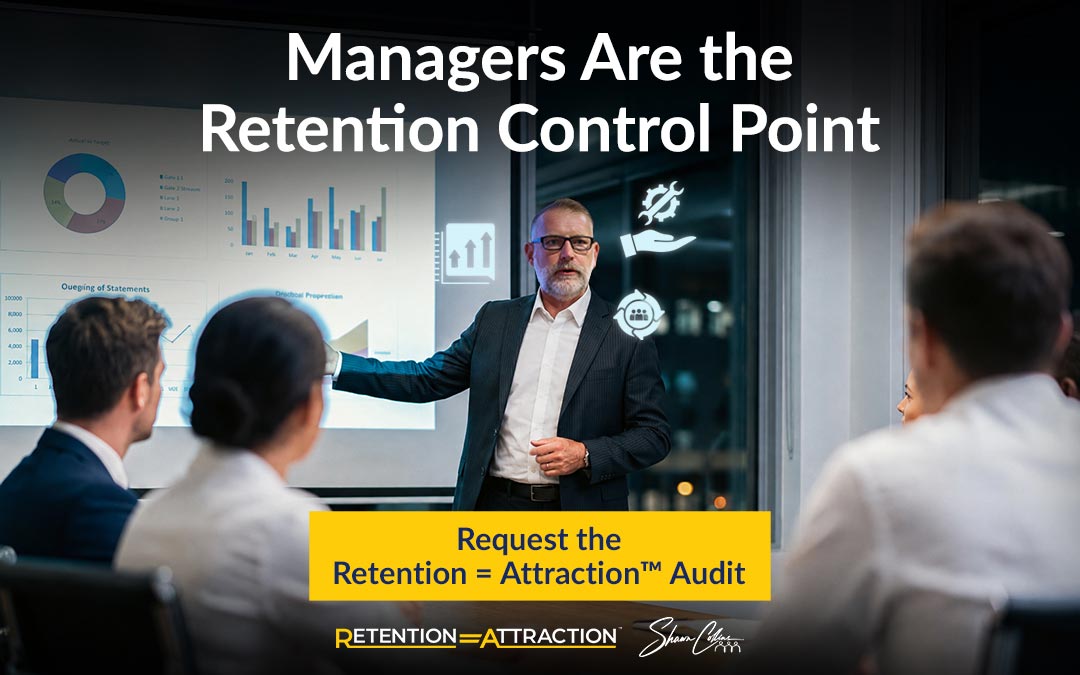
If you want to understand why people stay or leave, look closely at the person they experience every day.
That person is often the manager.
Owners and executives set direction. HR builds programs. Senior leaders establish expectations. But employees experience most of that through a manager. The manager decides whether expectations are clear, whether feedback happens early, whether support and accountability can exist together, and whether small problems are noticed before they become serious.
That makes manager capability more than a leadership-development issue. It is a retention issue.
Retention Gets Personal at the Manager Level
A company can have a strong mission, good benefits, and a competitive compensation package and still lose good people because their daily experience of leadership is inconsistent.
One manager gives regular feedback and makes expectations clear. Another avoids difficult conversations until a problem becomes serious. One manager challenges people while making it clear that support is available. Another pushes hard without support or provides so much support that accountability disappears.
Employees experience those differences every day.
That is why an owner who wants to improve retention cannot stop at company-level policies. The question has to move closer to the work: What is it like to be led here?
That question matters because manager capability can vary widely inside the same company. You may not have a culture problem everywhere. You may have a manager consistency problem.
The Manager Is Where Strategy Becomes Experience
A strategy can look excellent in a leadership meeting, but employees do not experience the strategy in that meeting. They experience it through conversations, decisions, priorities, feedback, follow-up, and the way their manager responds when something goes wrong.
Consider a company that says it values accountability. The CEO expects managers to address performance issues quickly, but one manager waits three months before addressing a recurring problem because the conversation feels uncomfortable. Another manager addresses every small issue immediately but creates an environment where employees feel watched rather than trusted.
The company has one stated value. Employees are experiencing two very different versions of it.
That inconsistency matters because when people cannot predict what leadership will look like from one manager to another, trust becomes harder to build. When trust becomes inconsistent, retention becomes harder to protect.
Manager Capability Is Measurable
“Develop your managers” is too vague to be useful.
If manager capability is going to affect retention, leaders need to identify the behaviors that matter. Do managers set clear expectations? Do they have regular conversations before problems become dramatic? Can they give direct feedback without creating unnecessary defensiveness? Can they challenge performance while maintaining trust? Do they follow up on commitments? Do employees know where they stand?
Those are observable behaviors. They can be discussed, coached, reinforced, and measured.
That is much more useful than sending managers to another generic leadership session and hoping something changes.
A Practical Example
Imagine a growing company with 10 managers. The company has good people, but turnover is concentrated in two teams. The owner initially sees the problem as an employee-engagement issue, so HR suggests another engagement survey.
The results are not surprising. Employees in those teams report lower confidence in leadership, less clarity, and more frustration with communication.
Now look one level deeper. The two managers have something in common. Neither has a consistent rhythm for one-on-one conversations. Performance conversations happen when something goes wrong, expectations are often assumed instead of clarified, and employees do not know when feedback is coming.
The organization does not necessarily need a massive new retention initiative. It needs to improve what those managers do every week.
Give the managers a repeatable conversation rhythm. Clarify what good support and challenge look like. Create expectations around follow-up. Coach the managers on the behaviors. Then measure whether employees experience a difference.
That is manager capability becoming practical.
Start by identifying the pattern.
If turnover is concentrated around certain teams, managers, or parts of the employee experience, do not assume you need a bigger program first.
Start by finding the pattern.
Support and Challenge Have to Work Together
One of the most common manager problems is imbalance.
Some managers are high on support and low on challenge. They care about people, but they avoid the conversations that would help those people grow. Other managers are high on challenge and low on support. They push for results, but employees experience the leadership as pressure rather than development.
Neither pattern produces the leadership experience most organizations want.
People need to know that their manager cares about them and expects something from them. That combination builds trust without removing accountability. It also gives managers a practical way to think about difficult conversations.
Instead of asking, “How do I avoid upsetting this person?” the better question is, “What does this person need from me right now to succeed?”
Sometimes the answer is support. Sometimes it is challenge. Often it is both.
Managers Need Rhythm, Not Just Training
Training can introduce an idea. Rhythm is what turns an idea into behavior.
A manager who learns how to give better feedback but never schedules the conversations will not create much change. A manager who understands the importance of clarity but continues to leave expectations unstated will not create consistency. A manager who learns about accountability but only addresses problems when they become urgent will continue operating reactively.
The goal is to make good leadership behaviors repeatable.
That means regular one-on-ones, clear expectations, consistent follow-up, early feedback, predictable conversations, and time to reflect on what is working and what is not. That is how manager development moves from an event into an operating habit.
Look for Churn Concentration
One of the most useful questions an owner can ask is not simply, “What is our turnover rate?”
Ask: Where is turnover happening?
If turnover is significantly higher on one team than another, that difference deserves attention. If new employees leave under one manager faster than they do under another, investigate. If employees repeatedly cite the same leadership behavior in exit feedback, listen to the pattern.
If one department consistently has lower confidence or higher frustration, do not hide that signal inside a company-wide average.
A company-wide number can tell you that there is a problem. Concentration can help you find where to look.
What Stronger Managers Give the Business
Better managers do more than make employees happier. They create clearer execution, reduce avoidable confusion, catch problems earlier, make expectations easier to understand, help employees grow, and create stronger communication between people and departments.
For an owner, that consistency matters.
A company should not depend on a handful of exceptional managers to create a healthy employee experience. If one great manager can retain people, develop talent, and create a strong team, the question becomes: How do we make those leadership behaviors more repeatable across the organization?
That is the manager capability conversation.
100X Leader Starts With Repeatable Leadership
The 100X Leader work fits this problem because the goal is not simply to give managers more information. It is to help leaders develop habits that multiply their impact through other people.
A manager who can communicate clearly, support and challenge appropriately, follow through, and build trust is influencing more than an individual employee. That manager is shaping the environment of an entire team.
When those habits become more consistent across managers, the organization becomes less dependent on heroic leadership.
The goal is not perfect managers. The goal is managers who can reliably create the conditions people need to do good work and stay engaged in it.
Owners Should Stop Treating Managers as the Middle
Managers are often treated like the middle layer of an organization. They are expected to carry leadership decisions downward and employee concerns upward.
That description misses their real role.
Managers are one of the primary places where the organization becomes real for employees. They are not simply passing information through. They are shaping the experience.
That makes manager capability a business priority.
If you want stronger retention, you need managers who can consistently lead people well. If you want stronger attraction, you need employees who have experienced that leadership and can speak credibly about it.
Retention and attraction are connected because the experience inside the organization eventually becomes part of the story outside the organization.
Identify What is Happening Before Deciding What to Fix
If you know turnover is concentrated in certain teams, roles, or leadership relationships, start by identifying what is happening before deciding what to fix.
The Audit is the first step toward finding the leadership and organizational patterns that may be creating unnecessary retention risk.
About the Author
Shawn Collins
Shawn Collins is a leadership strategist, keynote speaker, and founder of EXTEND GROUP. Since 1997, he has helped organizations strengthen leadership, improve communication, and build cultures that drive performance. As a GiANT-certified consultant in 5 Voices, 100X Leader, and 5 Voices for Teams, Shawn equips leaders with practical tools to create alignment, increase retention, and make strategy stick.