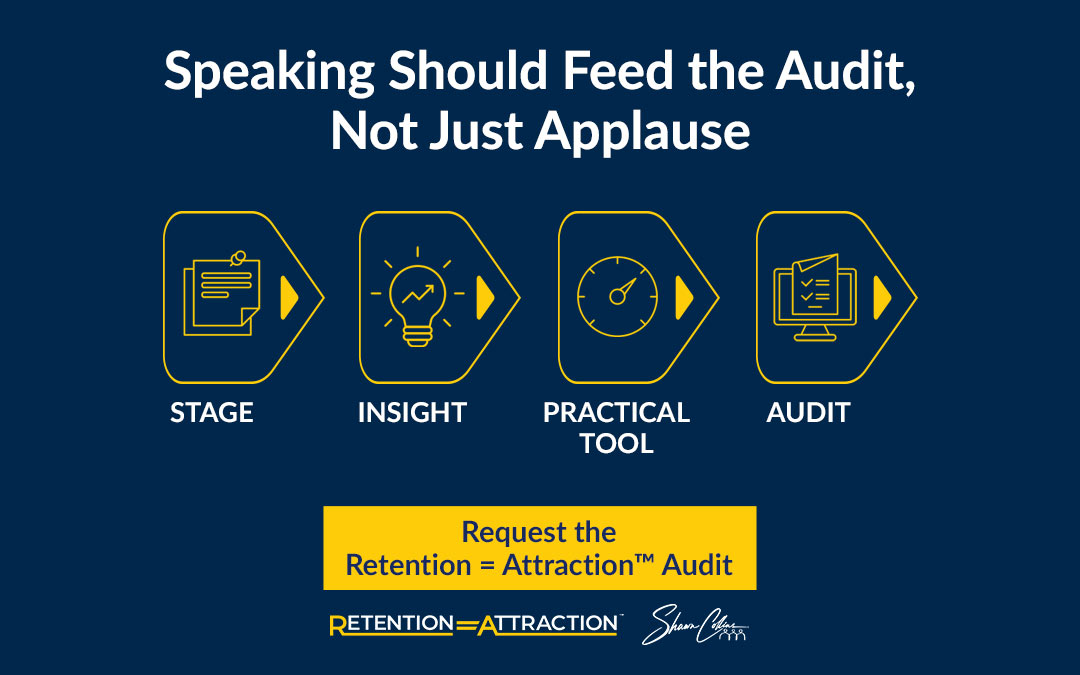
The strongest retention proof does not begin with the result. It begins with the business problem leaders were trying to solve. A strong talk should give leaders a practical next step that turns insight into action.
A good talk should create a next decision
Speaking has value when the audience can take something into Monday morning. Insight alone is not a sales process. If a leader recognizes a retention problem during a talk, the follow-up should give that leader a clear way to understand the problem in their own organization.
Do not close with a vague invitation
“Let’s connect” is easy to say and easy to ignore. A stronger close names the next step. For Retention = Attraction™, that next step is the Audit. The Audit gives leaders a practical entry point after the talk without forcing them to commit to a larger program before they understand the problem.
Connect the talk to the business problem
The follow-up should remind leaders what the talk was about and why it matters to their business. A retention conversation might focus on manager habits, communication, trust, role clarity, or execution rhythm. The follow-up should carry one of those ideas forward rather than introducing a completely new pitch.
Give the audience something they can use
The best speaking follow-up reinforces a practical tool, question, or diagnostic prompt. It helps the audience move from “that was interesting” to “I can see where this may be happening here.” That is the point where authority becomes useful.
If you want to understand where retention risk is showing up before choosing the next intervention, start with the diagnosis.
Make the next step measurable
The Audit creates a bridge from speaking to action. Instead of leaving the audience with inspiration alone, leaders can identify where retention risk is showing up and decide whether a focused play or larger system response makes sense. The talk starts the conversation. The Audit gives the conversation somewhere to go.
A practical example
After a leadership talk on retention, attendees receive a follow-up that names the problem discussed, summarizes the practical tool, and invites them to request the Audit to identify where that issue appears in their organization. The next step is clear instead of leaving the audience with a generic invitation.
What leaders should take away
A useful proof asset should make the next leadership decision clearer. It should show enough of the starting point to establish context, enough of the action to understand what changed, and enough of the movement to make the result credible. It should also be honest about what remains unresolved. That is how Retention = Attraction™ moves from a claim to something leaders can examine, discuss, and act on.
If you are ready to see what the retention patterns in your organization are telling you, start with the Audit.

About the Author
Shawn Collins
Shawn Collins is a leadership strategist, keynote speaker, and founder of EXTEND GROUP. Since 1997, he has helped organizations strengthen leadership, improve communication, and build cultures that drive performance. As a GiANT-certified consultant in 5 Voices, 100X Leader, and 5 Voices for Teams, Shawn equips leaders with practical tools to create alignment, increase retention, and make strategy stick.