When an organization has a retention problem, there is often a temptation to solve it with something big.
A new initiative. A new training program. A company-wide culture effort. Another survey. Another meeting.
But most organizations do not need a bigger initiative first. They need to know what is actually creating the problem and whether a focused change can make a difference.
That is where a quick win has real value.
A focused retention play gives leaders an opportunity to address one specific behavior or rhythm, watch what happens, and determine whether the organization can create visible movement. It might involve improving communication, establishing a better manager 1:1 rhythm, helping leaders recognize how they are showing up under pressure, or addressing another specific behavior that is creating friction.
The point is not to solve everything at once.
The point is to prove that something can move.
That distinction matters because quick wins are not gimmicks. They are the first proof that behavior can change. The August Retention = Attraction™ strategy has been built around that idea: reduce friction, improve manager rhythm, start with one focused play, and measure movement.
But there is an important next question.
What happens after the quick win?
That is where many organizations lose the progress they worked to create.
Movement Is Not the Same as Lasting Change
Imagine a manager who has been struggling with communication.
The manager is capable, experienced, and committed to the company. But conversations with employees tend to happen after something has already gone wrong. Expectations are sometimes assumed instead of clarified. Feedback gets delayed because the manager does not want to create conflict. Small issues become bigger issues because they are not addressed early.
The organization decides to focus on that behavior.
For several weeks, the manager becomes more intentional. Expectations are clearer. Conversations happen sooner. Employees have fewer surprises. The manager starts seeing that some of the frustration was not caused by a lack of effort. It was caused by a lack of rhythm.
That is a quick win.
And it is valuable.
But now suppose the organization simply moves on.
The manager gets busy. Other priorities take over. The conversations become less consistent. The habits that created the original problem begin to return.
The quick win did not fail.
It proved something important.
It proved the behavior could move.
The mistake would be treating that proof as the final result.
The Real Question Is What Needs to Become Repeatable
If a quick win produces better results, the next step is not automatically another workshop.
The next step is to ask what made the improvement possible and what needs to become part of the normal operating rhythm.
That may be shared language.
It may be a manager conversation rhythm.
It may be a clearer expectation around follow-through.
It may be a way for teams to recognize and address communication problems earlier.
Whatever the answer is, the goal is the same: make the better behavior easier to repeat.
This is where the idea of a retention operating system becomes important.
A system does not mean creating more bureaucracy. It means creating enough consistency that the organization does not depend on individual memory, personality, or urgency to produce the behavior you want.
If good communication only happens when Shawn is facilitating a workshop, you do not have a communication system.
If good manager conversations only happen when someone reminds managers to have them, you do not have a manager rhythm.
If teams only address friction after it becomes expensive, you do not have a reliable operating rhythm.
The organization needs a way to keep the behavior alive.
Shared Language Makes Good Behavior Easier to Repeat
One of the strongest ways to make a quick win last is to give people shared language.
When leaders and employees have different definitions of what good communication, accountability, support, challenge, or follow-through look like, every interaction requires interpretation.
That creates friction.
A shared language gives people a common starting point. It does not mean everyone thinks alike. It means people have a better way to understand differences, name problems, and move into useful conversations without making every disagreement personal.
That principle is central to the broader Retention = Attraction™ approach.
The Shawn Collins brand standards describe communication as a habit and emphasize that teams perform better when they have repeatable habits around meetings, decisions, and follow-through. They also emphasize that everyone needs to be heard and that shared language makes listening easier.
That is why shared language is not simply a training concept.
It is part of the operating environment.
When people have language they can continue using after the workshop or pilot ends, the organization has a better chance of preserving the improvement.
Before You Build the Next Initiative, Find the Pattern
The Audit helps identify the patterns creating retention risk so you can determine where a focused play can create movement and what may need to become part of the longer operating rhythm.
Manager Capability Is Where the System Becomes Real
Owners and senior leaders can decide that retention matters. HR can recommend better tools. Leadership teams can agree that communication needs to improve.
Employees still experience the organization through daily leadership.
That makes manager capability one of the most important parts of turning a quick win into a lasting change.
A manager may understand the importance of clear expectations but still struggle to communicate them when the day gets busy. A manager may understand the value of feedback but continue postponing difficult conversations. A manager may care deeply about employees but avoid challenging them because the manager does not want to damage the relationship.
Those are not necessarily motivation problems.
They are often habit problems.
The organization needs to help managers turn good intentions into repeatable behaviors.
That means the work cannot stop with what managers learned. Leaders have to think about where the behavior will show up during the normal week.
When will the conversation happen?
What expectation will be reinforced?
How will the manager follow up?
What happens when the behavior starts slipping?
Those questions turn an idea into an operating rhythm.
A Quick Win Should Give You Something to Build On
A useful quick win should produce more than a good feeling.
It should give leadership something to learn.
Maybe communication improved when managers had a clearer framework for difficult conversations. Maybe a predictable 1:1 rhythm surfaced problems earlier. Maybe a team became more productive after leaders became more aware of how they were working and communicating under pressure.
Those observations matter.
They tell you where the organization may have leverage.
The next step is to build around what you learned rather than simply moving to another topic.
That is one reason the August strategy ends with the August 31 bridge into September. August is focused on making quick wins real. September moves into the longer system conversation around shared language, manager capability, trust, role clarity, and execution rhythm.
The sequence matters.
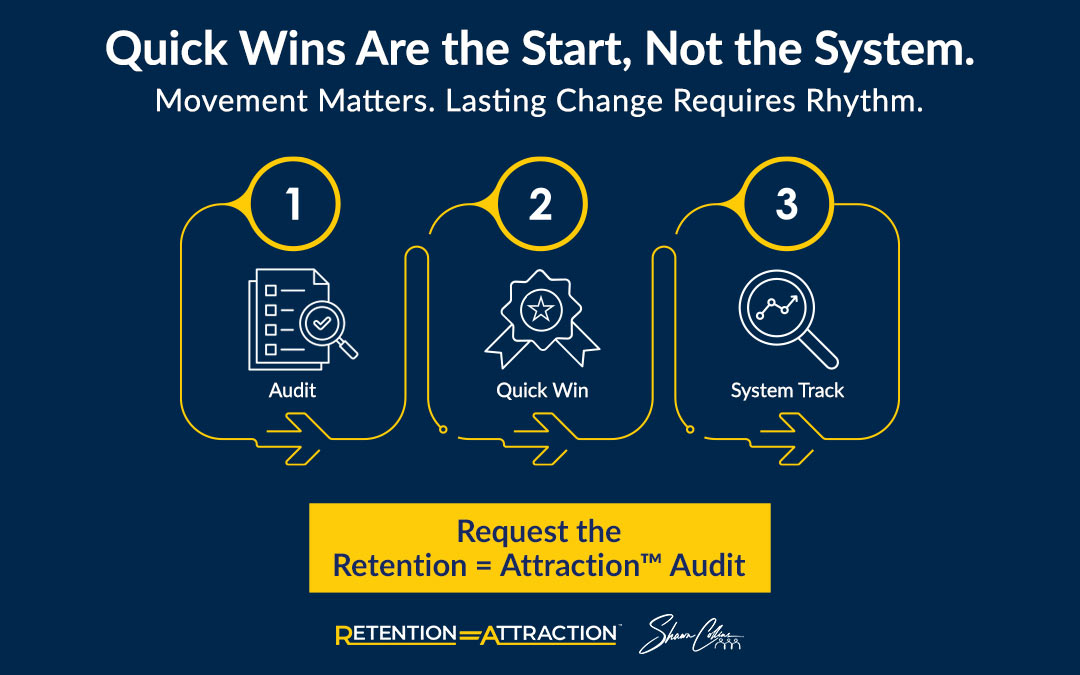
Audit. Quick win. System.
The Audit helps identify the leak.
The quick win shows that movement is possible.
The system changes the habits that keep creating the leak.
Do Not Confuse Activity With Progress
There is another trap worth avoiding.
Organizations can become very busy working on retention without actually improving retention.
Managers attend a workshop. Teams complete an exercise. A new framework is introduced. A leadership meeting happens. A survey is sent.
Those are activities.
The more important question is what changed because of them.
Are managers having better conversations?
Are expectations clearer?
Are problems being surfaced earlier?
Are teams experiencing fewer misunderstandings?
Are employees experiencing more consistency from their leaders?
Are the same retention risks showing up less often?
Those are much stronger indicators of movement.
This is why the August plan includes measurement rather than simply activity. The plan calls for before-and-after measures around retention risk, communication, manager rhythm, and team confidence.
The goal is not to make a quick win look successful.
The goal is to learn whether something actually moved.
What Owners Should Do With a Successful Quick Win
If you have completed a focused retention effort and you can see improvement, resist the urge to immediately declare victory.
Instead, ask three questions.
What changed?
Identify the behavior or condition that improved.
Why did it change?
Determine what made the movement possible. Was it shared language? A manager rhythm? Better expectations? More consistent follow-through?
What needs to continue?
Decide which behavior needs to become part of the organization’s normal rhythm.
That final question is the one that turns a pilot into a longer-term improvement.
If the organization needs a behavior to continue but has no mechanism for reinforcing it, the improvement remains vulnerable.
September Should Not Start From Scratch
The point of a strong August is not to finish August with another completed campaign.
It is to enter September with evidence.
Evidence that focused work can create movement.
Evidence that certain behaviors matter.
Evidence that leaders can change how they communicate, lead, and work with their teams.
That evidence gives you a better starting point for the next conversation.
Instead of asking, “What training should we do next?” you can ask, “What needs to become part of the way we operate?”
That is a much more useful question.
It also changes the way leaders think about investment. Rather than buying isolated events, you begin looking at the combination of shared language, manager capability, and operating rhythm that can support healthier behavior over time.
Retention Requires Repeatability
No organization can prevent every employee from leaving.
People move. Circumstances change. Careers change.
But leaders can influence the patterns that make staying easier or harder.
They can improve communication.
They can create better manager rhythms.
They can clarify expectations.
They can build shared language.
They can create an environment where problems are addressed before they become expensive.
And when those behaviors become repeatable, the organization becomes less dependent on heroic individual leaders.
That is the larger opportunity behind Retention = Attraction™.
You are not simply trying to stop someone from leaving.
You are building an organization where the leadership experience is consistent enough that good people have more reasons to stay.
That is why the quick win matters.
But it is only the start.
Build on the Movement
If a quick win has shown you that behavior can change, the next question is what it will take to make that change last. Do not guess. Start by understanding the retention patterns in your organization, then decide which behaviors need a focused intervention and which need to become part of the operating rhythm.

About the Author
Shawn Collins
Shawn Collins is a leadership strategist, keynote speaker, and founder of EXTEND GROUP. Since 1997, he has helped organizations strengthen leadership, improve communication, and build cultures that drive performance. As a GiANT-certified consultant in 5 Voices, 100X Leader, and 5 Voices for Teams, Shawn equips leaders with practical tools to create alignment, increase retention, and make strategy stick.