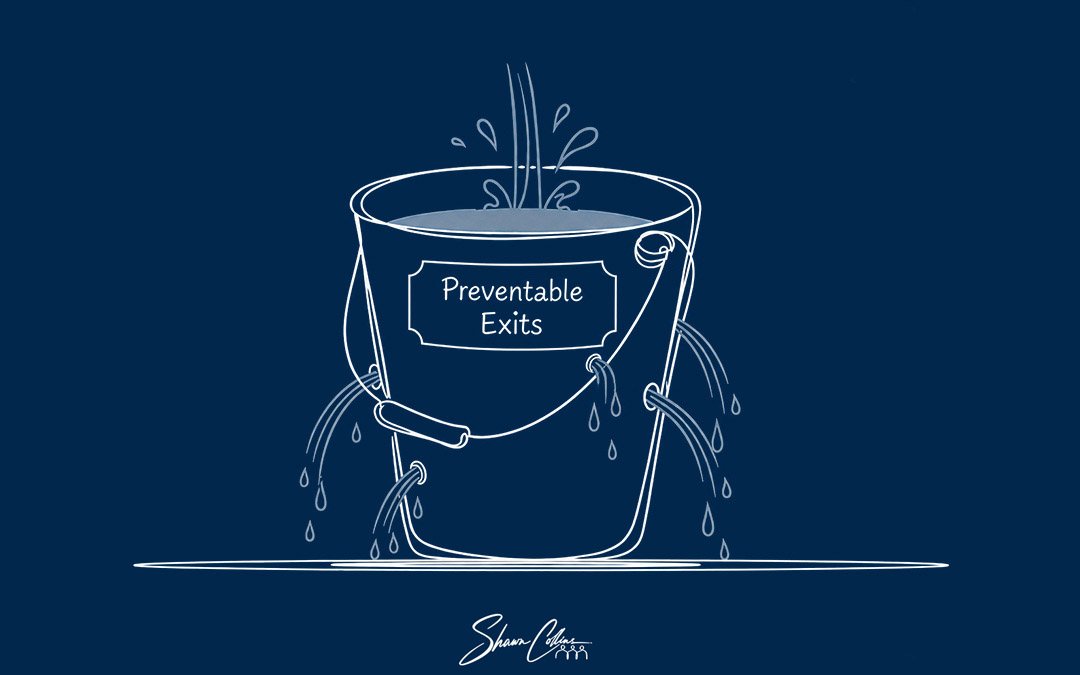
Most owners do not experience turnover as a statistic. They experience it as late nights, stretched managers, and profit that never quite matches the potential they see on paper.
A good person leaves. Someone else covers the work. Deadlines move. Customers feel the wobble. Then the cycle repeats. After a while, it starts to feel normal, almost like a cost of doing business.
The data says something different.
Why Turnover Is a Leak, Not a Line Item
When an employee walks out the door, the bill starts stacking immediately. Recruiting time. Posting fees. Interview cycles. Manager hours redirected from production to coverage. Overtime for the people who absorb the gap. Training time for the replacement. Mistakes while the new hire learns. Lost momentum on projects that were just gaining traction.
Work Institute offers a conservative way to estimate this cost. Take the departing employee’s base salary and multiply it by roughly 33 percent. That is the all-in replacement cost. Not for a luxury hire. For a normal one.
If your average salary is 48,000 dollars, that conservative turnover cost is around 16,000 dollars per exit. Now stack that across the last 12 months. How many people did you replace? How many times did your managers start over with another new hire?
For a 50-person company running 20 percent annual turnover, that is 10 exits a year. At 16,000 dollars per exit, the annual leak is 160,000 dollars. That is before you account for the drag on team morale, the customer experience inconsistencies, or the strategic projects that never launch because the team is always rebuilding capacity.
Turnover is not overhead. It is a leak. And most owners are pouring more water into the bucket without fixing the holes.
The Questions to Ask Before You Spend Another Dollar on Recruiting
Before you post another job or call another recruiter, ask three questions.
First, do you know your actual turnover cost, or are you guessing? Most owners can tell you what they spend on job postings. Very few can tell you what preventable turnover is costing them in total. If you do not measure it, you are choosing to stay confused.
Second, where is churn concentrating? Is it first-year exits? Is it a specific department or shift? Is it tied to one or two managers whose teams keep turning over? Turnover is rarely uniform. It clusters. And the clusters tell you where the leadership and culture issues live.
Third, what are you doing to prevent the next exit before it happens? Competitive pay helps. But people do not leave paychecks first. They leave experiences. Unclear expectations. Uneven managers. Weak communication. Constant rework. Work Institute data show that preventable turnover, driven by career stagnation, work-life balance issues, and management failures, accounts for the majority of exits. That makes turnover a leadership issue long before it becomes a staffing issue.
What Happens After the Retention = Attraction™ Audit
The Retention = Attraction™ Audit is built to answer those three questions in plain math and give you a one-year roadmap.
You bring a short set of inputs: headcount, average pay, rough turnover rate, basic customer data. The Audit produces three things. A clear, conservative estimate of what turnover is costing you each year. Scenarios that show what changes if you improve retention by just a few points, not perfection. And a one-year plan that focuses on leadership habits, culture health, and operating rhythm instead of chasing perks.
For a 25 to 75-employee company, preventing even a handful of exits can protect enough value to fund serious leadership and culture work with room to spare. You do not get that perspective from another inspirational talk. You get it from honest math and a practical plan.
The Audit turns culture into a dollars-and-cents decision. It shows you the break-even threshold. It tells you how many exits you need to prevent for the work to pay for itself. Then you decide.
If your turnover conversations feel repetitive and your managers are stretched thin covering gaps, it is time to quantify what the churn is really costing and see what a few points of retention improvement could do. The math is clearer than you think.
Why This Matters Now
Retention is the attraction strategy. When you lead well, people stay. When people stay, your results do your recruiting for you. Your best people refer other good people. Your customers experience consistency. Your brand stops being a revolving door story and starts being a place people want to join.
If retention is not a priority, attraction becomes a tax. You will keep paying recruiters, keep running ads, keep absorbing the margin drag of constant rehiring, and keep wondering why growth feels heavier than it should.
Turnover is not normal. It is a leak you can measure, manage, and fix.
Stop guessing about what turnover is costing and start calculating what you are leaking every year. The Retention = Attraction™ Audit gives you the numbers, the plan, and the clarity to act.

About the Author
Shawn Collins
Shawn Collins is a leadership strategist, keynote speaker, and founder of EXTEND GROUP. Since 1997, he has helped organizations strengthen leadership, improve communication, and build cultures that drive performance. As a GiANT-certified consultant in 5 Voices, 100X Leader, and 5 Voices for Teams, Shawn equips leaders with practical tools to create alignment, increase retention, and make strategy stick.