Most owners know exactly what they spend on recruiting. Job postings. Agency fees. Referral bonuses. Interview time. Onboarding costs.
Very few know what they spend on preventable turnover. And even fewer ask the question that matters most: “Am I funding the churn by ignoring the retention side of the equation?”
Before you post another job or call another recruiter, ask yourself these questions. Your answers will tell you whether you are solving the right problem.
Do You Know Your Actual Turnover Cost, or Are You Guessing?
Most owners can tell you their monthly recruiting spend down to the dollar. But when I ask, “What is preventable turnover costing you in total?” I usually get a pause, a guess, or “I know it is a lot.”
If you do not measure it, you are choosing to stay confused.
Turnover cost is not just the recruiter fee or the job posting. It is the training time, the manager hours redirected to coverage, the overtime for people absorbing the gap, the mistakes while the new hire ramps, the lost momentum on projects, and the drag on team morale.
A conservative way to estimate the cost of employee turnover: take the departing employee’s base salary and multiply it by roughly 33 percent. That is the all-in replacement cost. For a 50,000 dollar salary, that is about 16,500 dollars per exit. For a 70,000 dollar role, it is over 23,000 dollars.
Now multiply that by the number of people who left last year. That is your annual churn cost. If you are running 20 percent turnover on a 50-person team, you are replacing 10 people a year. At an average of 16,500 dollars per exit, that is 165,000 dollars annually. Before you account for the strategic work that never happened because the team was always rebuilding.
Recruiting spend is visible. Turnover cost is invisible. But invisible does not mean free.
Where Is Churn Concentrating, and What Does That Tell You?
Turnover is rarely uniform. It clusters. And the clusters tell you where the real problem lives.
Is it first-year exits? If so, your onboarding, role clarity, or hiring process is broken. You are bringing people in the front door and losing them before they are productive.
Is it concentrated in one department or under one manager? If so, you do not have a company-wide culture problem. You have a leadership problem in a specific place. And no amount of recruiting will fix a manager who is burning through people.
Is it happening after a specific tenure milestone, like 18 months or two years? That usually signals a career development or growth issue. People hit a ceiling, see no path forward, and leave.
The clusters tell you the story. But you have to look at the data to see them. Most companies treat every exit the same. They backfill the role and move on. That approach guarantees you will keep funding the same leak over and over.
Are Your Managers Consistent, or Is Every Team Running a Different System?
People do not quit companies first. They quit managers.
If one manager runs tight expectations, clear communication, and consistent feedback, and another manager is reactive, vague, and avoids hard conversations, your culture is not one thing. It is a coin flip based on who someone reports to.
Manager consistency is one of the highest-leverage employee retention strategies you can implement. But most owner-led companies promote good individual contributors into management roles without ever teaching them how to lead. No training. No framework. No shared language. Just a title and an expectation that they will figure it out.
Then turnover starts climbing under the untrained manager, and the company calls it a hiring problem instead of a leadership problem.
Before you spend another dollar on recruiting, ask this: Do your managers know how to have a hard conversation? Can they set clear expectations and hold people accountable without drama? Do they have a consistent rhythm for one-on-ones, feedback, and coaching? Or is every manager running their own system?
If the answer is “every manager runs their own system,” you are going to keep losing people no matter how much you spend on recruiting.
What Are You Doing to Prevent the Next Exit Before It Happens?
Competitive pay matters. But people do not leave paychecks first. They leave experiences.
They leave because expectations are unclear. They leave because they feel unsupported. They leave because their manager is burned out and it is spilling over onto the team. They leave because communication is inconsistent, feedback is rare, and no one ever told them what good looks like.
Work Institute data show that preventable turnover, driven by factors like career development, work-life balance, and management quality, accounts for the majority of exits. That means most of the churn you are experiencing is leadership-influenced, not market-driven.
The companies that win on retention are not the ones with the best perks or the highest pay. They are the ones with the clearest leadership, the most consistent managers, and the simplest operating rhythms.
So before you post another job, ask: What are we doing proactively to retain the people we already have? Are we investing in manager training? Are we creating clarity around roles and expectations? Are we building an operating rhythm that prevents burnout instead of causing it?
If the answer is “not much,” then recruiting is just a tax you keep paying to cover a leak you refuse to fix.
If you are tired of paying the same recruiting bill over and over, it is time to quantify the turnover cost and see what a modest improvement in retention could fund. The Retention = Attraction™ Audit gives you the numbers and the plan.
Why Retention Is the Attraction Strategy
Here is the business case in one line: retention is the attraction strategy.
When you lead well, people stay. When people stay, your results do your recruiting for you. Your best employees refer other strong people. Your customers experience consistency. Your operational quality improves. Your brand reputation shifts from “revolving door” to “place people stay and grow.”
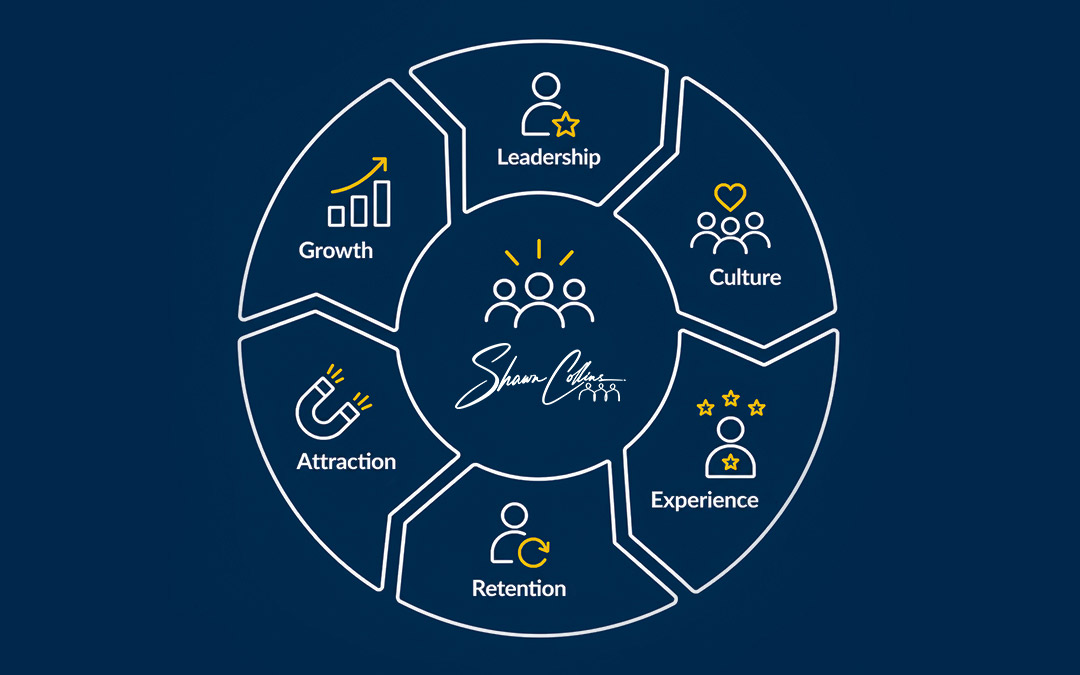
That is the Retention = Attraction™ flywheel. Leadership shapes culture. Culture shapes experience. Experience shapes retention. Retention drives attraction. Attraction lowers your cost to hire and raises the quality of your candidate pool.
If retention is not a priority, attraction becomes a tax. You will keep spending on recruiters, keep running ads, keep absorbing the margin drag of constant rehiring, and keep wondering why growth feels harder than it should.
The answer is not to recruit harder. The answer is to fix the holes in the bucket before you pour in more water.
Stop funding the churn. Start with the questions that matter. The Retention = Attraction™ Audit helps you see what turnover is really costing and where to focus first.

About the Author
Shawn Collins
Shawn Collins is a leadership strategist, keynote speaker, and founder of EXTEND GROUP. Since 1997, he has helped organizations strengthen leadership, improve communication, and build cultures that drive performance. As a GiANT-certified consultant in 5 Voices, 100X Leader, and 5 Voices for Teams, Shawn equips leaders with practical tools to create alignment, increase retention, and make strategy stick.