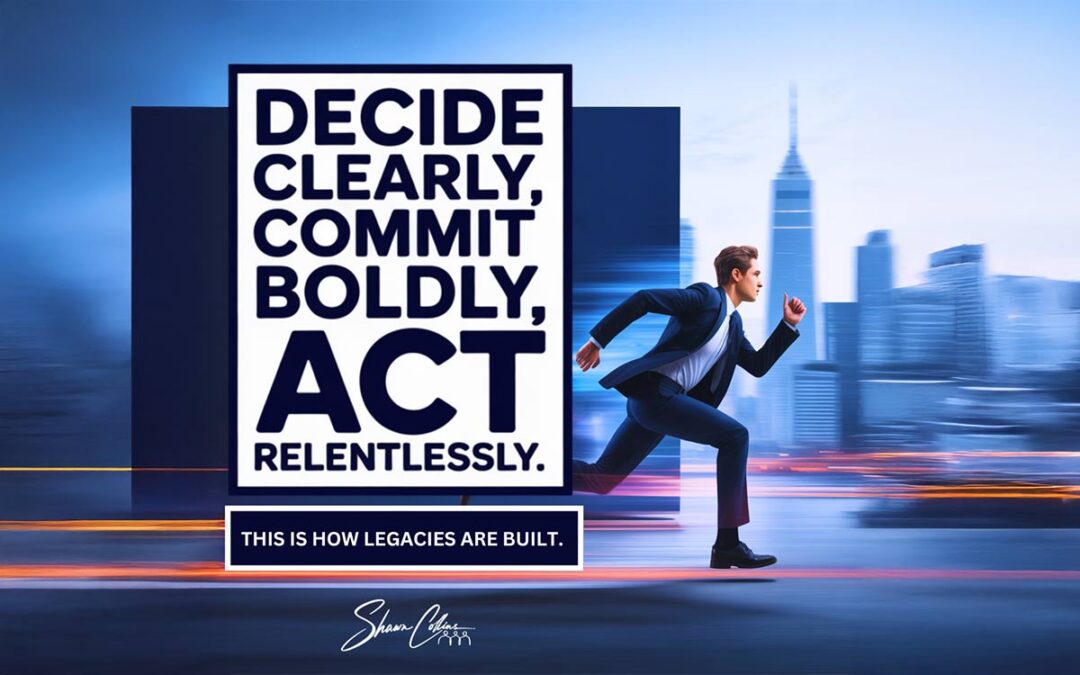
Decide clearly. Commit boldly. Act relentlessly. This is how legacies are built.
If you lead a business with real people, real payroll, and real pressure, you already feel the weight of legacy. You might not use that word, but you feel it when you walk into the office, sit down with a struggling team member, or look at your financials late at night and ask yourself, Is this worth it?
Legacy is what remains when the pressure and noise fall away. It is the culture people live in, the leaders you have developed, and the impact your business has on families and communities long after a project, quarter, or role ends.
Here is the truth. You are building a legacy whether you are intentional about it or not.
The Power Of A Legacy Mindset
A legacy mindset is not about ego, reputation, or your name on a building. It is about stewardship. You have been entrusted with people, resources, influence, and time. What you do with them reveals what you truly value.
For business owners, HR leaders, and entrepreneurs, a legacy mindset does three important things.
- It stretches your time horizon. You stop chasing quick wins that damage trust and start making decisions that hold up over years, not just this quarter.
- It clarifies what matters most. Legacy forces you to define what you want your people to experience and remember about following your leadership.
- It raises your standard of leadership. You stop asking, “Does this work right now?” and start asking, “Would I be proud if my children or my closest friends lived under this culture?”
A legacy mindset changes the questions you ask. You move from, “How fast can we grow?” to, “Can this growth be sustained without burning people out?” You move from, “How do I keep people from leaving?” to, “What kind of culture would people fight to stay in?”
Legacy is not the size of your business. Legacy is the health of your leadership and the culture it creates.
Why Legacy Matters For Owners, HR Directors, And Entrepreneurs
You carry different titles, but you share the same responsibility. You are shaping how people work, relate, and grow every day.
As a business owner, your decisions determine whether people experience work as a burden or a place of purpose and growth. Your legacy is not just revenue, it is the standard you set for how people are treated and trusted.
As an HR director, you are often the guardian of culture. You see the gap between what leaders say and what people feel. Your legacy is the systems, expectations, and practices that either align with your values or quietly erode them.
As an entrepreneur, you are building from the ground up. Habits feel small right now, but they are wet cement. Every choice about communication, accountability, and character will harden into the culture your future team lives in.
Without a legacy mindset, you drift into short-term thinking. You react instead of lead. You tolerate misalignment because conflict feels inconvenient. Over time, that drift becomes your story.
With a legacy mindset, you lead from conviction, not convenience. You understand that culture is not a side project. Culture is your operating system.
The Three Commitments Of Legacy-Building Leadership
Legacy is not a mystery. It is the byproduct of three daily commitments.
- Decide clearly
- Commit boldly
- Act relentlessly
These are not slogans. They are disciplines that shape how you think, lead, and build.
Decide Clearly: Clarity Is A Moral Obligation
Unclear leadership creates anxious teams. When people do not know your expectations, priorities, or decision filters, they start guessing. Guessing breeds politics, frustration, and disengagement.
Clear decisions honor people. They tell your team, “I respect your time, energy, and trust enough to be specific.” In faith terms, clarity is an act of integrity. Double-minded leadership fractures culture long before it shows up in your numbers.
A legacy mindset pushes you to ask:
- What exactly are we saying yes to?
- What are we saying no to, even if it costs us?
- Have I communicated this in a way people can repeat and act on?
When you decide clearly, you create a foundation for alignment, accountability, and real ownership.
Commit Boldly: Half-Hearted Leadership Starves Culture
Clarity without commitment is just talk. Your team has heard enough talk.
Bold commitment is not reckless risk-taking. It is a settled resolve that says, “This is the direction we are going, and I will stand in it, even when it stretches me.”
Leaders who build legacies do not keep escape hatches on every decision. They count the cost, align with their values and vision, then commit with courage. That level of commitment creates stability. It gives your people something solid to lean on when conditions shift.
From a faith perspective, bold commitment grows out of trust. You trust that walking in integrity, even when it hurts, leads to a deeper kind of success than shortcuts ever will.
Act Relentlessly: Consistent Execution Builds Trust
Most organizations do not fail because of lack of ideas. They stall because of inconsistent follow through.
Relentless action is not frantic hustle. It is steady, disciplined execution that lines up with what you said you would do. Over time, this pattern creates a powerful message inside your culture.
Your people begin to think, “When our leaders say something, they mean it. When they set a priority, they follow through. When they miss it, they own it.” That is how trust is built. That is how retention becomes a byproduct of health, not a metric you chase with perks and policies.
Relentless action turns intentions into impact, and values into lived experience.
From Pressure To Purpose
You live with pressure. Revenue, turnover, conflict, performance, all of it sits on your shoulders. A legacy mindset does not remove that weight, but it reframes it.
Instead of asking, How do I survive this season? you begin to ask, How do I steward this season in a way I will be proud of later?
Legacy-minded leaders practice clarity like a discipline, treat culture as their core work, and view every decision as a chance to live out their values in public. They understand that people rarely remember the details of a project, but they do remember what it felt like to follow your lead.
Your legacy is being written in the ordinary days, not just the milestone moments.
Your Next Step
Before you move into tactics, frameworks, and tools, pause and reflect.
- What do you want your people to say about your leadership when you are not in the room?
- Where are you clear, and where are you vague?
- What decision have you been delaying that needs a clear choice, bold commitment, and relentless follow through?
Do not wait for a perfect season to start leading with legacy in mind. It starts with the next decision you make today.
If you are ready to build a culture of clarity, commitment, and action, explore more practical tools and coaching at ShawnCollins.com and CulturebyShawn. Your legacy will not build itself. You are building it right now.
Understanding The Importance Of Clear Decision-Making
Every meaningful legacy rests on a long line of decisions. Not the easy ones, the crowded ones. The days when priorities compete, voices disagree, and the cost of being wrong feels heavy.
If you lead a business, direct HR, or build something from scratch, you live in that tension often. You feel the pressure to get it right, protect your people, and keep the business healthy. That pressure either sharpens your clarity or feeds your hesitation.
Confusion in the leader always becomes confusion in the culture.
When your decisions are slow, vague, or constantly changing, your people feel it. They start to hedge. They wait instead of act. Momentum leaks out of the organization, one unclear decision at a time.
Why Clarity Sits At The Core Of Strategic Decisions
Strategic decisions are not just about what makes sense on a spreadsheet. They sit at the intersection of purpose, people, and performance. That is why clarity matters so much.
Clear decision-making does three important things inside your organization.
- It aligns effort. When a decision is clear, people know what matters now, what can wait, and what no longer deserves their energy. You reduce friction, duplicate work, and quiet the noise.
- It builds trust. Even if people do not fully agree, they can respect a decision that is explained, grounded in values, and consistent with how you have led before.
- It accelerates execution. The faster your team understands the decision, the faster they can move. Clarity shortens the gap between “We decided” and “We did.”
From a faith perspective, clarity reflects character. It communicates, “I am not hiding. I am not drifting. I am willing to stand by what I believe is right for our people and our mission.”
How Decision Paralysis Quietly Damages Your Culture
Most leaders are not short on information. They are crowded by it. You might recognize this pattern:
- You gather more data, ask more people, and wait for perfect certainty.
- You delay the decision, hoping conditions will clarify the path for you.
- You live in constant low-level anxiety because nothing is closed, everything is pending.
This is decision paralysis. It rarely looks dramatic. It shows up in small delays, vague timelines, and “We are still thinking about it.” Over time, that pattern trains your team to expect hesitation instead of leadership.
Here is what decision paralysis produces inside a culture.
- Hidden frustration. Your best people want direction. When decisions drag, they feel stuck and begin to disengage.
- Shadow decision-makers. If you do not decide, someone else will. Mid-level leaders and informal influencers fill the vacuum, often without alignment.
- Risk avoidance. People learn that bold moves get stuck in limbo, so they stop bringing them. Initiative dries up.
Indecision is still a decision. It communicates, “We value safety over progress, comfort over clarity.” That message shapes behavior more than any slogan on a wall.
Mindset Shifts That Support Clear, Confident Choices
Clear tools help, but clarity starts in your mindset. If you want to decide more clearly, you have to think differently about what a “good decision” really is.
1. From “No Risk” To “Known Risk”
Many leaders wait for the moment when a decision feels completely safe. That moment never comes. Every meaningful choice carries risk.
Healthy decision-making is not about removing risk. It is about naming risk.
A legacy-minded leader asks:
- What are the specific risks if we move forward?
- What are the specific risks if we do nothing?
- Which risk aligns better with our values and long-term vision?
When you compare clear risks, not vague fears, your next step becomes easier to see. You begin to lead with courage, not comfort.
2. From “Perfect Choice” To “Aligned Choice”
Perfectionism quietly kills clarity. If your internal standard is “the one perfect decision,” you will churn, overthink, and delay.
Instead, anchor to alignment. Ask:
- Does this decision align with our stated values?
- Does it support the culture we say we want?
- Does it move us toward the long-term legacy we intend to build?
A decision that aligns with your values and vision may still feel uncomfortable, but it will sit right with your conscience. From a faith lens, that alignment matters more than short-term ease. You are choosing what is right, not just what is convenient.
3. From “Leader As Expert” To “Leader As Clarity-Giver”
You do not need to be the smartest person in the room. You need to be the clearest.
When you see yourself as the expert who must have the right answer, you carry a weight you were not meant to carry. You avoid input because it threatens your identity. This leads to rushed or isolated decisions.
A healthier mindset sounds like this: “My primary job is to gather wisdom, listen well, then decide and communicate clearly.”
That shift frees you to:
- Invite different perspectives without losing authority.
- Admit what you do not know, then decide with the best available insight.
- Own the decision, even when it came from collaborative input.
Your team does not need you to be flawless. They need to know where you stand and how to move with you.
4. From “Delayed Decision” To “Time-Bound Decision”
Open loops drain energy. When you let decisions sit with no clear decision date, they occupy mental space for you and everyone around you.
Instead, create a simple habit: every meaningful decision gets a time boundary.
- Define what you still need to know.
- Set a specific date to decide after gathering that information.
- Communicate that date to the people affected.
When you hit the date, you decide, even if you wish you had more certainty. This simple discipline sends a message to your culture, “We do not drift. We move.”
5. From “Protect My Image” To “Steward My Influence”
Fear of being wrong keeps many leaders stuck. The deeper fear is often about identity. “If this fails, what will people think of me?”
Legacy-minded leaders see their role differently. Their question becomes, “How do I steward the influence I have been given?” That focus shifts you from image management to faithful leadership.
When you view decisions as stewardship:
- You seek what is good for the people and the mission, not what protects your ego.
- You can admit mistakes and course-correct without shame.
- You model humility and courage, which strengthens the culture around you.
From a faith perspective, this is where peace comes from. You are not chasing the approval of every voice. You are aiming to lead with integrity before God and the people entrusted to you.
Clarity As A Daily Discipline
Clear decision-making will never feel convenient. It will pull you into hard conversations, trade-offs, and uncomfortable honesty. That is why most leaders drift back into vague commitments and slow choices.
But if you want to build a legacy of trust and health, clarity is not optional. Clarity is a discipline.
Here is a simple reflection you can use before your next significant decision:
- What exactly are the options on the table? Write them clearly.
- Which option aligns best with our values, culture goals, and long-term vision?
- What risks am I actually afraid of, and which of those are about my image instead of our mission?
- By when will I decide, and how will I communicate that decision in a way people can repeat?
Your organization will only be as clear as you are willing to be. Decide to lead with clarity, and you will give your team something far more valuable than short-term comfort. You will give them direction, stability, and a culture they can trust.
In the next section, we will turn this mindset into practical techniques you can use to sharpen every major decision you face. If you are ready to deepen this work inside your organization, explore the tools and coaching available through ShawnCollins.com and CulturebyShawn, and begin practicing clarity as a daily leadership habit.
Techniques To Improve Decision Clarity
Mindset gives you the foundation. Techniques give you handles. If you want clearer decisions, you need simple, repeatable tools that take the guesswork out of priority, risk, and alignment.
Think of these techniques as your leadership dashboard. When pressure rises and noise grows, you can come back to these few questions and frameworks to steady your thinking and lead with conviction.
1. Use A Simple Priority Filter
Most leaders do not struggle with too few options. They struggle with too many. A clear priority filter cuts through that fog.
Build a short, repeatable set of questions that every significant decision must pass through.
Your filter can include prompts like:
- Does this decision move us closer to our long-term vision, or is it just a short-term win?
- Does it strengthen or weaken the culture we say we want?
- Does it serve our people and customers with integrity?
- Do we have the leadership capacity to execute this well right now?
Once you define your filter, use it with discipline.
- Write the filter. Keep it visible for you and your senior team.
- Run options through it. Do not just think it through in your head, talk it out or capture it on a page.
- Score or rank options. Use a simple scale, for example: high, medium, low alignment with each question.
Patterns will emerge. Some decisions almost automatically move to the top because they pass cleanly through your filter. Other options consistently show poor alignment. Clarity grows when you see those patterns on paper instead of just feeling them in your gut.
2. Separate “Mission Critical” From “Nice To Have”
Not every decision deserves the same energy. When you treat every choice like a mission critical moment, you drain yourself and your team.
Create three clear categories for decisions inside your organization.
- Category 1: Mission Critical. Decisions that directly affect your core purpose, financial stability, or culture health.
- Category 2: Strategic Support. Decisions that influence efficiency, scalability, or long-term positioning but do not threaten the core in the short term.
- Category 3: Operational Preference. Decisions about preference, style, or minor process improvements.
Once you categorize, match the level of process to the level of impact.
- Mission Critical. Slow down enough to use full frameworks, gather key voices, and review alignment carefully.
- Strategic Support. Use a lighter version of your frameworks with tighter timelines.
- Operational Preference. Delegate whenever possible, and give clear guardrails so others can decide.
Clarity grows when you stop treating minor decisions with major drama. This discipline also develops your people, because you release them to own the lower-level calls while you focus on the ones that truly shape legacy.
3. Practice Structured Risk Assessment
Fear lives in the vague. Risk becomes manageable when you name it and structure it.
Use a simple risk assessment template for significant decisions. Create two short lists for each option.
- List 1: Risks If We Act. Capture specific risks related to finances, people, culture, reputation, or operations.
- List 2: Risks If We Do Not Act. Capture the cost of delay, missed opportunities, or cultural impact if you stay where you are.
Then ask three questions for each identified risk:
- How likely is this? Use language like low / medium / high.
- How costly would this be? Again, low / medium / high is enough to start.
- What is one step we can take to reduce or prepare for this risk?
This approach creates clarity for you and your team.
- You stop treating all risks as equal.
- You see that inaction carries real risk too.
- You move from fear to stewardship, because you are planning, not panicking.
From a faith perspective, this honors the responsibility you have been given. You are not pretending risk does not exist. You are facing it with honesty and wisdom.
4. Align Every Decision With Values And Vision
Values and vision only matter if they shape your choices. Decision clarity improves when you force alignment into the conversation, not just the annual planning retreat.
Create a simple “Values and Vision Check” you can use in any meeting where you are choosing a direction.
- Restate the vision. In one or two sentences, answer: Where are we trying to go over the long term?
- Restate your top values. Choose a short list, for example: integrity, ownership, excellence, care, or another set you already use.
- Ask alignment questions for each serious option.
- Does this option clearly move us toward the vision?
- Which stated values does it support, and how?
- Does this option violate or compromise any value, even slightly?
Then create a simple summary statement for the option you choose. For example:
“We are choosing Option [X] because it moves us toward [vision statement] and expresses our values of [value 1] and [value 2]. We are accepting the trade-off of [cost or sacrifice] because it maintains our integrity.”
You do not have to share this exact language with everyone, but having it written gives you a clear anchor. When pressure mounts or people question the decision, you come back to this alignment, not to emotions or politics.
5. Use Time-Boxed Decision Cycles
Clarity rarely comes from more thinking. It often comes from a clear decision cycle that tells everyone, “Here is how and when we decide.”
For major decisions, create a simple time-boxed cycle with four stages.
- Clarify The Question.
Write the decision question in one sentence. For example: “Should we [action] by [timeframe]?” If you cannot write the question clearly, you are not ready to decide. - Gather Input.
Identify whose voices you need, and by what date you will gather their insight. Use focused questions instead of open-ended requests for opinion. - Decide By A Stated Date.
Set a clear decision date and communicate it. “We will decide on [topic] by [date].” Hold yourself to it unless major new information appears. - Communicate In A Single Message.
When you decide, share one clear message that covers: what we decided, why we decided it, how it connects to our values and vision, and what happens next.
This cycle does not add bureaucracy. It reduces swirl. People know the process, the timing, and what to expect. That predictability builds trust, especially in seasons of change.
6. Clarify Roles With The “Who Decides What” Map
Many decisions feel cloudy because no one knows who actually owns the call. Shared responsibility sounds kind, but it often creates shared confusion.
Create a simple “Who Decides What” map for your leadership team and key functions.
- List major decision types. For example: hiring for key roles, budget allocation above a certain amount, policy changes, product direction, or culture commitments.
- Assign an owner. Name the person or role that has final say for each decision type.
- Clarify input expectations. Identify who must be consulted before the owner decides, and who simply needs to be informed after the decision.
You can use a simple framework with three levels of involvement.
- Owner. The person who has the responsibility to decide and own the outcome.
- Consulted. Voices who provide input that the owner should consider.
- Informed. People who need to know the decision once it is made.
When everyone knows their role in each type of decision, meetings become sharper. People stop lobbying in circles and start contributing where they add real value. This not only improves clarity, it also reduces drama and hidden power struggles.
7. Use Communication Codes To Close The Loop
Even good decisions feel unclear when communication is sloppy. You can improve decision clarity simply by naming which stage of the conversation you are in.
Adopt a communication code for decision-related conversations. For example, any time you discuss a topic, label the moment with a simple phrase.
- “I am brainstorming.” You are exploring ideas, no decision is being made yet.
- “I am seeking input.” You intend to decide soon and want focused feedback.
- “I am deciding.” You are ready to choose and will communicate that choice.
- “I have decided.” The decision is made, and you are now moving to execution.
Teach your team to use the same language with each other. This simple code removes a lot of unspoken anxiety. People know whether they are in a creative conversation or a commitment moment. That clarity protects trust and prevents the common complaint, “I thought we already decided this.”
8. Anchor Your Decisions With Character Questions
Technical tools matter, but your character still sits at the center of every decision. Legacy-minded leaders use a few grounding questions to check their heart before they choose a direction.
Before you finalize a significant decision, ask yourself:
- Am I choosing this for the good of the mission and the people, or mainly to protect my image?
- Have I been honest about the trade-offs, or am I hiding the hard parts?
- If the people I respect most saw this decision and the way I made it, would I feel at peace?
- Does this reflect the kind of leader I believe God is calling me to be?
These are not abstract questions. They anchor you when the pressure to compromise is real. They bring your faith, values, and legacy back into the room when short-term comfort tries to take the lead.
Your Next Step
Decision clarity does not come from more information. It comes from better structure and stronger character, practiced consistently.
- Choose one priority filter question you will start using for every significant decision this week.
- Pick one decision on your plate right now and run it through the risk assessment template.
- Schedule time with your leadership team to map “Who Decides What” for your top decision categories.
You do not need twenty tools. You need a few that you actually use. Start small, practice daily, and watch how clarity begins to spread through your culture. As you grow these habits, the next step is to match them with bold commitment, so your clear decisions translate into focused, confident movement.
The Role Of Bold Commitment In Leadership
Clear decisions set your direction. Bold commitment keeps you from drifting when the wind changes.
Many leaders do the hard work to decide, then quietly leave the back door open. They keep alternate plans in their mind, soften their language with the team, or wait to see how people react before they fully own the choice.
Your culture feels that hesitation. And it responds to what you are committed to, not just what you talk about.
Why Commitment Matters After The Decision
Once you decide, the real leadership work begins. Commitment is what turns a choice on paper into a lived reality inside your organization.
Bold commitment matters for at least three reasons.
- It creates stability. When you stand firmly behind a decision, your team can orient around it. They stop re-arguing the past and start building the future.
- It converts clarity into courage. People may still feel nervous about the direction, but your settled commitment gives them the courage to step in with you.
- It sets the tone for ownership. When you own the decision, others follow your lead and own their part in the execution.
Without that level of commitment, every decision stays fragile. You will revisit it in meetings, circle around it in hallway conversations, and invite quiet resistance instead of active alignment.
Indecisive commitment is just as damaging as unclear decisions. Your people want to know, “Are we really doing this, or is this just another idea that will fade?” Your answer shows up not in your words, but in your level of commitment.
How Bold Commitment Drives Momentum
Momentum does not appear by accident. It grows when three things line up: clarity, commitment, and consistent action. Commitment is the bridge between “We decided” and “We are moving.”
Here is how bold commitment accelerates momentum inside your organization.
- It focuses energy. Commitment cuts off competing options. When you stop entertaining every alternate route, you free up energy to drive in one direction with force.
- It simplifies decisions downstream. Once the main direction is truly set, smaller choices become easier. Your team can say, “Since we committed to [X], the right call here is [Y].”
- It builds emotional resilience. Challenges feel different when the path itself is not up for debate. Instead of asking, “Are we still doing this?” people ask, “How do we solve this?”
Think about it like this.
Clarity points the way. Commitment locks the compass.
When you commit boldly, you send a clear internal message to your team.
- This decision is not a test balloon.
- We are not waiting to see how popular it is.
- We have counted the cost, and we are in.
That message frees your people to act. They no longer need to protect against a sudden reversal. They can engage fully, even if they are still processing the change.
What Bold Commitment Is Not
Some leaders resist strong commitment because they confuse it with stubbornness or arrogance. Bold commitment is very different.
- It is not refusing to course-correct. Healthy commitment keeps the direction firm while staying open to adjust methods and tactics.
- It is not ignoring wise counsel. You should gather input before and even after a decision. Commitment simply means you do not live in constant re-negotiation.
- It is not bulldozing people. Bold does not mean harsh. You can commit with clarity and still lead with empathy and patience.
From a faith perspective, bold commitment looks like trust. You trust that integrity, follow through, and stewardship matter more than your comfort. You commit to the path you believe is right, and you walk it with humility before God and your people.
Practices That Cultivate Courageous Commitment
You do not wake up one morning with bold commitment. You grow it through small, consistent practices that train your heart and your habits.
1. Close The Back Door Publicly
After a clear decision, say explicitly what you are not going to keep open.
- State the decision in simple language.
- Name the main alternatives you are not pursuing.
- Affirm that you will not keep revisiting those alternatives unless major new information appears.
For example, you might say to your leadership team, “We are choosing Direction [A]. That means we are not pursuing [B] or [C]. We will put our full focus into [A] for the next [timeframe].”
By naming what you are closing, you send a message of commitment, not indecision. It honors your team’s time and reduces the constant second-guessing that wears people down.
2. Attach Your Name To The Decision
Bold commitment is personal. Your team needs to hear you say, “I own this.”
Whenever you communicate a major decision, include a simple ownership statement:
- “I take responsibility for this direction.”
- “If this does not work, that is on me, not on you.”
- “I believe this is the right next step for our mission and our people.”
That kind of ownership does two things.
- It builds trust, because people know you will not blame them for a path you chose.
- It invites them to own their part, because they see you modeling accountability from the top.
Ownership at the top is the spark for ownership throughout the culture.
3. Translate Commitment Into Concrete Non-Negotiables
Commitment becomes visible when you define what will and will not change.
After a decision, identify a short list of non-negotiables, then share them in clear language. For example, for any major initiative you can name:
- Non-negotiable outcomes. “This must accomplish [outcome], or we will reassess.”
- Non-negotiable behaviors. “We will stay aligned with [values] in how we execute, even if it slows us down.”
- Non-negotiable time or resource boundaries. “We are willing to invest [boundary], but not beyond that without a new decision.”
These non-negotiables turn vague commitment into visible standards. People can see, measure, and reference them. This clarity gives your managers and HR leaders a framework to support alignment, coach behavior, and address drift.
4. Practice “Courage Before Consensus”
Healthy leaders listen, but they do not wait for universal agreement before they move. If you lead by consensus alone, the boldness will leak out of your culture.
Courage before consensus means you:
- Gather input with humility.
- Weigh that input against your mission, values, and long-term vision.
- Decide and commit, even if some respected voices still disagree.
When you model this, you teach your organization that:
- Disagreement is allowed.
- Respect is required.
- Unity in action matters more than uniformity in opinion.
From a faith lens, this posture reflects a heart that fears God more than people. You value obedience to what you believe is right over the comfort of unanimous approval.
5. Anchor Commitment With A “Why Worth Suffering For”
Commitment always has a cost. Time, energy, attention, relational strain, or short-term pain. If the “why” behind your decision is shallow, you will bail when the cost shows up.
Before you communicate a decision, clarify a reason that is strong enough to carry you through the resistance. Ask yourself:
- Why does this matter for the long-term health of our people and our culture?
- What problem are we faithfully addressing, not just reacting to?
- If this gets hard, what conviction will keep me standing in this choice?
Write your “why worth suffering for” in one or two sentences. Share some version of it with your team. When the pushback comes, return to it. This keeps your commitment rooted in purpose, not in pride.
6. Build Rhythms Of Review Without Reopening The Decision
Bold commitment does not mean blind commitment. You still need to review progress and adjust your approach. The key is to do it in a way that protects the integrity of the original decision.
Set regular check-in points with a clear boundary:
- Use each review to ask, “How are we doing within this decision?” rather than, “Should we undo the decision?”
- Only revisit the decision itself if you see significant new information, moral concerns, or repeated failure that cannot be solved at the tactical level.
- Communicate this review structure to your team so they know when their feedback can shape execution and when the direction itself may be reconsidered.
This rhythm gives your managers and HR leaders confidence. They know the decision is solid, yet they still have a place to raise concerns, offer insights, and improve how you carry it out.
How Bold Commitment Inspires Teams And Stakeholders
People do not follow titles. They follow leaders who are clear, consistent, and courageous.
When you commit boldly:
- Your team feels safer to commit their own energy, because they see you standing firm.
- Your managers have a clear reference point when coaching and aligning their people.
- Your external partners and stakeholders experience you as reliable, not reactive.
Over time, that pattern creates a reputation. People know you as a leader whose word means something. You do not change direction every time pressure increases or opinions shift.
That is part of your legacy. Not perfect decisions, but faithful commitment to the decisions you make, rooted in character and clarity.
Your Next Step
Look at one meaningful decision you have already made this quarter.
- Have you truly closed the back door, or are you still entertaining alternate paths in your mind and in side conversations?
- Have you publicly attached your name to this decision?
- Have you defined and communicated the non-negotiables that show you are serious?
Choose one concrete action you will take this week to deepen your commitment to that decision. Send a clarifying message, define the non-negotiables, or set a clear review rhythm. As your commitment strengthens, you will feel the difference in your culture. Your next move is to match that bold commitment with relentless action, so the path you have chosen turns into visible, sustained progress.
Overcoming Barriers To Commitment
You already know that commitment matters. You feel the difference between a decision you are “trying out” and one you have truly owned. The hard part is not agreeing with the idea of commitment. The hard part is staying committed when fear, uncertainty, and organizational friction start to push back.
Every serious leader carries quiet doubts around commitment. You ask yourself, “What if I am wrong? What if this hurts people? What if I cannot sustain this?” Those questions are human, but if you do not address them with clarity and courage, they will quietly water down every decision you make.
The Hidden Fears That Undercut Commitment
Before you can strengthen commitment, you need to be honest about what resists it inside you. Most leaders face some version of these internal barriers.
- Fear of being wrong. You worry that a bold commitment will expose you if the decision does not work. So you hedge, use soft language, or keep escape routes open.
- Fear of conflict. You know some people will dislike the decision. To avoid tension, you delay, soften, or “half commit” so you can keep everyone comfortable.
- Fear of cost. You see the time, money, and energy this decision will require, and something in you pulls back. You want the outcome, but not the price.
- Fear for your image. You quietly ask, “How will this make me look?” instead of, “What is right for our people and mission?” That shift in focus weakens conviction.
From a faith perspective, these fears often reveal where you place your trust. Are you more anchored in the approval of others, or in your responsibility before God to lead with integrity, even when it is uncomfortable?
You cannot remove fear, but you can dethrone it. Commitment grows when fear is named, faced, and put back in its proper place.
Uncertainty: When “More Information” Becomes A Hiding Place
Wise leaders gather information. The problem comes when “more data” becomes a safe delay tactic instead of a step toward a decision.
You might recognize these patterns in yourself or your team:
- Meetings that end with “Let us get more input” on the same topic, again.
- Decisions that stay in “pilot mode” far beyond a healthy test period.
- Initiatives that start, stall, and never quite get a clear “yes” or “no.”
On the surface, this looks cautious and wise. Underneath, it often reflects a deeper uncertainty about your own judgment or your team’s readiness. That uncertainty slowly erodes credibility.
A healthier approach sounds like this: “We have enough information to make a faithful decision. We will commit, monitor, and adjust as we go.”
That mindset keeps you moving without pretending you control every variable. It treats leadership as stewardship, not prediction.
Organizational Challenges That Weaken Commitment
Even when your heart is ready, your structure might be fighting you. Certain organizational patterns make bold commitment feel almost impossible to sustain.
- Misaligned incentives. If leaders are rewarded for keeping everyone happy in the short term, they will avoid hard decisions that cause temporary discomfort, even if those decisions are right for the long term.
- Unclear authority. If people are not sure who owns a decision, they will resist acting on it. They wait for another voice to weigh in, then another. Commitment dissolves in the fog.
- Culture of re-litigation. If every major decision can be reopened in the next meeting, your organization learns that commitment does not matter. People engage halfway, waiting for the next reversal.
- Low psychological safety. If people are punished for raising concerns or surfacing problems, they will withdraw their honest input. That silence makes you less confident, and your commitment becomes brittle.
Business owners, HR leaders, and entrepreneurs often feel this tension most intensely. You know what needs to happen, but you also see the relational and structural complexity that surrounds every decision.
Healthy commitment requires both personal courage and cultural support. You need resilience inside you, and you need an environment that does not punish conviction.
A Practical Framework To Diagnose Your Commitment Barriers
Use this simple reflection to identify where your commitment is leaking. You can walk through it alone, with a coach, or with your senior team.
- Choose one major decision you have already made or know you need to make.
- Rate your commitment on a simple scale: low, medium, or high. Be honest.
- Ask three questions.
- What am I afraid of if I commit fully to this?
- What am I afraid of if I do not commit?
- Where is our organization structured to support or weaken this commitment?
- Circle the biggest barrier you see, whether internal (fear, doubt, identity) or external (structure, incentives, culture).
- Define one concrete action you can take this week that would increase your commitment by one level on your scale.
Do not chase perfection. Focus on movement. If you move from low to medium, or from hesitant to clear, your team will feel it.
Building Resilience: How To Stay Committed When It Gets Hard
Commitment is easy on announcement day. The test comes on day [insert number], when resistance shows up, the metrics dip, or key people push back.
Resilience is not about gritting your teeth and pretending it does not bother you. It is about building internal and external supports that keep you standing when pressure rises.
1. Pre-Decide Your Response To Resistance
Most leaders are surprised by pushback. They interpret it as a sign they made the wrong call. In reality, any meaningful decision will disturb someone’s comfort or sense of control.
Before you roll out a decision, ask:
- Where is resistance most likely to come from?
- What concerns will be legitimate and need real engagement?
- What reactions will simply reflect discomfort with change?
Then, pre-decide how you will respond.
- Commit to listen fully, without getting defensive.
- Commit to clarify the “why” behind the decision with calm conviction.
- Commit not to walk back the decision in the first wave of emotion, unless you uncover a serious moral or data issue.
When resistance shows up, you will not scramble. You will simply execute the response you have already chosen in a clear-headed moment.
2. Create A Small Circle Of Truth-Tellers
Bold commitment can slide into stubborn pride if you isolate yourself. You need a few people who will speak with honesty, not flattery.
Build a small circle with clear expectations.
- Invite [insert small number] trusted leaders, mentors, or peers.
- Tell them specifically, “I need you to tell me what you see, especially when my commitment is drifting or when I am holding on to a decision for the wrong reasons.”
- Give them permission to ask you, “What is it like to be on the other side of you right now?”
From a faith lens, this is a form of accountability. You are choosing humility. You are saying, “I do not trust myself to see everything clearly, so I will submit my decisions and my motives to wise counsel.” That posture guards your commitment from ego and keeps it rooted in character.
3. Tie Commitment To Your Identity As A Steward, Not A Performer
If you see yourself mainly as a performer, your commitment will rise and fall with outcomes. When results dip, you will question your worth and start backing away from the decision to protect your image.
Stewardship offers a different lens. A steward asks, “Have I been faithful with what I have been given, even when results lag?”
To shift toward stewardship, use questions like:
- Am I leading this decision in a way that aligns with our values, even when it costs me?
- Am I communicating with honesty, clarity, and care?
- Am I willing to admit mistakes and adjust tactics without abandoning what I still believe is right?
Stewardship strengthens resilience. You are no longer hanging your identity on the latest metric. You are anchoring it in faithfulness to the role and people entrusted to you.
Strengthening Conviction In Your Leadership Role
Conviction is deeper than preference. It is the settled belief that some paths are right, even when they are hard, and that your role is to walk them with courage and humility.
To grow conviction around a decision, work through three layers.
1. The Moral Layer: Is This Right?
Before strategy or optics, settle the moral question.
- Does this decision honor the dignity of the people involved?
- Does it align with your stated values, even when no one is watching?
- Can you, in good conscience, ask God to bless the way you are making and executing this decision?
If you cannot answer yes, conviction will always feel shaky. You will know, deep down, that you are out of alignment.
2. The Cultural Layer: What Kind Of People Will This Shape Us To Be?
Every decision is a culture decision. It teaches your organization something about what is really important.
Ask yourself:
- What does this decision say about what we value most?
- What behaviors will it reward or punish over time?
- Will this move us closer to a culture of clarity, ownership, and trust, or further from it?
When you see a direct line between the decision and the culture you want to build, your conviction grows. You are not just solving a problem, you are shaping a people.
3. The Legacy Layer: Will I Be Glad I Stood Here?
Legacy pulls you out of the urgency of the moment and forces you to look ahead.
Use this simple reflection:
- If I look back on this decision [insert time horizon] from now, will I be grateful I stood my ground, even if it was costly?
- What story do I want my team to tell about how we handled this season?
- If someone I love watched me lead through this, would I want them to imitate what I am doing?
When your answer lines up across the moral, cultural, and legacy layers, you gain a deep well of conviction. That conviction will carry you when emotions swing and circumstances shift.
Practical Steps To Strengthen Commitment This Week
You do not need a complex program to overcome barriers to commitment. You need a few clear moves that you actually take.
- Clarify one decision where your commitment feels soft. Name the fear or barrier that is holding you back.
- Write a short “why worth suffering for” statement for that decision. Keep it visible and refer to it when resistance appears.
- Have one honest conversation with a trusted truth-teller about how you are leading through this decision. Invite their perspective on your level of conviction and clarity.
- Send one clarifying message to your team that closes the back door, names your ownership, and outlines the next concrete steps.
Commitment grows through practice, not theory. As you face your fears, adjust your structures, and root your decisions in character and faith, you will feel your resilience rise. Your team will feel it too. In the next section, we will focus on relentless action, so your strengthened commitment turns into consistent, visible progress that shapes the culture and legacy you are called to build.
Relentless Action: Turning Plans Into Results
Clear decisions and bold commitment mean little if they stall in meetings, slide decks, or well-worded announcements. Legacy is not built on intentions. It is built on patterns of action that your team can see, feel, and predict.
Relentless action is not about grinding yourself and your people into exhaustion. It is about steady, consistent execution that matches what you say you value. It is the quiet, repeatable discipline that separates organizations that talk about growth from those that actually build something that lasts.
Why Consistent Execution Separates Lasting Businesses
You already know how easy it is to create plans. Strategic retreats, whiteboards, roadmaps, priorities for the quarter. The hard part is keeping those plans alive when reality pushes back.
Relentless action matters because it:
- Builds credibility. When you consistently do what you said you would do, people begin to trust your word again. Trust is the foundation of retention and engagement.
- Creates momentum. Small, repeated wins compound. Your team starts to believe, “We are the kind of organization that finishes what we start.”
- Reveals and refines your culture. How you execute, especially under pressure, teaches your people what really matters more than any value statement.
From a faith perspective, relentless action reflects stewardship. You are not just dreaming or talking. You are faithfully working what has been entrusted to you, one step at a time.
Plans impress people for a moment. Follow through shapes people for a lifetime.
The Core Habits Of Relentless Leaders
Relentless leaders are not superhuman. They simply practice a few core habits with near stubborn consistency. These habits are available to any business owner, HR leader, or entrepreneur who is willing to trade comfort for clarity and discipline.
1. Translate Vision Into Weekly Commitments
Vision inspires, but it does not tell anyone what to do on Monday. Relentless action starts when you connect the big picture to specific, time-bound commitments.
Use a simple cascade:
- Clarify the priority. Choose [insert small number] key initiatives that matter most this season. Too many priorities guarantee shallow execution.
- Define weekly outcomes. For each initiative, ask, “What must be true by the end of this week for us to have moved forward?”
- Assign clear owners. Every outcome gets one name, not a group. Shared ownership usually means no ownership.
Capture these weekly commitments in a single visible place. When your team sees the direct line from vision to weekly action, focus and energy rise. HR leaders can use this clarity to align performance conversations and coaching around real movement, not vague effort.
2. Protect Execution Time Like A Leader, Not A Victim
Many leaders know what needs to get done. They simply let their calendars get hijacked by urgency, noise, and other people’s priorities. Relentless action requires you to protect execution time with intention.
Build a simple rhythm:
- Block focused work windows. Reserve consistent time blocks in your week for deep execution on your highest priorities. Treat these blocks like immovable meetings with your future legacy.
- Guard against “drive-by” decisions. Train yourself and your team not to derail those windows with last-minute requests that do not serve the agreed priorities.
- Teach your managers to do the same. If your frontline leaders never get focused time, your culture will stay reactive and shallow.
You are not a victim of your calendar. You are the architect of it. The way you structure your time quietly communicates what you actually value.
3. Use Simple, Visible Scoreboards
People move faster when they can see where they stand. Relentless action is easier when progress is visible, not hidden in spreadsheets or scattered updates.
Create basic scoreboards for your key initiatives. Keep them simple enough that any team member can understand them at a glance.
- Define a small set of indicators. Choose indicators that show real movement, not just activity. For example: milestones completed, commitments met, or specific [insert metric] that matter to the initiative.
- Update consistently. Set a rhythm, such as weekly, for updating the scoreboard in a shared space, physical or digital.
- Review in team meetings. Start relevant meetings with a quick look at the scoreboard. “Here is where we stand. Here is what we learned. Here is what we will do next.”
What gets seen gets owned. Consistent, visible progress creates a sense of shared responsibility and healthy pressure. People understand that their actions move the needle, not just fill time.
4. Anchor Daily Work In Clear “Next Actions”
Plans stall when tasks stay vague. “Improve onboarding.” “Fix turnover.” “Work on culture.” None of those phrases tell someone what to do today.
Relentless action requires clear next actions that pass a simple test: one person can do it, in one place, at one time.
Make this a standard habit:
- Every meeting ends with specific next actions, each with a single owner and a deadline.
- Every initiative has a short, current list of next actions, not just a long-term project plan.
- Every leader asks, “What is the next right step?” when they feel overwhelmed, instead of trying to solve the entire problem at once.
This habit lowers the friction to start. Your team stops staring at the mountain and starts taking the next faithful step.
5. Practice Short, Honest Daily or Weekly Check-Ins
Relentless action thrives in short, consistent touchpoints, not just long, occasional meetings. The goal is not more talking. The goal is closing the gap between plan and reality.
Use a simple check-in structure with your team or direct reports:
- What did we commit to last time?
- What did we actually do?
- What got in the way?
- What will we commit to before the next check-in?
Keep these conversations tight and honest. No long stories to defend inaction. No shame when someone misses a commitment. Just clarity, ownership, and support to remove barriers.
HR leaders can model this rhythm with managers, then teach them to use it with their teams. Over time, this cadence builds a culture where follow through is normal, not exceptional.
Discipline: The Quiet Engine Behind Relentless Action
Relentless action looks loud from the outside. Inside the leader, it comes from quiet discipline. Discipline is not about willpower alone. It is about designing your habits and environment so that the right actions are easier to take and harder to avoid.
1. Decide Your Non-Negotiable Behaviors
Start with a short list of behaviors that you will not compromise, even in busy seasons. These become your execution guardrails.
For example, you might decide:
- We always turn big decisions into written commitments with owners and dates.
- We always review progress on key priorities before adding new ones.
- We never leave a meeting without clear next actions.
Write your non-negotiables, share them, and invite your team to hold you to them. Discipline strengthens when it is visible and shared, not private and vague.
2. Use “If, Then” Triggers To Beat Inertia
Inertia is one of your biggest enemies. You know what to do, but you hesitate, get distracted, or drift. “If, then” triggers help you pre-decide your response to common moments where action tends to stall.
Build simple statements like:
- If a new idea comes up that is outside our current priorities, then we will park it and review it at our next planning rhythm, not act on it immediately.
- If a commitment is at risk of being missed, then the owner must communicate early, not after the deadline.
- If a meeting runs long, then we will cut discussion instead of cutting time for finalizing next actions.
These triggers reduce the need for in-the-moment willpower. You are simply following the script you already agreed on.
3. Create Personal Accountability Rhythms
As a senior leader, not many people will chase you about your commitments. That can quietly weaken your discipline. You need personal rhythms that keep you honest.
Use a weekly self-review that asks:
- What did I commit to this week in front of others?
- What did I actually complete?
- Where did I choose comfort or distraction over the action I knew was needed?
- What specific adjustments will I make next week to close that gap?
From a faith perspective, this is a form of confession and repentance in your leadership. You are naming where you fell short, receiving grace, and choosing to walk differently in the next stretch. That posture keeps your heart soft and your discipline strong.
Accountability Mechanisms That Support Relentless Progress
Accountability is not about policing people. It is about creating an environment where commitments matter, progress is visible, and help is available when someone gets stuck.
1. Clarify Ownership With Public Commitments
Private agreements fade. Public commitments stick. Create simple ways for individuals and teams to declare, “Here is what we will do by [insert timing].”
For key initiatives:
- Have owners state their commitments out loud in team settings.
- Capture those commitments in writing where the relevant people can see them.
- Review them at the next check-in, with the same group present.
The goal is not to embarrass anyone. The goal is to make commitments visible and shared, so people feel supported and responsible at the same time.
2. Separate Care From Collusion
Leaders often avoid holding people accountable because they do not want to seem harsh or uncaring. That instinct is human, but it can quietly turn into collusion with inaction.
Healthy accountability sounds like this:
- “You committed to [action]. I see that it is not done. Help me understand what got in the way.”
- “What do you need from me or from others to follow through next time?”
- “Let us agree on a new, realistic commitment and what will be different this time.”
Care means you walk with people. Collusion means you quietly let them stay stuck. Your culture needs care, not collusion.
3. Build A Rhythm Of Course Correction, Not Blame
Relentless action does not mean everything works the first time. You will miss targets, underestimate complexity, or discover new constraints. The question is what you do next.
Use a simple course correction process:
- What did we intend? Restate the original commitment.
- What actually happened? Describe reality without spin.
- What did we learn? Identify patterns, not excuses.
- What will we do differently next time? Translate learning into new actions or structures.
HR leaders can guide teams through this process after key efforts. Over time, people learn that accountability is not about punishment. It is about growth, learning, and better execution.
4. Align Rewards With Follow Through, Not Just Ideas
If your organization celebrates big ideas more than steady follow through, do not be surprised when people chase the next concept instead of finishing the current one.
Shift your recognition patterns:
- Call out individuals and teams who consistently keep their word.
- Celebrate completed milestones, not just announced initiatives.
- Include follow through as a visible part of performance conversations and talent decisions.
Over time, people will learn that in your culture, reliability and ownership are honored. That message shapes behavior far more than any speech about accountability.
Relentless Action As A Spiritual Discipline
For leaders guided by faith, relentless action is not just a productivity tactic. It is an expression of character. Scripture often connects faith with works, belief with action. What you truly believe about your role, your people, and your God will eventually show up in your calendar and your habits.
Relentless action asks you to live as if:
- Your time is a gift, not a possession.
- Your people are image-bearers, not resources to be consumed.
- Your commitments matter, even when no one is watching.
That kind of leadership builds a different kind of legacy. One where people remember your consistency more than your charisma, your integrity more than your intensity.
Your Next Step
Relentless action starts small and specific, not grand and vague.
- Choose one priority that matters most in your role right now. Write one clear outcome you want to see in the next [insert short timeframe].
- Define three next actions that will move you toward that outcome. Assign each to a specific owner with a clear deadline.
- Schedule one check-in to review those actions, ask what got in the way, and decide the next steps.
Do not wait for the perfect system. Start with one priority, one set of actions, one honest review. As you practice relentless action in these small ways, your culture will start to feel different. In the next section, we will look at how to build an organization-wide culture that supports decisiveness, commitment, and action, so you are not carrying this alone but multiplying it through every level of your team.
Building A Culture That Supports Decisiveness, Commitment, And Action
Up to this point, we have focused on you as the leader. Your clarity, your commitment, your action. That work matters, but if it lives only in you, your organization will always depend on your presence to move.
Legacy is not built on a heroic leader. Legacy is built on a healthy culture that keeps moving with clarity, commitment, and action even when you are not in the room.
Your job is not just to decide clearly, commit boldly, and act relentlessly. Your job is to build a culture that does those three things as a way of life.
Culture: The Invisible System That Shapes Every Decision
Culture is not your values poster or your employee handbook. Culture is what your people learn to expect from leadership and from each other.
In practical terms, culture is:
- The way decisions actually get made.
- The way commitments are honored or ignored.
- The way action is supported, celebrated, or quietly punished.
If you want a culture of decisiveness, commitment, and action, you cannot rely on slogans. You have to build systems, habits, and rituals that send a consistent message.
Every policy, meeting, and conversation is a culture signal. You can use those signals on purpose, or they will send messages you never intended.
Step 1: Define What “Decisive, Committed, And Active” Actually Mean Here
Vague aspirations confuse people. You need shared definitions that people can see, practice, and coach to. Start by translating these three principles into clear behavioral standards for your organization.
Gather your senior team and work through each word with intent.
- Decisive. What does healthy decisiveness look like here? What does unhealthy impulsiveness look like? What does unhealthy hesitation look like?
- Committed. How do we want our leaders and teams to show commitment once a decision is made? What behaviors do we consider half-hearted?
- Active. What does relentless, steady action look like in our context? What patterns signal drift, delay, or avoidance?
Turn your answers into short, practical statements such as:
- “We time-box major decisions and communicate a clear decide-by date.”
- “Once we commit, we do not quietly reopen the decision without major new information.”
- “We translate every big decision into specific next actions with owners and deadlines.”
HR leaders can then weave these standards into job descriptions, onboarding, performance conversations, and leadership development. Entrepreneurs can use them as early guardrails so that as the team grows, the culture grows intentionally, not by accident.
Step 2: Align Your Leadership Behaviors With The Culture You Say You Want
Your people listen to what you say, but they follow what you do. If you want decisiveness, commitment, and action as cultural norms, you and your top leaders must embody them in visible ways.
Use this simple reflection across your leadership team:
- Decisiveness. Where are we slow, vague, or unclear right now? How often do we leave meetings without real decisions?
- Commitment. Where have we made decisions, then quietly backed away when resistance showed up?
- Action. Where have we allowed plans to sit without clear owners, next steps, or follow through?
Then, choose a few public behaviors that will signal a shift.
- Start meetings by clarifying the decisions that need to be made, not just the topics to be discussed.
- End meetings by stating decisions out loud, naming owners, and confirming timelines.
- Circle back visibly when you follow through or when you miss, and own it. “We said we would do [X] by [timeframe]. Here is what happened. Here is what we are doing next.”
Leadership behavior is your loudest culture communication tool. If leaders model clarity, ownership, and follow through, your culture will begin to mirror them.
Step 3: Build Communication Habits That Reduce Noise And Increase Clarity
Decisiveness depends on clear communication. If your communication is vague, your culture will be indecisive, no matter how strong your intentions are.
Integrate simple communication habits across the organization.
- Use decision language. Encourage leaders to start sentences with, “We have decided to…,” “We will decide by…,” or “I am seeking input on…,” so everyone knows the stage of the conversation.
- Standardize decision summaries. For significant decisions, teach leaders to communicate four simple points in writing: what we decided, why we decided it, how it aligns with our values and priorities, and what happens next.
- Close the loop. Require that every major decision communicated to a group includes a clear statement of who owns execution and where people can go with questions.
HR directors can support this by building templates and quick guides for leaders. Business owners and entrepreneurs can model this in their own emails and meetings until the language becomes normal.
From a faith perspective, clear communication is an act of respect. You are telling your people, “I will not leave you guessing. Your work and trust matter too much for that.”
Step 4: Design Rhythms Where Decisiveness, Commitment, And Action Are Practiced
Culture grows in rhythm. If you want certain behaviors to stick, you need recurring moments where those behaviors are expected and reinforced.
Consider building specific rhythms around these three questions.
1. Where Do We Practice Decisiveness?
Create consistent spaces that require real decisions, not just updates.
- Establish a regular leadership meeting where each agenda item includes a specific decision question.
- Use a shared agenda format that labels topics as: decide, discuss, or inform, and treat “decide” items as non-optional.
- End those meetings by reviewing all decisions made, with owners and timelines.
Over time, your team will learn that these spaces are where clarity happens. That expectation alone starts to shift culture.
2. Where Do We Practice Commitment?
Commitment shows up in how you talk about decisions after they are made.
- Introduce a simple expectation for leaders: “We debate in the room. We align outside the room.”
- Ask leaders, before they leave key meetings, “Can you support this decision and communicate it as your own, even if it was not your first choice?”
- Address undermining behavior quickly. Side conversations that reopen settled decisions erode commitment across the culture.
This is where HR leaders play an important role. Teach managers how to express disagreement in healthy ways before decisions are made, and how to model unity once the decision is set.
3. Where Do We Practice Action?
Action is reinforced in the daily and weekly pulse of the organization.
- Build short weekly standups around commitments, not just updates. “What did we say we would do? What did we do? What is next?”
- Encourage teams to keep visible boards of current commitments with owners and due dates.
- Make it normal to talk about obstacles early so that help can arrive before deadlines are missed.
Rhythms create reliability. When people know where decisions are made, where commitments are reinforced, and where action is checked, they can engage with confidence instead of guessing.
Step 5: Align Your People Systems With The Culture You Want
If your hiring, development, and performance systems reward different behaviors than the ones you say you value, your culture will always feel split. To build a culture of decisiveness, commitment, and action, your people systems must support those traits.
Walk through your core HR processes with these lenses.
- Hiring. Do your interview questions probe for how candidates make decisions, own commitments, and follow through? Or do they only test technical competence?
- Onboarding. Does your onboarding clearly explain how decisions are made here, what commitment looks like, and how action is tracked? Or do new hires have to figure that out informally?
- Performance conversations. Do you assess and coach people on clarity, ownership, and follow through, or only on individual output?
- Promotion and recognition. Who gets promoted and celebrated? The loudest idea generator, or the leader who consistently brings clarity and finishes what they start?
Use these insights to create a short “culture criteria” checklist that must be considered in every hire, promotion, and recognition moment. This keeps culture from becoming an afterthought. It becomes a non-negotiable filter.
When your systems and your stated values match, people begin to trust that you mean what you say. That trust is the soil where ownership and motivation grow.
Step 6: Increase Ownership By Clarifying Authority And Expectations
Decisiveness, commitment, and action die in a fog of unclear authority. If people do not know what they are allowed to decide, they either freeze or push decisions back up to you.
To build ownership into your culture, clarify three things for every key role or level.
- Decision scope. What decisions can this role make without further approval? What must they recommend, and what must they simply execute?
- Outcome expectations. What outcomes is this role accountable for, not just tasks?
- Support channels. Where do they go when they are stuck, and how soon should they raise the flag?
Communicate these clearly, then invite people to walk in that authority. When someone pushes a decision back to you that is within their scope, send it back with coaching, not with rescue. Over time, your people will stop waiting for permission and start acting within their lane.
From a faith lens, releasing ownership is an act of trust. You are treating people as image-bearers with capacity and calling, not as replaceable parts. That respect invites them to rise to the standard you set.
Step 7: Shape The Emotional Climate Around Risk And Mistakes
You cannot have a culture of decisive, committed action if people believe that one wrong move will cost them their job or their reputation. Fear of failure quietly creates hesitation at every level.
Healthy cultures handle risk and mistakes in a very specific way.
- They differentiate between character issues and execution misses. Breaking trust, acting without integrity, or hiding the truth receives firm consequences. Honest effort that falls short receives coaching and course correction.
- They treat mistakes as learning moments. After a miss, leaders ask, “What did we learn?” before, “Who is to blame?”
- They reward wise risk. People who took a clear, aligned risk and owned the outcome are respected, even when the result was not perfect.
As a leader, practice this in your own response to bad news. When someone brings you a problem or a failure, train yourself to first say, “Thank you for bringing this quickly and honestly.” Then move into problem solving.
The way you respond to mistakes will either fuel or suffocate initiative. If people know they can act without fear of personal attack when they stumble, they will move with more courage and ownership.
Step 8: Use Language That Keeps Legacy And Stewardship In View
Language shapes culture more than most leaders realize. If your language is only about numbers, deadlines, and tactics, your people will see their work as transactional. Legacy-minded language reminds them that their decisions, commitments, and actions matter beyond the moment.
Integrate phrases that call people up, not just call them out.
- “What story do we want this team to tell about how we handled this decision?”
- “How will this choice impact the people we serve and the families connected to this business?”
- “What is it like to be on the other side of our leadership right now?”
From a faith perspective, this language points back to stewardship. You are reminding your team that this business is not just a machine for profit. It is a place where character is formed and people are cared for through the way you decide, commit, and act together.
Your Next Step: One Cultural Move At A Time
You do not build a culture of decisiveness, commitment, and action with one speech or one retreat. You build it choice by choice, system by system, week after week.
- Choose one leadership rhythm you will adjust this month so that real decisions are made, commitments are owned, and next actions are clear.
- Choose one people system hiring, onboarding, performance, or recognition that you will align more closely with the culture you say you want.
- Choose one phrase or question that keeps legacy and stewardship in view, and start using it consistently with your team.
You are not just running a business. You are cultivating a culture that will outlast you. If you are ready to build that culture with intention, not accident, explore deeper tools and coaching through ShawnCollins.com and CulturebyShawn. The way you shape your culture today will become the story your people tell for years to come.
Sustaining Momentum Over Time
Starting strong is not your problem. You have launched initiatives, cast vision, and rallied people before. The real test of leadership is what happens in month [insert number], when the adrenaline is gone, the problems are real, and the next “urgent” thing is already knocking on your door.
Legacy is not built in the launch. Legacy is built in the grind, when you choose to keep moving with clarity, commitment, and action long after the excitement fades.
Sustaining momentum is not about pushing harder forever. It is about creating a clear way to monitor progress, adjust wisely, and stay anchored to your larger purpose in a changing environment.
Why Momentum Fades In Otherwise Strong Organizations
If you lead a business, HR function, or growing venture, you have likely felt this pattern multiple times.
- A new strategy gets announced with energy.
- People lean in for a short season.
- Other priorities show up, data looks messy, a key person leaves, and everything slows down.
Momentum rarely dies from a single event. It erodes through a mix of unclear progress, unexamined drift, and constant reaction to external noise.
To sustain momentum, you need three things working together:
- Honest monitoring of progress and health.
- Structured adjustment that protects commitment while refining approach.
- Regular re-anchoring to purpose and legacy so people remember why this matters.
Without those, you end up starting new things to distract from the old things you never finished. That pattern burns people out and weakens trust.
Monitoring Progress Without Drowning In Metrics
Momentum survives when people can answer two simple questions: “Are we making progress?” and “Is it worth the effort?” Your job is not to create endless dashboards. Your job is to define a few clear signals that tell you whether your decisions, commitments, and actions are doing their work.
1. Choose A Small Set Of Legacy-Aligned Indicators
Most leaders track operational data. Revenue, expenses, pipeline, headcount. Those matter, but they do not tell the whole story of your legacy.
Create a short list of indicators that reflect both performance and culture. For example, you might include:
- Execution indicators. Progress on key initiatives, completion of agreed milestones, delivery against time-bound commitments.
- Culture indicators. Markers of clarity, ownership, trust, or health that matter in your context, such as [insert relevant cultural measure].
- People indicators. Signals of engagement and retention health, such as quality of internal promotions or [insert qualitative indicator].
The point is not to track everything. The point is to define a small set of signals that answer, “Are we moving, and are we becoming the kind of organization we want to be while we move?”
HR leaders are especially important here. They can help you choose indicators that actually reflect culture, not just output.
2. Establish A Clear Review Rhythm
Information without rhythm creates noise. Decide how often you will review these indicators and at what level.
- Leadership rhythm. A regular review where owners present progress on key initiatives, highlight culture and people implications, and propose next steps.
- Team rhythm. Shorter, more focused check-ins where each team reviews its specific slice of the indicators and adjusts its actions.
Keep these reviews honest and consistent.
- Use the same format each time so people know what to expect.
- Start with facts, not feelings. “Here is what we said we would do. Here is what happened.”
- Ask, “What did we learn?” before asking, “Who is at fault?”
Consistency beats intensity. A clear, reliable review rhythm does more for momentum than a once-a-year summit filled with big ideas that no one revisits.
3. Make Progress Visible, Not Hidden
Momentum grows when people can see it. Do not let progress sit in private reports or your own head.
- Create simple, shared visuals for your key initiatives and culture commitments.
- Share “we moved” updates regularly, even if the movement feels small.
- When progress stalls, say that out loud too. Name it, then address it.
Visibility builds ownership. When your team can see where you stand, they can engage with where to go next.
Adjusting Strategy Without Losing Commitment
Healthy leaders adjust strategy. Unhealthy leaders adjust so often, or so quietly, that people stop believing any direction will last. The goal is not rigid commitment that ignores reality. The goal is faithful commitment with flexible methods.
1. Separate “Direction” From “Approach”
Many leaders accidentally tie their identity to a specific tactic. When the tactic fails, they feel personally exposed, so they defend it instead of adjusting.
Protect momentum by distinguishing between:
- Direction. The core decision or priority you committed to because it aligns with your values, vision, and legacy goals.
- Approach. The specific strategy, process, or tool you chose to pursue that direction.
Teach your team this simple rule:
- The direction is firm until we consciously change it.
- The approach is flexible and expected to evolve.
In reviews, use language like, “We are holding our direction. We are changing our approach in these ways.” That phrasing protects the sense of commitment while giving you freedom to adapt.
2. Use Structured “Adjust Or Stay The Course” Conversations
When momentum dips, avoid reactive swings. Use a simple framework to decide whether to adjust or stay the course.
- Restate the direction.
“We committed to [direction] because it aligns with [values/vision].” - Review current reality.
“Here is what has happened since we committed. Here is what is working. Here is what is not.” - Identify root causes.
Ask, “Is the problem with the direction, the approach, or our execution?” Do not assume they are the same. - Choose a response.
- If the direction is still right and the approach is flawed, adjust the approach.
- If execution is weak, address capacity, clarity, or accountability.
- Only reconsider the direction if you see major new information, moral misalignment, or repeated failure despite strong execution.
Communicate the outcome clearly. “We are staying the course because [reason], and we are adjusting [specific approach].” Or, “We are revising the direction because [reason], and here is what that means for our commitments.”
This protects your credibility. Your people see that you are not stubborn, but you are not reactive either.
3. Guard Against “Initiative Sprawl”
Nothing kills momentum faster than stacking new priorities on top of old, unfinished ones. This is especially tempting for entrepreneurs and visionary owners who constantly see new possibilities.
Create a simple rule: for every significant new initiative, you must do at least one of the following before you launch:
- Finish an existing initiative.
- Pause or stop something with equal weight.
- Reassign capacity consciously, not by quiet overload.
Use a visible initiative list, and review it with your team. For every new idea, ask, “What will we stop, pause, or finish to make room for this?” This discipline protects your people from constant whiplash and signals that you take execution as seriously as ideation.
Keeping Legacy In Focus When Conditions Change
The environment around your business will keep shifting. New technology, market shifts, regulations, expectations of work. You cannot control that. You can control how much those shifts pull you off your legacy path.
Legacy-minded leaders treat change as context, not as their compass.
1. Reconnect Strategy To Legacy At Key Intervals
At regular intervals, step back from the details and ask legacy-level questions with your leadership team.
- How have our recent decisions and actions shaped the culture people experience here?
- What are we becoming known for on the inside? Clarity, ownership, and trust, or politics, drift, and fatigue?
- Are we leading from fear of losing ground, or from conviction about who we are called to be?
Use these conversations to recalibrate. You may decide to slow certain initiatives that erode culture, even if they look attractive in the short term. You may choose to sustain a hard path because it aligns with your deeper purpose.
From a faith perspective, this is where you bring your plans back before God and ask, “Am I still stewarding these people and resources in a way that honors you, or have I drifted into self-protection or pride?” That reflection keeps your leadership anchored when conditions swirl.
2. Build “Legacy Questions” Into Everyday Leadership
You do not need a retreat to think about legacy. You can weave it into the way you talk and decide daily.
Start using questions like these in meetings and decision points:
- “If we keep leading like this for [insert time horizon], what kind of culture will we have built?”
- “What will our people remember about how we treated them during this season?”
- “If someone we love worked here, would we be proud of the way this decision affects them?”
These questions slow down reactive thinking and re-center what matters. They also teach your managers and HR partners to think in legacy terms, not just quarterly terms.
3. Adjust The Pace, Not The Purpose
Sometimes the right move is not to stop, but to adjust speed. If your team is stretched to a breaking point, momentum will not last. You need a pace that is sustainable for real people, not imaginary ones.
Use these checks when you sense strain:
- Are we seeing consistent signs of overload, such as chronic missed commitments or pervasive fatigue?
- Have we layered too many “top priorities” on the same people?
- Are our current expectations consistent with the resources and capacity we have, or are we leading from wishful thinking?
When the answer points to overload, adjust the pace without abandoning your purpose.
- Sequence initiatives instead of stacking them.
- Shorten planning horizons while preserving long-term direction.
- Clarify what can wait, so people know you see their humanity, not just their output.
Long-term momentum depends on sustainable pace, not constant intensity. Your legacy will be shaped as much by how you cared for your people on the journey as by what you achieved.
Practical Habits To Keep Momentum Alive
Sustained momentum does not require perfect systems. It requires a few simple habits that you repeat long enough for them to shape your culture.
- Monthly “Momentum Review.” Ask yourself and your core team: Where are we moving? Where are we stuck? What one decision, one commitment, or one action would most help us move again?
- Quarterly “Stop Doing” List. Identify activities, reports, meetings, or initiatives that no longer serve your direction. Cut or redesign at least one each cycle.
- Regular gratitude and story sharing. Highlight small stories of clarity, commitment, and follow through in your organization. These reinforce that the way you move matters, not just what you achieve.
From a faith lens, gratitude keeps your heart soft and your ego in check. It reminds you that sustained momentum is not just your effort. It is grace, partnership, and stewardship over time.
Your Next Step
Momentum is not a mystery. It is the byproduct of monitored progress, intentional adjustment, and anchored purpose.
- Choose one initiative that matters most to your legacy right now. Define two or three simple indicators that will tell you if it is moving.
- Schedule a recurring review where you and your key people look at those indicators, distinguish direction from approach, and decide whether to adjust or stay the course.
- Add one legacy question to your next leadership meeting agenda, so your team does not drift into short-term thinking.
Do not settle for short bursts of effort that fade. Lead in a way that sustains momentum with clarity, conviction, and care. In the next section, we will put these ideas into practical tools and frameworks you can use with your team to keep decisions clear, commitments strong, and action relentless over time.
Practical Leadership Tools And Frameworks
You do not need more theories. You need tools you can take into a meeting this week and use with real people. This section gives you practical frameworks, checklists, and templates to help you decide clearly, commit boldly, and act relentlessly inside your organization.
Keep this lens in mind. The best tools are simple, repeatable, and visible. If your managers cannot explain and use them in [insert short timeframe], they will not shape your culture.
Tool 1: The “Clear Decision” Canvas
Use this canvas whenever you face a meaningful decision. It forces clarity on purpose, options, risk, and ownership, instead of letting decisions sit in vague discussion.
Template Structure
- Decision Question: Write one sentence, for example, “Should we [action] by [timeframe]?”
- Purpose: Why does this decision matter for our mission, people, and culture?
- Options: List [insert number] real options, including “do nothing.”
- Values Alignment: For each option, note how it aligns or conflicts with your core values.
- Risks: For each option, note key risks if we act and if we do not act.
- Decision Owner: Who owns the final call?
- Decide By Date: When will we decide?
How To Use It
- Fill it out before or during a meeting where the decision will be made.
- Keep the question and options visible to everyone, for example on a shared screen or whiteboard.
- End the conversation by writing the actual decision, owner, and next actions at the bottom of the canvas.
This tool slows you down just enough to be thoughtful and fast enough to keep momentum. HR leaders can train managers to use it for hiring, policy, or culture decisions. Owners and entrepreneurs can use it to keep strategic decisions grounded in values, not just urgency.
Tool 2: The “Decide, Commit, Act” One-Page Plan
Most plans are too long and too vague to drive real behavior. This one-page format keeps everyone focused on the few things that matter.
One-Page Layout
- Top Section: Decide
- Decision: What have we decided to do?
- Why: Why are we doing this, and how does it align with our values and vision?
- Success Definition: What will be true when this is successful?
- Middle Section: Commit
- Owner: Who is ultimately responsible?
- Key Stakeholders: Who must support, approve, or be in the loop?
- Non-Negotiables: What we will not compromise as we execute.
- Bottom Section: Act
- Next [insert number] Actions: Specific actions, each with one owner and due date.
- Check-In Rhythm: How often we will review progress.
- Measures: [Insert small number] simple indicators we will track.
How To Use It
- Complete the page immediately after making a major decision.
- Share it with everyone who will be affected or involved.
- Use it as the agenda for your regular check-ins until the work is complete.
One page gives you focus. No more wondering what happened to last quarter’s decision. You have a living document that ties together clarity, commitment, and action.
Tool 3: The Legacy Leadership Check-In
This is a simple reflection and coaching tool you can use monthly with yourself or your direct reports. It keeps your leadership anchored in clarity, culture, and character.
Legacy Check-In Questions
- Clarity
- Where have I been clear this month?
- Where have people experienced confusion from me?
- What decisions have I left open that need closure?
- Commitment
- Which decisions have I truly owned and stood behind?
- Where have I hedged or sent mixed messages?
- What “back doors” do I need to close?
- Action
- What did I say I would do, and did I do it?
- Where did I let distraction or fear delay necessary action?
- What is one concrete step I will take this week to move a stuck area forward?
- Character and Faith
- Have I led in a way that honors the people entrusted to me?
- Would I be at peace if someone I love experienced my leadership this month?
- What might God be inviting me to adjust in my heart or habits?
How To Use It
- Block [insert short time] for yourself each month to work through the questions.
- Use a shorter version in 1:1s with your direct reports, focusing on their role and impact.
- Capture one or two commitments at the end of each check-in and review them the next time.
This tool keeps your leadership from drifting into autopilot. It turns “legacy” into a regular checkpoint, not a vague future hope.
Tool 4: The 3-Level Decision Clarity Checklist
Not every decision requires the same rigor. This checklist helps you match the depth of your process to the impact of the decision, which protects speed and quality at the same time.
Step 1: Classify The Decision
- Level 1: Mission and Culture. Affects who you are, how you treat people, or long-term direction.
- Level 2: Strategic and Structural. Affects resource allocation, key processes, or medium-term direction.
- Level 3: Operational. Affects day-to-day activities, preferences, or low-risk improvements.
Step 2: Apply The Right Checklist
For Level 1 decisions, confirm:
- We named a clear decision question.
- We checked values and vision alignment.
- We involved the right voices for wisdom and impact.
- We named key risks of acting and not acting.
- We documented the decision, why, and what it means for culture.
For Level 2 decisions, confirm:
- We defined success in specific terms.
- We identified who owns execution.
- We reviewed implications for capacity and current priorities.
- We set a clear “decide by” date and met it.
For Level 3 decisions, confirm:
- We named a single owner.
- We set a simple deadline.
- We informed anyone directly affected.
Use this checklist as a quick guide before closing significant decisions. HR directors can adapt it into short reference cards for managers.
Tool 5: The Commitment Integrity Map
Your culture feels the gap between what you say and what you do. This tool helps you track major commitments and your follow through, so you can lead with integrity and adjust when needed.
Map Columns
- Commitment: What did we promise? (to staff, customers, board, or partners)
- Audience: Who heard this commitment?
- Owner: Who is responsible for delivering it?
- Timeframe: By when?
- Status: On track, at risk, off track, complete.
- Notes and Adjustments: What has changed, and how did we communicate that change?
How To Use It
- Track only meaningful commitments, not every small task.
- Review the map in your leadership meeting at a set rhythm.
- When you need to adjust or delay a commitment, plan a clear message that explains why and respects the audience who heard it.
Integrity is not never adjusting. Integrity is telling the truth about what changed, why it changed, and how you will respond. This map supports that kind of leadership.
Tool 6: The Relentless Action Cadence
This framework gives your teams a simple, repeatable weekly rhythm to turn decisions into movement. It works for executive teams, department teams, and small entrepreneurial groups.
Cadence Structure
- Weekly Start (15–30 minutes)
- Review: What did we commit to last week?
- Report: What did we complete, what is still open, and why?
- Reset: Based on our priorities, what are the top [insert number] commitments for this week?
- Midweek Touchpoint (short)
- Quick review of at-risk commitments.
- Identify barriers that need leadership support.
- Decide small adjustments to stay on track.
- Weekly Close (short)
- Capture wins related to clarity, commitment, and action.
- Note any commitments that slipped and why.
- Confirm what will carry into next week.
Key Rules For This Cadence
- Keep it consistent in time and format.
- Keep it focused on commitments, not general updates.
- Use it for coaching and support, not punishment.
HR leaders can equip managers with this cadence so that every team, not just the executive team, learns to treat commitment and follow through as normal practice.
Tool 7: The “Who Decides What” Role Matrix
This matrix clarifies decision authority and reduces confusion that slows action. It is simple enough to build in a basic table or document.
Matrix Structure
- Rows: Decision categories, for example: hiring decisions by level, compensation changes, policy updates, capital spending above [insert threshold], strategic partnerships, culture initiatives.
- Columns: Key roles or groups, for example: Owner, Executive Team, HR Director, Department Leader, Team Lead.
- Cells: Mark each role’s involvement using a short code:
- O = Owner (final decision)
- C = Consulted (gives input before decision)
- I = Informed (told after decision)
How To Use It
- Build the first draft as a senior team.
- Test it on real recent decisions. Did the matrix match what actually happened or what you wish had happened?
- Share the matrix widely and revisit it at a set rhythm as your organization grows.
Clarity on authority is oxygen for action. People stop waiting and start moving when they know what sits in their lane.
Tool 8: The Culture Alignment Grid
This grid gives HR leaders and executives a way to evaluate whether systems and habits support or weaken a culture of clear decisions, bold commitment, and relentless action.
Grid Layout
- Columns: Key Culture Drivers
- Decision-Making
- Communication
- Accountability
- Rewards and Recognition
- People Processes (hiring, onboarding, performance)
- Rows: Culture Outcomes
- Clarity
- Commitment
- Action
In each cell, answer two questions:
- How does this system or habit currently support this outcome?
- How does it currently work against this outcome?
How To Use It
- Fill it out with a cross-functional group, including HR and operations.
- Identify the [insert small number] cells where misalignment is most painful, for example: performance reviews that ignore follow through, or communication habits that leave decisions vague.
- Choose one or two changes you will make in the next [insert timeframe] to move a weak cell closer to alignment.
This grid turns “culture work” into focused improvements. Over time, those improvements stack into a stronger environment for legacy leadership.
Tool 9: The “On-The-Other-Side-Of-You” Feedback Guide
Legacy-minded leaders ask, “What is it like to be on the other side of my leadership?” This guide gives your people a safe way to answer that, and it gives you a structured way to listen.
Feedback Questions (for your direct reports or peers)
- When I make decisions, how clear am I about what, why, and what happens next?
- Where do I send mixed messages about my commitment to a direction?
- When you need me to act, where do you experience delay or distraction from me?
- When I miss a commitment, how well do I own it and reset expectations?
- What is one behavior you see in me that strengthens our culture, and one that weakens it?
How To Use It
- Share the questions in advance with a small group you trust.
- Frame the conversation with humility: “I am working on leading with more clarity, commitment, and action. I need your honest feedback.”
- Listen without defending. Take notes. At the end, summarize what you heard and share one or two changes you will make.
From a faith perspective, this practice keeps your heart teachable. It reminds you that leadership is stewardship, not status.
Your Next Step
You do not need to implement every tool at once. In fact, you should not.
- Choose one tool that fits a current tension you feel, for example: unclear decisions, weak follow through, or culture drift.
- Test it for [insert short timeframe] with a small team or in one part of the business.
- Refine and spread what works, instead of chasing a new system every month.
Tools do not build legacies. Leaders who use tools with consistency and conviction do. If you are ready to go deeper with frameworks like these, explore coaching and resources through ShawnCollins.com and CulturebyShawn. Turn your desire for a lasting legacy into daily practices your people can feel.
Conclusion: Embarking On The Legacy Journey
You have more than concepts in front of you now. You have a path.
Decide clearly. Commit boldly. Act relentlessly. These are not slogans, they are daily choices that shape your leadership, your culture, and the legacy people will live in long after you are gone.
Here is the core truth. You are already building a legacy. The only question is whether it will be intentional, aligned, and worth passing on.
What You Are Really Building
As a business owner, HR director, or entrepreneur, your work is not just products, policies, or profit. You are building:
- A culture where people either feel clarity or confusion.
- A standard of leadership where commitments either mean something or do not.
- A pattern of execution where action either follows words or stops at intention.
Legacy is not the size of your organization or the title on your door. Legacy is the story people tell about what it felt like to follow your lead.
That story is being written, one decision, one meeting, one honest (or avoided) conversation at a time.
The Three Anchors Of Legacy-Building Leadership
Throughout this journey, three anchors have repeated for a reason. They are simple enough to remember, and strong enough to guide you in complex seasons.
- Decide clearly. Confusion at the top becomes confusion in the culture. Clear decisions honor people, align effort, and reflect integrity. You lead as a steward when you refuse to hide behind vague direction or open-ended “someday” choices.
- Commit boldly. Once you decide, your team does not need more hedging. They need to see you stand. Bold commitment is not stubbornness, it is courage shaped by values, truth, and long-term vision.
- Act relentlessly. Plans do not build legacies. Patterns do. Steady, faithful action, week after week, is what turns values into lived experience and strategy into real impact.
If you remember nothing else, remember this:
Clarity sets direction. Commitment creates stability. Action earns trust.
The Inner Work Behind The Outer Change
Technical tools and frameworks matter, but they sit on top of your character. To lead with this level of clarity, commitment, and action, you will keep facing the same internal questions:
- Will I lead from conviction, or from convenience?
- Will I steward my influence, or protect my image?
- Will I treat people as partners in a shared mission, or as resources to be managed?
From a faith perspective, this is where leadership gets holy. You are not just managing outcomes. You are stewarding souls that have been entrusted to your care for a season. How you decide, commit, and act in front of them is forming more than their work. It is forming their view of leadership, trust, and even God’s character in some cases.
Legacy leadership is spiritual work disguised as operational work.
What Your People Need From You Next
Your team does not need a perfect leader. They need a clear, honest, and consistent one.
They need to see you:
- Make decisions with clarity, even when the answer is not popular.
- Stand in those decisions with humility, even when resistance shows up.
- Keep moving with steady action, even when the emotions cool and the grind begins.
They need you to admit when you miss it, adjust without shame, and stay anchored to the values you say you live by. They need you to show that culture health is not a side conversation. It is the operating system you protect, even when shortcuts look attractive.
When you lead this way, something healthy begins to happen. Retention, engagement, and performance stop feeling like metrics you chase. They start to emerge as byproducts of a place where people know what to expect, where commitments matter, and where leaders walk their talk.
Your First Step After You Close This Page
Big visions rarely fail at the idea stage. They fail because no one turns them into a concrete next move.
So before you move on to the next email or meeting, choose one step.
- One decision. Name a decision you have delayed. Write the question, set a decide-by date, and tell the people affected when they will hear from you.
- One commitment. Identify one area where your commitment has felt soft. Close the back door. Communicate clearly what you are in on, and what you are not.
- One action. Pick one priority that matters this week. Define a single next action, assign an owner, set a deadline, and schedule a short check-in to review it.
Do not wait for a calmer season to start leading this way. The habits that build your legacy must live in the real pressure, not in an imaginary future where everything slows down.
Walking This Path With Support
You were not designed to carry this work alone. Every leader who takes legacy seriously needs others who will ask hard questions, offer honest perspective, and help turn conviction into practice.
If you are ready to:
- Clarify how you decide, so your culture stops living in the fog.
- Strengthen your commitment, so your word means something again.
- Build rhythms of action, so your team feels consistent progress instead of constant swirl.
Then it is time to move from reading to building.
Explore the coaching, tools, and culture work available at ShawnCollins.com and CulturebyShawn. Use what you have read here as a starting point for real conversations with your team, not just notes in a journal.
Your legacy is not waiting at the end of your career. It is being shaped today in the way you decide, commit, and act in the ordinary moments of leadership.
The journey has already begun. The next step is yours.
About the Author
Shawn Collins
Shawn Collins is a leadership strategist, keynote speaker, and founder of EXTEND GROUP. Since 1997, he has helped organizations strengthen leadership, improve communication, and build cultures that drive performance. As a GiANT-certified consultant in 5 Voices, 100X Leader, and 5 Voices for Teams, Shawn equips leaders with practical tools to create alignment, increase retention, and make strategy stick.