One of the most common questions I hear from owners and HR leaders is this: “What actually happens after I request the Retention = Attraction™ Audit? Is this just a sales pitch wrapped in a survey?”
Fair question. Let me walk you through exactly what you get, what it looks like, and how the 90-day plan works. No fluff. No vague culture talk. Just the process.
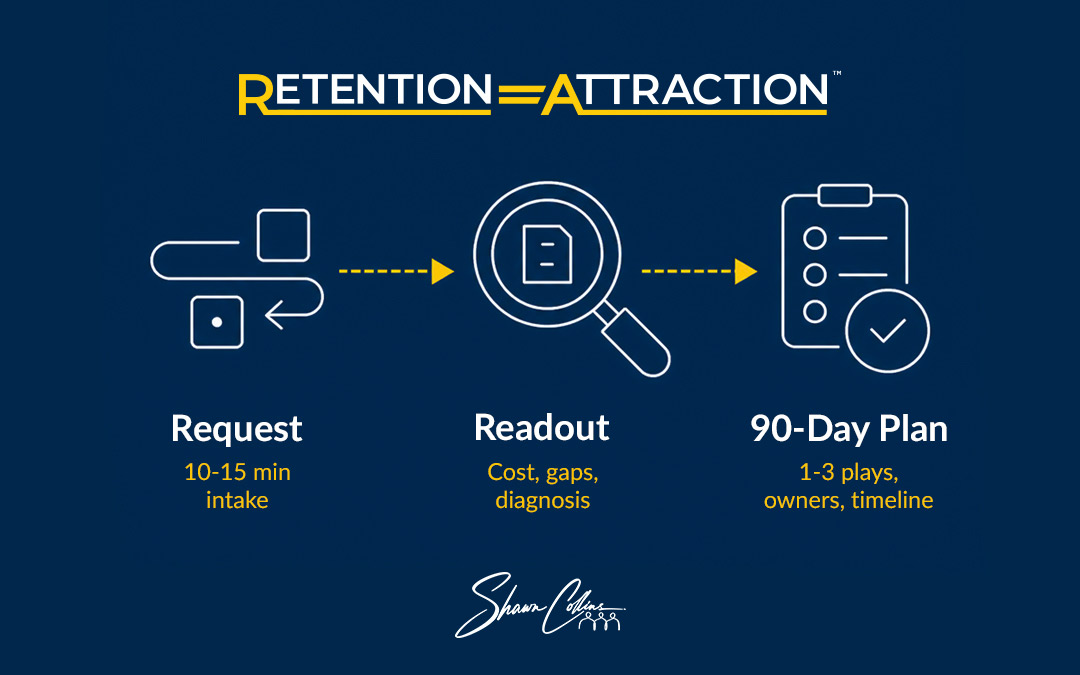
Request, Readout, 90-Day Plan
The Retention = Attraction™ Audit follows three steps: Request, Readout, 90-Day Plan.
Step 1: Request
You bring a short set of inputs. Headcount. Average pay or salary bands. Your best estimate of voluntary turnover over the last 12 months. Time-to-fill and ramp-to-productivity estimates. A few reality-check questions about leadership clarity and communication habits. If you have customer retention or engagement data, we can use it. If you do not, we work with what you have.
The intake takes 10 to 15 minutes. You do not need perfect data. You need honest numbers.
Step 2: Readout
I build your report and deliver it in a readout call. The report includes four things.
First, a clear, conservative estimate of what turnover is costing you each year. We use a proven method: turnover cost equals roughly 33 percent of base salary per departing employee. That covers recruiting time, training drag, overtime for coverage, mistakes during ramp, and lost momentum. It is a conservative floor, not a ceiling.
Second, scenarios that show what changes if you improve retention by just a few points. Not perfection. Not zero turnover. Just modest improvement. For most companies, preventing three to five exits over 12 months is enough to fund the work and still come out ahead.
Third, a snapshot of where turnover is concentrating. Is it first-year exits? Is it clustering in one department or under one manager? Are people leaving because of career stagnation, work-life imbalance, or management friction? The data tells a story. The readout translates that story into plain language.
Fourth, a diagnosis of the leadership and culture gaps that are driving the churn. This is not a survey score. This is a practical assessment of whether your managers are equipped, whether your team has clarity, and whether your operating rhythm can sustain performance without burning people out.
The readout is built for the owner or executive who has to act on Monday. It is not a 60-page report built for a board. It is a decision tool.
Step 3: 90-Day Plan
The third step is where the Audit turns into action. I deliver a 90-day plan built around one to three plays.
A play is a focused leadership or culture intervention designed to move the needle on retention, clarity, or execution. Examples: installing a consistent one-on-one rhythm for managers, running a Communication Code session to reduce friction in meetings, launching a 5 Gears workshop to help teams manage presence and productivity, or building a simple onboarding checklist to reduce first-year exits.
Each play includes owners, a timeline, clear success measures, and a meeting rhythm to keep progress visible. The plan is sequenced. You do not try to fix everything at once. You focus on the highest-leverage gap first, run the play for 90 days, measure the result, then decide what comes next.
The 90-day plan is not a wish list. It is a prioritized action roadmap tied directly to the turnover cost and leadership gaps uncovered in the Audit.
Why 90 Days
Ninety days is long enough to see real movement and short enough to maintain urgency.
Most culture initiatives fail because they try to do too much, take too long, and lose momentum before anyone sees results. The 90-day plan keeps the scope tight, the wins visible, and the accountability clear.
At the end of 90 days, you remeasure. Did turnover improve? Did manager consistency improve? Did the friction points reduce? If yes, you lock in the win and move to the next play. If no, you adjust and keep going. Either way, you are operating from data, not guesswork.
If you are tired of vague culture advice and want a plan you can actually execute, the Retention = Attraction™ Audit gives you the roadmap, the priorities, and the 90-day focus to get started.
What Happens After the First 90 Days
After the first 90-day cycle, most organizations choose one of three paths.
Path one: continue with another 90-day play focused on the next highest-leverage gap. Maybe the first play addressed manager consistency. The next play might focus on communication clarity or role expectations.
Path two: scale the work across more teams or locations. If the pilot showed strong results in one department, you expand it.
Path three: move into a longer-term engagement with a full Retention = Attraction™ system track. This could include 5 Voices for Teams (a 12-month team language and trust-building program), 100X Leader (a six to 12-month manager development track), or Altitude (a 12-month executive operating rhythm). The Audit becomes the diagnostic front door. The system tracks become the sustained engine.
The choice is yours. The Audit does not lock you into anything. It gives you clarity so you can decide.
Why This Is Not a Sales Pitch
Here is the difference between a sales pitch and a diagnostic.
A sales pitch starts with the answer and works backward. “You need our platform. You need our program. You need our solution.” The diagnosis comes second, if at all.
A diagnostic starts with the truth and works forward. “Here is what the data shows. Here is what it is costing you. Here are the gaps. Here is what we recommend you fix first. Now you decide.”
The Retention = Attraction™ Audit is a diagnostic. It produces a number, a story, and a plan. Then you choose whether to act on it.
If you are an owner or executive who values clarity over hype, this is built for you.
Request the Audit. Get the readout. See the 90-day plan. Then decide if it makes sense for your business.

About the Author
Shawn Collins
Shawn Collins is a leadership strategist, keynote speaker, and founder of EXTEND GROUP. Since 1997, he has helped organizations strengthen leadership, improve communication, and build cultures that drive performance. As a GiANT-certified consultant in 5 Voices, 100X Leader, and 5 Voices for Teams, Shawn equips leaders with practical tools to create alignment, increase retention, and make strategy stick.