Most owners do not ignore retention because they do not care.
They ignore it because the buying path feels fuzzy.
They know people are leaving. They know managers are stretched. They know the same roles keep opening. They know recruiting has become more expensive in time, energy, and attention. But when the solution sounds like a long culture project, another survey, or a broad consulting engagement, they pause.
That pause makes sense. Owners are not looking for more noise. They need a clear business choice.
That is why the Retention = Attraction™ Audit starts with a simple promise: show what turnover and leadership friction are costing, where the patterns are concentrating, and what to fix first.
The owner-facing thesis
The Audit is not another engagement survey. It is a decision tool.
It helps you move from “we have a people problem” to “we can see the cost, the pattern, and the first action path.” That matters because vague pain rarely gets funded. Clear pain gets addressed.
If you are an owner, president, operator, or HR leader trying to gain executive support, the Audit is designed to make the issue concrete without asking your team to stop running the business.
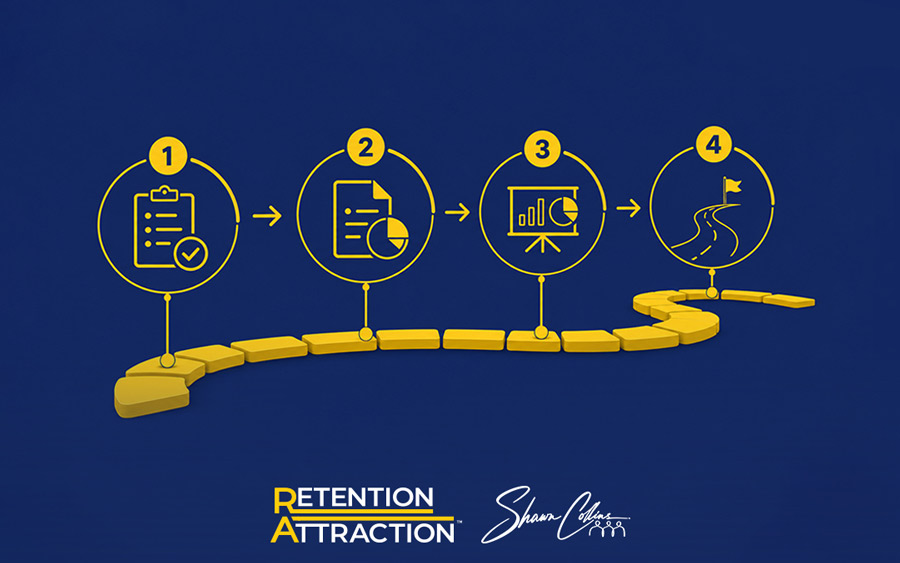
Step 1: You request the Audit
The request starts at shawncollins.com/retentionaudit.
This is the front door. You are not signing up for a long program before the problem is clear. You are asking for a defined look at what is happening inside your retention data.
The goal at this stage is simple: confirm that the Audit fits your company, your current pain, and the decision you are trying to make.
A good fit usually has one or more of these signals:
- Your company keeps rehiring for the same roles.
- Your managers are carrying more people issues than they can handle.
- Your recruiting effort is covering for deeper friction.
- Your HR team has data, but needs a business-ready case.
- Your leadership team agrees retention matters, but has not agreed where to begin.
Step 2: We clarify the business issue
Before the work begins, the business issue needs to be named.
This matters because “turnover” can mean several different things. It may be a first-year turnover problem. It may be a manager consistency problem. It may be a role clarity problem. It may be tied to one department, one shift, one supervisor, one handoff, or one stage of growth.
The Audit does not treat every exit the same way. It looks for concentration, patterns, and leadership signals.
That is where the business value starts. Averages can hide what is costing you. Patterns tell you where to look.
Step 3: You provide focused inputs
The Audit is built to be useful without becoming a disruption.
The inputs are focused around the information needed to build a practical readout. Depending on the situation, that can include headcount, turnover history, role groups, manager layers, recruiting pressure, exit themes, stay themes, and operating pain points.
The point is not to collect everything. The point is to collect enough to identify the cost, the pattern, and the first action path.
A clean input process protects your time and keeps the work tied to decisions.
Step 4: You receive the executive readout
The readout is where the Audit earns its value.
A useful readout does not dump information on a leader and call it progress. It should help the owner, HR, finance, and operations see the same issue from their own seats.
The readout should answer practical questions:
- What is turnover likely costing us?
- Where is the cost concentrating?
- What leadership or manager patterns appear to be connected?
- What are we paying for more than once?
- What should we fix first?
- What should not become a project yet?
That last question matters. Many teams lose energy because they try to address too many culture issues at the same time. The Audit is designed to narrow the field so the next move is clear.
Make the cost visible before Q3 decisions get locked in.
If turnover, weak manager habits, or recurring team friction are starting to shape your planning, do not wait for another exit to make the cost visible.
Step 5: You leave with a 90-day action path
A report is not the win.
The win is what changes after the readout.
That is why the Audit points toward a 90-day action path. In most cases, leaders do not need a giant rollout. They need one to three focused plays that can create visible movement.
Those plays may include a better manager rhythm, a Communication Code reset, a 5 Gears capacity conversation, a tighter handoff system, or a leadership-team discussion around role clarity and accountability.
The action path should be simple enough to start and strong enough to matter.
What the Audit is not
- This is not a generic engagement survey.
- It is not a self-serve calculator.
- It is not a motivational workshop.
- It is not a platform sale.
- It is not a long program in disguise.
The Audit is a defined diagnostic and readout. It exists to help leaders see the retention issue well enough to make a business decision.
That distinction matters. Many leaders already have more data than they can use. The problem is not always a lack of information. The problem is that no one has converted the information into a decision path.
A practical example
Consider a 58-person manufacturer heading into Q3.
The owner knows recruiting has been painful. HR has exit notes. Operations knows one shift is constantly short. Finance sees overtime rising, but the team has not tied the pieces together.
Everyone is touching the same problem, but each leader is naming it differently.
The Audit creates one table for the discussion. It may reveal that the real issue is not company-wide turnover. It may show a pattern concentrated in one role group under one manager layer during the first 120 days.
That changes the conversation.
Instead of debating whether “people do not want to work anymore,” the team can ask better questions. What is happening in that manager rhythm? What expectation is unclear during onboarding? What handoff breaks between hiring and floor training? What does the supervisor need to lead consistently?
That is a usable business conversation.
The real value is shared clarity
Retention issues often linger because each function carries a different piece of the pain.
Owners feel margin drag and growth drag.
Finance sees cost.
Operations feels schedule pressure.
HR feels recruiting pressure.
Managers feel capacity pressure.
The Audit brings those views into one readout so the leadership team can stop treating churn as someone else’s problem.
When that happens, the conversation changes from “who owns this?” to “what do we fix first?”
That is the point.
Before you spend more on attraction
If your company is spending more time, money, and energy trying to attract people, ask one question first:
Are we making it easier for the right people to stay?
That question belongs in Q3 planning.
Recruiting may still matter. Pay may still matter. Benefits may still matter. But if the daily experience of work is pushing good people away, attraction becomes more expensive than it should be.
Retention = Attraction™ starts with the Audit because leaders need a clear place to begin.
Turn retention concern into a clear business decision.
The Audit gives you a clear starting point: the number, the pattern, and the first action path. Use it before another quarter gets built around the same preventable churn.

About the Author
Shawn Collins
Shawn Collins is a leadership strategist, keynote speaker, and founder of EXTEND GROUP. Since 1997, he has helped organizations strengthen leadership, improve communication, and build cultures that drive performance. As a GiANT-certified consultant in 5 Voices, 100X Leader, and 5 Voices for Teams, Shawn equips leaders with practical tools to create alignment, increase retention, and make strategy stick.