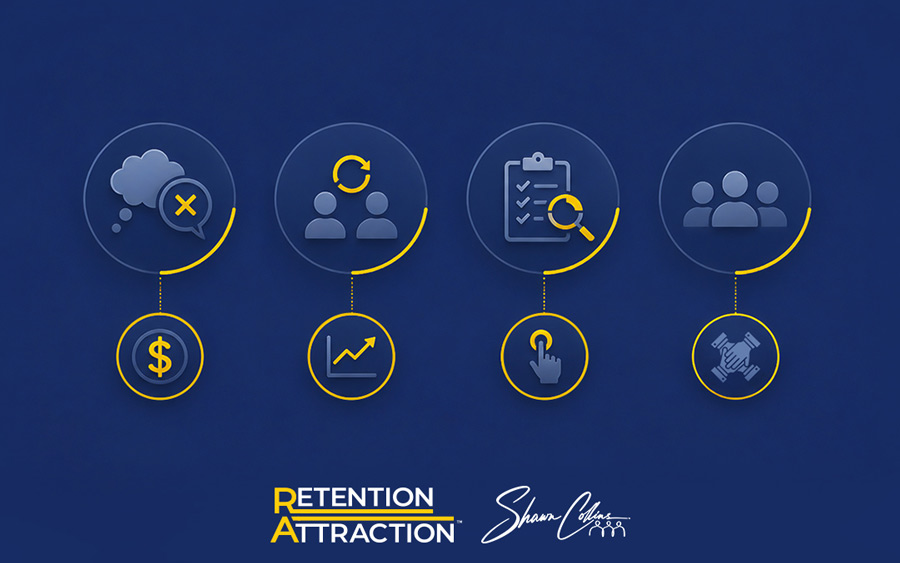
Turnover has a way of becoming normal.
The job opens again. The manager says the market is tough. HR posts the role. Operations works around the gap. Finance absorbs the overtime. The owner feels the drag, but no one slows down long enough to ask what keeps repeating.
That repetition becomes the turnover tax.
You pay it through recruiting expense, overtime, ramp time, rework, missed handoffs, manager distraction, and customer inconsistency. Some of that cost may be unavoidable. Some of it is not.
The problem is that four objections often keep leaders from acting soon enough.
The owner-facing thesis
Most retention objections sound reasonable until you attach them to cost.
The Retention = Attraction™ Audit helps leaders stop debating whether retention matters and start seeing what preventable churn may be costing, where it is concentrating, and what to fix first.
Objection 1: “Culture is soft”
This objection usually comes from leaders who do not want vague language, loose promises, or another feel-good initiative.
They are right to be cautious.
Culture becomes a problem when it is used as a word with no business anchor. But culture is not soft when it shows up in the schedule, the numbers, the customer experience, and the manager load.
If poor communication creates rework, that is business.
If unclear expectations slow execution, that is business.
If manager inconsistency drives avoidable exits, that is business.
If people stop trusting leadership, withhold information, and leave before problems are addressed, that is business.
The answer is not to sell culture harder. The answer is to connect it to cost, behavior, and execution.
That is what the Audit is designed to do.
Objection 2: “Turnover is normal”
Some turnover is normal. Not every exit is a failure. People move, retire, shift careers, and make personal decisions leaders cannot control.
But “normal” can become a dangerous hiding place.
The better question is not whether turnover exists. The better question is where it is concentrating.
- Are the exits clustered under one manager?
- Are they tied to one role?
- Are they happening early in tenure?
- Are they connected to schedule pressure?
- Are they happening after a leadership change?
- Are the same people carrying the same vacancies over and over?
That is where the turnover tax hides. A company can have an acceptable average and still have one team, shift, or role group creating real drag.
Averages smooth out pain. Patterns point to action.
Objection 3: “We already run surveys”
Survey data can be useful. It can help leaders hear themes they might miss.
But a survey is not a retention plan.
If people fill it out, leadership reviews the charts, and nothing changes, the survey can create more skepticism. Team members learn that input does not always lead to action. Managers learn that feedback arrives without a clear path. HR gets stuck trying to move a business issue without enough executive commitment.
The issue is not the survey itself. The issue is what happens after the data arrives.
A useful retention process should answer these questions:
- What is the business cost?
- Where is the issue most concentrated?
- What leadership behavior is connected to the pattern?
- What should change in the next 90 days?
- Who owns the action?
- How will we know if movement is happening?
That is different from running another survey. It turns data into a decision.
Stop letting objections protect the same costly pattern.
If turnover, weak manager habits, or recurring team friction are starting to shape your planning, do not wait for another exit to make the cost visible.
Objection 4: “This is HR’s job”
HR should be involved. HR often sees the pattern before anyone else admits it.
But retention is not just HR’s job.
Owners feel it in margin and growth capacity.
Finance feels it in replacement cost, overtime, ramp time, and risk.
Operations feels it in quality, throughput, schedule pressure, safety, and customer consistency.
Managers feel it in workload, morale, and lost credibility.
HR can help lead the process, but HR cannot fix manager behavior alone. HR cannot carry accountability that belongs to operations.
HR cannot protect margin without finance. HR cannot reset leadership norms without the owner.
Retention becomes stronger when the right leaders sit at the same table with the same information.
A practical example
A 42-person service company says turnover is normal because the labor market is tight.
The owner believes pay is the main issue. HR says exit notes show communication concerns. Operations says people leave because the work is hard. Finance says overtime has become part of the cost structure.
Each answer contains part of the truth.
The Audit helps sort the pattern. It may show that exits are not spread evenly across the company. They may be concentrated among new hires assigned to one supervisor. The real issue may be unclear onboarding expectations, inconsistent feedback, and no weekly manager rhythm during the first 60 days.
That finding changes the action.
The company does not need a broad morale campaign. It needs a focused manager habit, a clearer onboarding handoff, and a 90-day scorecard for one role group.
That is how a vague objection becomes a practical choice.
What owners should listen for
- When someone says culture is soft, ask what poor communication is costing.
- When someone says turnover is normal, ask where the exits are concentrating.
- When someone says the company already surveys, ask what changed after the last readout.
- When someone says retention belongs to HR, ask which function is not feeling the cost.
Those questions are hard to dodge because they move the conversation from opinion to ownership.
Why this matters before the next hire
Recruiting may fill the seat. It does not automatically fix the reason the seat keeps opening.
If the same role keeps turning over, the company may be paying twice. Once to replace the person. Again through the same manager, rhythm, or clarity problem that pushed the issue forward.
That is the turnover tax.
The Audit exists to make that tax visible before leaders keep funding the same pattern.
The action that matters now
You do not need every answer before you begin.
You need a clear enough starting point to stop guessing.
The Retention = Attraction™ Audit gives leaders a defined way to see the number, the pattern, and the first action path. It helps owners, HR, finance, and operations move from objection to decision.
Move past the stall and make the turnover tax visible.
The Audit gives you a clear starting point: the number, the pattern, and the first action path. Use it before another quarter gets built around the same preventable churn.

About the Author
Shawn Collins
Shawn Collins is a leadership strategist, keynote speaker, and founder of EXTEND GROUP. Since 1997, he has helped organizations strengthen leadership, improve communication, and build cultures that drive performance. As a GiANT-certified consultant in 5 Voices, 100X Leader, and 5 Voices for Teams, Shawn equips leaders with practical tools to create alignment, increase retention, and make strategy stick.